





With just two weeks to go until Affordable Care Act subsidies expire, top Republicans on Capitol Hill are now conceding that, for all the seeming action on health care, premiums are almost certain to skyrocket on Jan. 1.
In the House, lawmakers are set to take a vote on a GOP health care proposal Wednesday that stitches together a grab bag of conservative ideas, including expanded association health plans, cost-sharing reductions in the ACA marketplace and new transparency requirements for pharmacy benefit managers. (Notably absent from the bill is an extension of the enhanced premium subsidies under the ACA, also known as Obamacare.)
But all that vote will do is demonstrate that Republicans can pass a partisan bill in one chamber — if the bill passes at all.
There are real questions about whether Republicans will actually be able to muscle their proposal through the House. And that would be the easy part. With the 60-vote threshold in the upper chamber, there’s little chance the legislation will go anywhere but a Senate filing cabinet.
“We’re not going to pass anything by the end of this week,” Senate Majority Leader John Thune, R-S.D., said Tuesday, before adding that there could be a “pathway” to a deal in January “if Democrats are willing to come to the table.”

Of course, by January, premiums will already have gone up for millions of Americans getting their health insurance through the ACA marketplace. Many enrollees are expected to see their premiums more than double when the enhanced Obamacare subsidies expire at the end of this month.
Senate Minority Leader Chuck Schumer, D-N.Y., argued Tuesday that there’s no time to waste, telling reporters, “After Jan. 1, the toothpaste is out of the tube.”
“Millions of people will have lost their health care, many more will have changed their policies,” Schumer said.
The purpose of the House GOP bill seems to be to ease political pressure, giving Republicans something to point to when Democrats blame them ahead of next year’s midterms for higher premiums — or, as Democratic Rep. Jim McGovern of Massachusetts put it: “ass covering.”
Top Republican leaders, for their part, argue that the bill they’re proposing will make health care more flexible and give consumers more options.
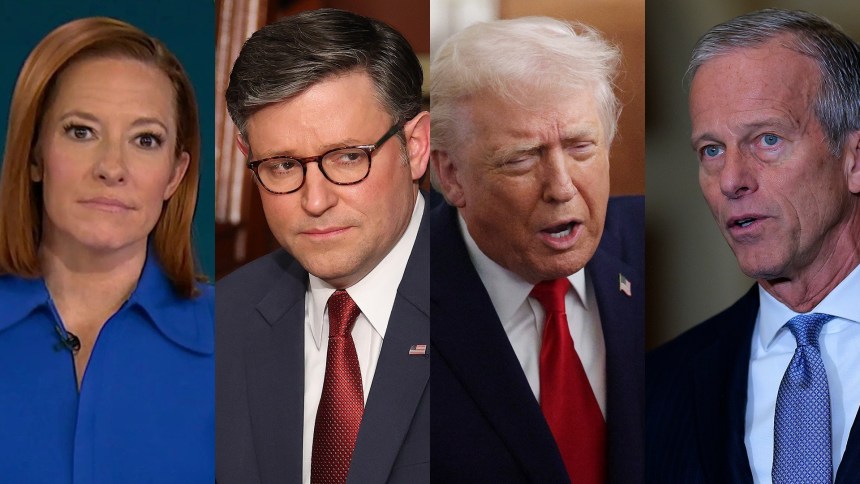
“It offers commonsense solutions to lower premium costs for everybody, all Americans,” Speaker Mike Johnson, R-La., said.
But even the more moderate members of the GOP conference aren’t exactly buying that line.
In recent days, vulnerable House Republicans amped up pressure on their leaders to give them a vote on an amendment to extend the subsidies — if not completely, then at least partially.
Over the weekend, Johnson floated the possibility of allowing a vote on an amendment to extend the subsidies. But by Tuesday, amid internal turmoil, that plan fell apart.
A last-ditch effort by those moderates to get a vote on extending those subsidies proved unsuccessful Tuesday evening, when the House Rules Committee blocked four amendments that would have addressed the expiring tax credits.
On Tuesday morning, Rep. Mike Lawler, R-N.Y. — who represents one of three Republican seats Kamala Harris won in 2024 — called not holding a vote on the expiring subsidies “political malpractice.”
Rep. Jeff Van Drew, R-N.J. said that if lawmakers fail to act and premiums go up, “it’s going to hurt Republicans.”
But the question is what GOP advocates for an extension will do now.
The first answer came on Wednesday morning, when four Republican lawmakers — Reps. Brian Fitzpatrick, R-Pa., Mike Lawler, R-N.Y., Robert Bresnahan, R-Pa., and Ryan Makenzie, R-Pa. — all joined a discharge petition led by House Democratic Leader Hakeem Jeffries, D-N.Y.
With their signatures, Democrats now have 218 lawmakers supporting the measure, forcing a vote on a bill to extend the subsidies, without reforms, for three years. (The discharge petition won’t ripen until January, so once again, Congress is unlikely to act before premiums spike.)
But even if that bill passes the House, it likely won’t do much for enrollees. The Senate already rejected the three-year extension proposal, and Thune’s communications director was quickly looking to downplay the prospect of the Senate voting again.
“A clean, three-year extension of the Biden COVID bonuses was on the Senate floor last week, and it failed,” Ryan Wrasse posted on X.

But that assumes Democrats bring forward a bill that is a three-year extension.
An aide close to the House GOP pointed out to MS NOW that the the Democratic discharge petition is not, at this moment, a three-year extension of the Obamacare subsidies. The discharge petition is actually for H.R. 1834, which touches every committee in Congress.
In practice, this aide said, Democrats could use this legislation as a vehicle for a vote on whatever health care legislation the Senate comes up with — such as, potentially, a Senate deal on health care.
A bipartisan group of roughly 20 lawmakers met earlier this week, in an effort to find a potential off-ramp to the impasse. And Sen. Susan Collins, R-Maine, who helped spearhead the new talks, called Monday night’s meeting “extraordinarily constructive.”
“When you consider the ideological range of the members who participated, it was very encouraging,” she told MS NOW on Tuesday.
Collins’ bill with Sen. Bernie Moreno, R-Ohio, is being used as a possible baseline for these talks. That plan calls for a two-year “glide path” off the enhanced subsidies, with larger reforms in the second year.

Collins indicated that she hopes to have a proposal formalized later this week — though any vote, if it gets to that point, would probably not come until the new year.
Of course, a solution to rising rates is no guarantee. And even if senators could find a deal, and even if Democrats used the discharge petition to force a vote on that legislation, there’s no guarantee these Republicans — or all House Democrats, for that matter — would vote for that bill.
At the moment, the vulnerable Republicans signing onto the Jeffries discharge petition seem most interested in giving themselves political cover from the skyrocketing Obamacare premiums.
“I think leadership left us with no option,” Lawler told MS NOW on Wednesday.
Mychael Schnell contributed to this report.

Kevin Frey is a congressional reporter for MS NOW.