





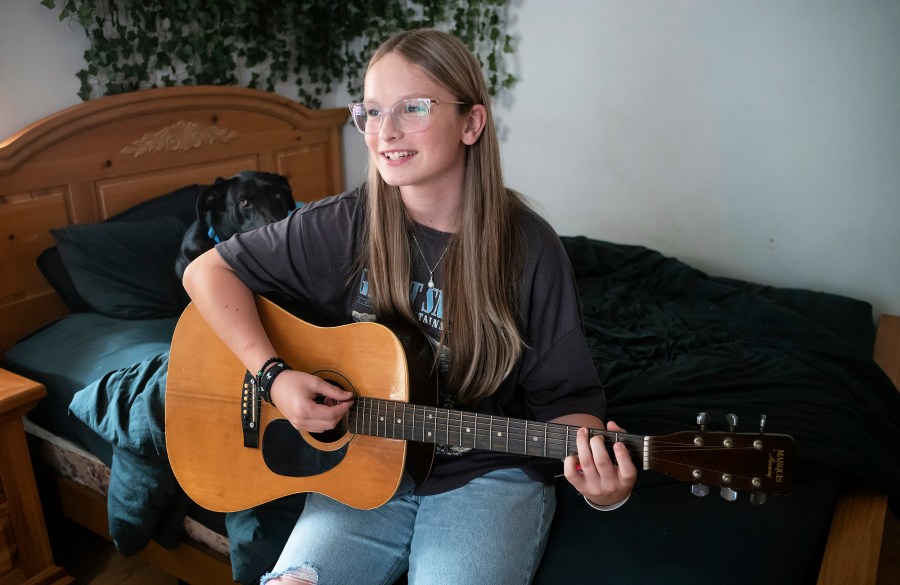
Becky Pepper-Jackson is a typical 15-year-old girl who likes dogs, sports, playing music and spending time with her friends.
Becky was assigned male at birth. As a kid, she always had a sick feeling. “I just felt wrong in my body,” she told MS NOW in an interview on Monday.
She began identifying as female long before she started puberty. In third grade, and with the support of her family, she began the process of transitioning to live her life as a girl at her home in rural West Virginia.
“By fourth grade, I came out publicly,” she said.
Her family immediately supported her decision. Her mother just wishes critics would understand that it isn’t something she compelled her child to do. “If I can’t make her fold her laundry and unload the dishwasher, why do they think that I’d be able to change her gender?” Heather Jackson said.
When Becky began middle school in 2021 — about two years into her transition — she aspired to join the girls’ cross-country team in the fall, followed by track in the spring. That same year, lawmakers in West Virginia passed the Save Women’s Sports Act, a law that blocks “biological males” from participating in women’s team sports.
With the help of her mom, Heather, Becky filed a lawsuit challenging the ban’s constitutionality under the 14th Amendment and Title IX, which prohibits sex discrimination in schools that receive federal funding.
“It’s about giving equal opportunity to everybody,” Heather Jackson said. “I believe that that’s a fundamental right in this country, is equal opportunity. And I see what sports bring to youth.”
“Ultimately, we would like to promote curiosity over criticism,” Jackson said.
After victories in the lower federal courts, as well as a short-term win from the Supreme Court — when the justices declined to block the lower court’s order — Becky was allowed to participate in school sports for three years. She joined the cross-country team. She didn’t qualify for track but instead found success participating in shot put and discus.

In April 2024, the 4th Circuit Court of Appeals formally ruled in Becky’s favor. The appellate court held that the West Virginia ban violated Title IX and that the lower U.S. district court had erred in dismissing her equal protection claim under the 14th Amendment. The state appealed, writing in its petition to the Supreme Court that the 4th Circuit’s ruling “rewrites Title IX, a law designed to protect female athletes, into one that subordinates their interests to those of certain males.”
The Supreme Court granted West Virginia’s request to hear the case, taking up the issue of student transgender athletes for the first time. On Tuesday, the justices will weigh whether West Virginia can ban Becky from participating in school sports.
Lawmakers in West Virginia have said its law was designed to stave off “the mounting stories of defeat and displacement by males nationwide” and “preserve girls’ school sports.”
“It hurts to hear people say that I’m taking away spots from other girls, when all I’m trying to do is just be good at my sport, and I’m working so hard every day for it.” Becky said.
“They say that she has an advantage, and she plays three different sports,” Heather added. “She’s excellent at one. So if she had this leg up on everybody, she would be sweeping them all.”
Becky’s lawyers argue in their brief to the Supreme Court that she’s the one being disadvantaged. “In reality, West Virginia’s law banned exactly one sixth-grade transgender girl from participating on her school’s cross-country and track-and-field teams with her friends,” they write. “Rarely has there been such a disconnect between a law’s actual operation and the justifications for it.”
On Tuesday, the Supreme Court will also hear arguments in Little v. Hecox, a 14th Amendment challenge brought by a transgender athlete over a similar ban in Idaho. Lindsay Hecox, an aspiring athlete at Boise State University who no longer plays sports, has since moved to dismiss her own lawsuit. The justices will still hear arguments in her case on Tuesday.
Although this is the court’s first case concerning transgender athletes, this is not the first transgender rights case to reach the high court. Last term, the justices ruled 6-3 in U.S. v. Skrmetti to uphold Tennessee’s ban on certain medical treatments for transgender minors. The justices held that the state’s ban did not need to satisfy “heightened scrutiny” and did not violate the equal protection clause of the 14th Amendment due to its classification of patients based on age and medical diagnosis, not sex.
The debate over transgender rights has become a political flashpoint in recent years and took center stage during Donald Trump’s 2024 presidential campaign. Twenty-six other states have passed similar bans, though some are currently blocked by courts. Last February, fulfilling a campaign promise, Trump signed an executive order titled “Keeping Men Out of Women’s Sports,” aimed at blocking all transgender women athletes from participating in women’s sports.
West Virginia Gov. Patrick Morrisey joined Trump at the signing. “Radical gender ideology has created an unsafe and unfair environment for female athletes, forcing them to compete against biological males,” he said at the time. “I am grateful that we now have a president who will fight to protect women and girls in sports.”
Becky, too, is fighting — for her right to participate in school sports. “It’s something that needs to be done, because attention needs to be drawn to the fact that lawmakers are controlling people’s lives without even talking to them,” she said.
And she’s dealing with becoming the face of a national issue because, she says, she feels an obligation to do so. “I’m from the middle of nowhere in West Virginia,” she said. “I thought this was going to be a small thing, and then it turned into something massive.”

Fallon Gallagher is a legal affairs reporter for MS NOW.