




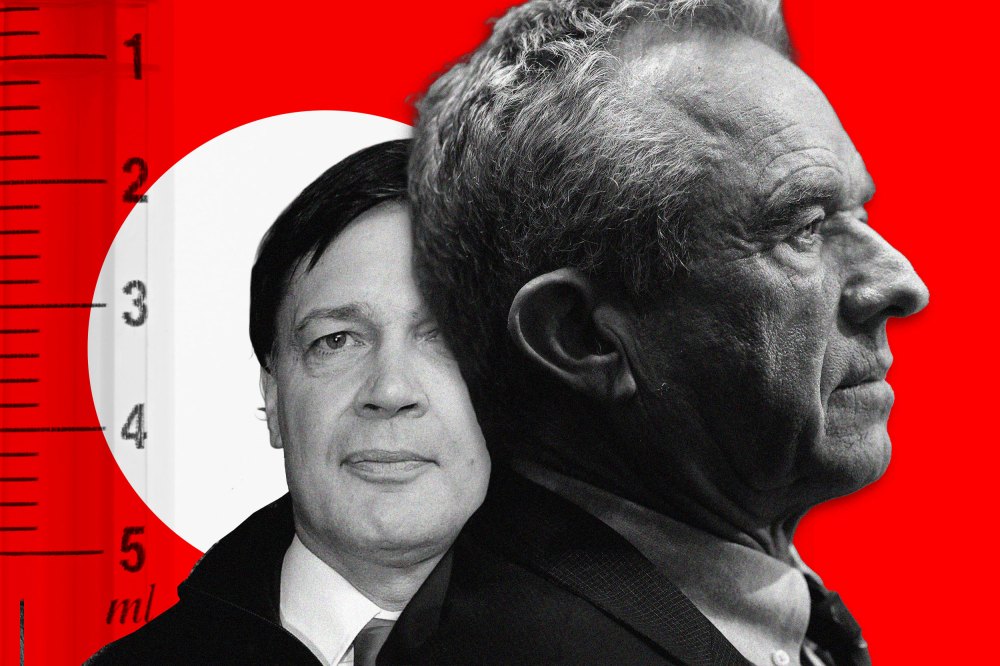
If you know anything at all about the anti-vaccine movement, you might know the name Andrew Wakefield. Andy to his friends, doctor to his fans, he is the father of the anti-vaccine movement and the architect of the theory, many times debunked, on which the modern coalition was built: that the measles, mumps and rubella vaccine is to blame for autism.
“To our community, Andrew Wakefield is Nelson Mandela and Jesus Christ rolled up into one,” an anti-vaccine activist once told the New York Times.
“The news is going back to the tried and true, the fear-mongering of the one great monster that once walked this earth and put us all in harm’s way on the vaccine issue,” teased another anti-vaccine voice, Del Bigtree, in a January video titled “Andrew Wakefield: The Real Story.”
“You are one of the most resilient human beings I’ve ever met,” current Secretary of Health and Human Services, Robert F. Kennedy Jr. said admiringly to Wakefield on a 2020 Instagram livestream. “You’ve been beleaguered, besmirched, attacked, made a pariah. You have absorbed more undeserved vitriol than anybody that I’ve met in my life, and yet you’re so resilient and always retain your optimism.”
Wakefield replied that what made “the job easy, Bobby, is having friends like you alongside me.”
You might remember in the late 90s, that Wakefield—a handsome gastroenterologist with as it would later be shown, a flair for media—held a press conference about his study of 12 children published in the Lancet, where he announced he’d found a link between a new bowel disease, autism, and the combination vaccine.
It was years before the world learned the truth, through the efforts of an intrepid journalist: that Wakefield’s work was fraudulent. That he’d gathered his child subjects with the help of and anti-vaccine groups and a lawyer looking to profit from them, how he was paid for his efforts, how he falsified data for his study, and how, most egregiously UK regulators found, he ordered colonoscopies, spinal taps, and sedation of these vulnerable children in furtherance of his fraudulent conclusions. In the meantime, the media credulously covered Wakefield’s overhyped findings and parents panicked and stopped vaccinating their kids. By the time his paper was retracted, a medical board in London stripped Wakefield of his license for “unprofessional conduct,” and numerous studies failed to replicate his conclusions, the discredited doctor was remaking himself in America.
Twenty-something years later, Wakefield remains unapologetic and stands by his work. He did not respond to requests for an interview or comment. At a conference this month, he said he refuses to speak with journalists from mainstream outlets.
Public health has been turned inside out by the second administration of Donald Trump. Even as outbreaks of vaccine preventable diseases like measles and pertussis tear through American communities, people once rightly dismissed as anti-vaccine cranks are now running federal agencies and making health policy. And it is in this landscape that the comeback of Andrew Wakefield no longer feels impossible—it is underway.
On Wednesday evening, a CDC webpage was edited to read: “The claim ‘vaccines do not cause autism’ is not an evidence-based claim because studies have not ruled out the possibility that infant vaccines cause autism.” Anti-vaccine proponents saw the change—a dubious scientific claim published by what was, before Kennedy’s tenure, the crown jewel of U.S. public health—as a dream realized, for the movement and Wakefield.
“Time to apologize to Dr. Andrew Wakefield and all the others who were maligned and vilified for simply asking the right questions,” Republican Sen. Ron Johnson, Wis., posted on Wednesday.
This came on the heels of Trump’s sudden call to break up the MMR shot (“NOT MIXED!”) and a request from acting CDC director that manufacturers develop single vaccines to replace the combined MMR. The director who oversees the vaccine schedule and regulation at the Food and Drug Administration told Bari Weiss they are “planning new guidance.”
“For the millions of parents whose children were injured, ignored, gaslit, and shamed — this is vindication,” Wakefield said in response to the news. “But more importantly, it’s hope.”
The idea of Wakefield as a persecuted truth-teller is one of the movement’s longest-running fictions. Yes, his paper was retracted, and his license to practice medicine taken away. But he gained quite a lot, too, not the least of which is a devoted base of fans who see Wakefield as a martyr for their cause.
The idea of Wakefield as a persecuted truth-teller is one of the movement’s longest-running fictions. Yes, his paper was retracted, and his license to practice medicine taken away. But he gained quite a lot, too, not the least of which is a devoted base of fans who see Wakefield as a martyr for their cause.
Wakefield has built a comfortable life in Austin, Texas by clinging tightly to his discredited theory. He founded a clinic where he was paid about a quarter-million dollars each year as executive director until he was stripped of his UK medical license and resigned. He divorced and began popping up in tabloids, photographed with his new girlfriend, model turned powdered shake entrepreneur Elle Macpherson, at glitzy alternative health events, like the “Doctors Who Rock awards.” (They broke up in 2019.) Through nonprofits including Strategic Autism Initiative, Autism Media Channel, and Crystal Clear Film Foundation, Wakefield has produced and directed half a dozen widely-panned, documentary-style movies, each focused on revealing what Wakefield offers as evidence of the dangers of vaccines.
It was Wakefield’s 2016 film, “Vaxxed,” slickly made with daytime television producer Bigtree and anti-vaccine nonprofit Children’s Health Defense’s director of programming, Polly Tommey, that got the most attention and coalesced a movement. Parents of children with autism sold out independent theaters and showed up to tell their stories of vaccine injury to a production studio on wheels—interviews that would become the second movie in the “Vaxxed” franchise.
“Film is a way of communicating with millions of people at one time, rather than just one person in the clinic,” Wakefield said this month at an anti-vaccine convention in Austin.
Wakefield and Kennedy have been allies in the anti-vaccine crusade for years. They have been the rockstars of the movement: appearing at conferences, making films, and speaking on podcasts and at rallies together. Like Kennedy, Wakefield saw opportunity in Trump world. He met with Trump at a fundraiser in 2016 and attended one of his 2017 inaugural balls, posting a video of himself, dressed in a tuxedo, strolling through the party, calling for a “huge shakeup” of the Centers for Disease Control and Prevention.
It would be another eight years for that shakeup to happen, but in the meantime Wakefield focused on his eventual comeback, and telling his story to anyone who would listen, a version where he was not a fraud, but a pioneering scientist whose research threatened pharmaceutical companies and thus, had to be crushed.
Post-Covid, with mainstream right wing publications eager to host contrarian doctors, Wakefield appeared on programs like The Blaze, Infowars, and Real America’s Voice. In January, Del Bigtree, who directed communications for Kennedy’s failed presidential campaign, hosted a special episode of his show, “ANDREW WAKEFIELD: THE REAL STORY,” where Wakefield said he’d been persecuted by the government, the medical establishment and by an investigative reporter because “they” were afraid. In May, Wakefield appeared on Michael Knowles’ Daily Wire podcast:
“Well, they’ve taken just about everything they can from you,” Knowles concluded after a fawning 90 minutes. “They haven’t killed you yet and a man who’s had everything taken from him is one of the most dangerous men in the world because you really only have an incentive to pursue your line of inquiry and to pursue the truth.”
Now Wakefield is angling to be interviewed by Joe Rogan, replying to a post by the country’s most popular podcaster that said “Name someone who you think deserves to go on Joe Rogan, but is overlooked,” with “🙋 I would love to ….”
Wakefield’s narrative became lore in anti-vaccine circles. When Trump withdrew his nomination of Dave Weldon to lead the CDC in March, the former Republican congressman responded in an indignant letter devoted mostly to Wakefield’s story—not his own. “If Wakefield had the money to defend himself, he would never have lost his license,” he wrote. “The court documents clearly show that Wakefield and his co-authors had not done anything unethical or inappropriate, and their work was possibly valid. But that was all big Pharma needed.”
It’s inevitable, really. The anti-vaccine movement has taken over the institutions it fought against. Now it will get to rewrite its origin story.
Earlier this month, I watched Wakefield at the “Moment of Truth” conference in Austin.
He was there to take a victory lap, and to promote his new paper, published by the McCullough Foundation, a non-profit founded by cardiologist turned anti-vaccine crusader Dr. Peter McCullough. The report—which did not undergo peer review and was co-written by McCullough Foundation researchers, including one who previously authored a flawed review of autopsy data that falsely attributed harm to Covid vaccines—claimed to find combination and early routine childhood vaccination constituted the most significant risk for autism. The paper, which self-cites Wakefield’s retracted study, has been largely ignored.
But at the Austin event, hosted by Children’s Health Defense, the anti-vaccine nonprofit Kennedy founded and stepped down from to run HHS, the report was framed as vindication for Wakefield.
Wearing a gray utility vest over a black long-sleeve shirt, his forearm stacked with beaded bracelets, Wakefield played the part of expert and martyr—the scientist who had discovered the link between vaccines and autism, who had paid for it with his life and reputation.
“When I first got involved in this, 30 years ago, there were perhaps five people, a handful of people around the world, who were prepared to discuss the thorny issue of vaccine safety,” Wakefield said.
After decades of being maligned or ignored by health officials, medical organizations, the media, and the public at large, Wakefield said their time, and specifically his time, had finally come. With his friend Kennedy now helming HHS and with Trump’s support, vaccines were up for debate again—and not just the measles, mumps, rubella vaccine that his retracted paper first falsely linked to autism, but all of them.
“When people say, ‘No more,’ it will be no more across the board,” Wakefield roared.
His expression moved between scorn and triumph. Hundreds of followers applauded him as the doctor who’d been right all along.

Brandy Zadrozny is a senior enterprise reporter for MS NOW. She was a previously a senior enterprise reporter for NBC News, based in New York.