




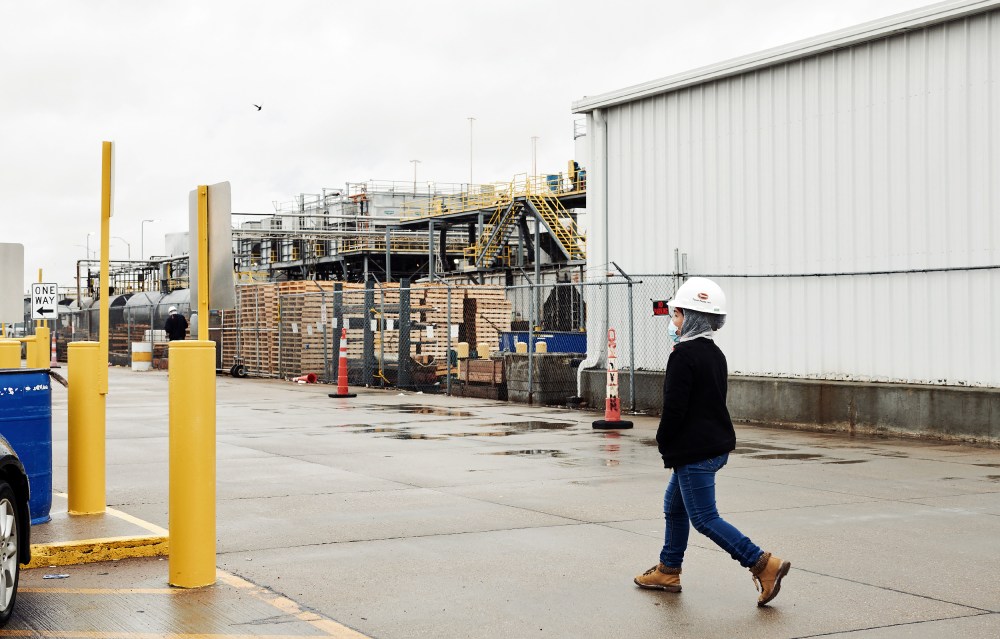
LEXINGTON, Neb. — Barbara Cabrera compares the moment to a bomb exploding.
Days before Thanksgiving, Tyson Foods announced that it would close its plant here, eliminating 3,200 jobs after the new year. In a town of 11,000, roughly a third of the population would soon be unemployed.
Cabrera, 62, collapsed to the ground when she heard the news. Her voice broke as she told MS NOW what was about to happen to her town. “We are all leaving,” she said in Spanish, tears streaming down her face.
The closure in the county seat has exposed a stark tension in the American economy: Even as President Donald Trump celebrates a booming stock market, working-class communities are grappling with persistent inflation, job insecurity and economic uncertainty that threatens to devastate entire towns. In Dawson County, where more than 70% of voters supported Trump in the 2024 election, residents are confronting a painful disconnect between the president’s upbeat economic messaging and their own increasingly bleak prospects.
The national numbers bear out that disconnect. While the S&P 500 has surged above 6,900 this year to record highs — up roughly 16% — unemployment has climbed to 4.6 percent, the highest level since 2021. Job growth has stalled, with the economy adding just 64,000 positions in November, while inflation remains stubbornly high.
Economists describe the current moment as a “K-shaped economy,” where affluent households with stock portfolios benefit from market gains while working-class communities like Lexington face job losses and rising costs. For residents whose livelihoods depend on steady paychecks rather than investment returns, the president’s celebration of Wall Street’s performance feels increasingly disconnected from their daily reality.
Anxiety and fear pulse through every corner of Lexington.

Amalia Bautista, who owns a goods store in downtown Lexington, says that after Tyson’s announcement, customers walked into her store in tears, worried about their children and how they will pay rent. Since then, her sales have declined by 10% to 20%. Customers tell her they can afford only essentials — food and medicine.
“People here live paycheck to paycheck,” she said.
“I’m really, really upset,” said Nuridin Nur, who owns the African International market, a small grocery and storefront a few blocks away. “I don’t know what I’m supposed to do.”
Nur, a father and a Somali immigrant who moved to the U.S. after living in a Kenyan refugee camp, worked at Tyson Foods for five years before opening his shop. Now, after building a business he takes pride in, he fears he may have to close. Dozens of families have already left town, and his sales have dropped precipitously.
“Who will pay my bills?” Nur asked. “Who will pay my rent?”
Daniel Buller, executive director of Crossroads Mission Avenue, a nonprofit that helps homeless people in central Nebraska, said Tyson had already caused a catastrophe. His shelters in nearby towns have 250 beds, and he expects them to be 80% to 90% full when the plant closes in January — a worrying prospect during the harsh winter months.
Food insecurity in Dawson County has risen 53% since 2023, according to Stephanie Sullivan, a spokesperson for the Food Bank for the Heartland. With the recent government shutdown, disruptions to food stamp benefits and now the Tyson closure, Sullivan said she fears a major surge in hunger.
As families move away, church congregations are shrinking. At the First United Methodist Church, membership in the Latino ministry has plummeted 67% since Nov. 21 — from 60 members to 20, said the Rev. Elmer Armijo.
“From the economic perspective, from the spiritual perspective, everybody is worried,” Armijo said. “What do we need to celebrate? What will be the joy of this community this Christmas season?”
Still, there are those who remain optimistic about the city’s resilience. Clay Patton, vice president of the Lexington Area Chamber of Commerce, pointed to the community’s hardworking ethos and entrepreneurial spirit, and expressed hope that the plant might be repurposed or sold.
At the local public library, out-of-state food manufacturing companies are actively recruiting, offering relocation packages and even hiring on the spot.
“We’ve done at least 10 offers,” said Grant Prenzlow, a human resources manager at Wholestone Prestage, a pork-processing company in Nebraska and Iowa. Most of the people he interviewed, he said, showed strong loyalty to Tyson — a quality he seeks in new employees.
Nebraska Gov. Jim Pillen and Rep. Adrian Smith, both Republicans, are working to keep the plant and its workers in the state.
“Whether through continued use by Tyson or attracting a new owner or operator, the existing facility and workforce should not be left idle,” Smith told MS NOW.
Laura Strimple, communications director for Pillen, said it was a “high priority to make sure that in whatever capacity the facility is utilized, it happens as soon as possible.”
A Tyson Foods spokesperson said the company is rightsizing, as it stands to lose $600 million in its beef business during the next fiscal year, and is assessing possible uses for the Lexington facility within its network, though no details or timelines have been provided.
For workers like Barbara Cabrera, it is enough to offer a sliver of hope.
“I continue asking God for a miracle,” she said.

Rosa Flores is a national correspondent for MS NOW.