




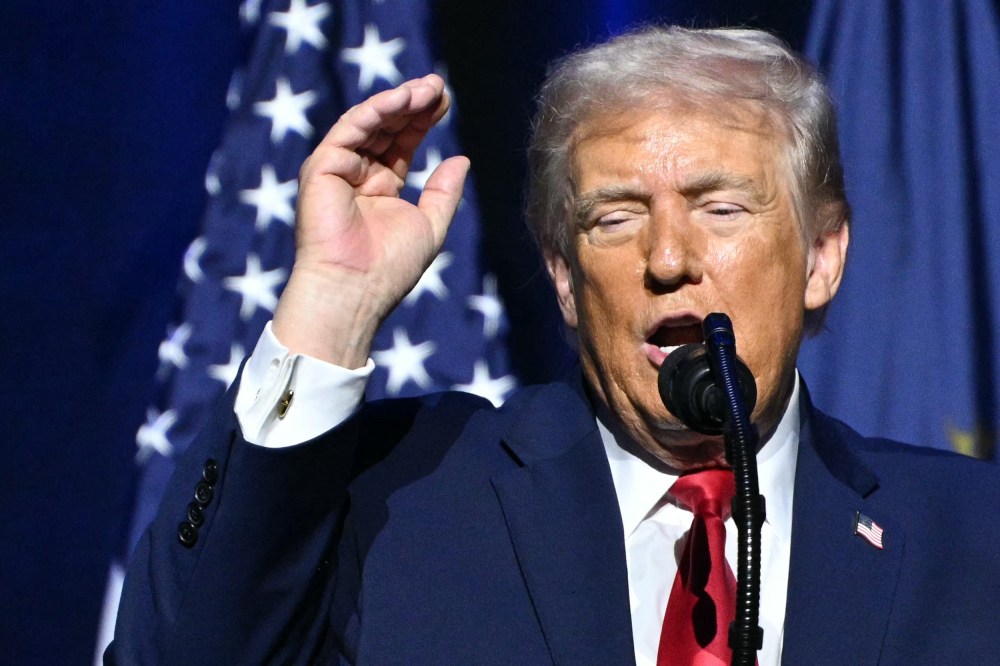
President Donald Trump visited the swing state of Michigan on Tuesday to deliver a speech before the Detroit Economic Club, a nonpartisan, members-only organization. He falsely declared “inflation is defeated” and ranted his way through a familiar list of grievances — election fraud, transgender athletes and Republican defectors in Congress among them.
The speech was a crucial opportunity for the Trump administration, which has been trying to get the president to focus on affordability — a word he has repeatedly derided as a “Democrat hoax” — in swing states ahead of midterm elections. Those efforts have been largely unsuccessful so far: In Pennsylvania last month, Trump delivered a meandering speech in which he again called affordability a “hoax” and attacked former President Joe Biden using vulgarity.
But in Trump’s telling on Tuesday, the economy is his administration’s latest success story.
“The results are in, and the Trump economic boom has officially begun,” he said. In a speech that lasted more than an hour and regularly went off script, Trump bragged about “almost no inflation and super high growth” and said that grocery prices and rents are down.
But federal data released Tuesday shows that inflation has remained almost unchanged, at 2.7% last month, with prices for food and housing on the rise. The GDP, on the other hand, was up by 4.3% in the third quarter of 2025, indicating economic growth.
Trump also claimed that tariffs “are making money for Michigan,” insisting “they are paid by middlemen.” But tariffs are ultimately passed onto consumers, and the Yale Budget Lab estimates that Trump’s tariffs are costing the average American household $1,700 annually. He also said gasoline is “under $2 in many places” — but the national average is $2.80, according to AAA, and the lowest appears to be $2.20 in Oklahoma. (In Michigan, the state average is almost $2.90, according to the data.)
The economy remains a key issue for Michigan voters, who have complained of rising prices amid Trump’s aggressive tariff campaign, according to local polling. The poll, conducted by The Detroit News and local NBC affiliate WDIV, found that almost half of respondents — 48% — said Trump’s economic policies have made the economy weaker overall. More than 60% said their household costs have gone up in the past year.
The state, which narrowly voted for Trump’s re-election amid his promises to combat inflation, will be a focal point for the GOP in November, as Republicans seek to maintain control of two swing U.S. House districts they won in 2024.
The president often gets defensive when speaking on the economy. He told Politico last month he would grade the economy “an A-plus-plus-plus-plus-plus,” and insisted that “prices are coming down,” despite evidence to the contrary. And in a breathless, defiant pre-Christmas address delivered from the White House, Trump blamed the cost-of-living crisis on Democrats and made baseless claims about the cost of gasoline and the status of inflation.
The blame game continued Tuesday, as the president faulted Democrats and his predecessor — whom he referred to as “sleepy Joe Biden” — for Americans’ economic woes.
Following the speech, the Democratic National Committee cast Trump’s economy as “a disaster.”
“Under Donald Trump’s failed economic policies, Michiganders are seeing their paychecks get tighter, and jobs disappear,” said DNC Chair Ken Martin in a press release. “And today, Trump tried to gaslight Michigan families once again — but they weren’t fooled — because new polling shows that Trump is disastrously unpopular in Michigan.”
Trump has touted some economic wins in his second term: The prices of eggs, gasoline and Thanksgiving turkeys have all come down, and he has announced cost-cutting deals with several prescription drug companies. In his White House address last month, Trump announced so-called “warrior dividends” of $1,776 — “in honor of our nation’s founding in 1776” — that would be paid out to more than 1.45 million service members.
Trump also recently announced a slate of new measures that he suggested would bring down prices for average Americans. Last week, he said he was calling for a one-year cap of 10% on credit card interest rates and that he would take immediate steps to “ban large institutional investors from buying more single-family homes” — a plan that appears similar to the housing plan put forward by former Democratic presidential candidate and Vice President Kamala Harris. (Trump said Tuesday he would provide more details on that plan at the annual World Economic Forum in Davos, Switzerland, next week.) And on Monday, Trump said in a Truth Social post that his administration was working with tech companies, including Microsoft, to bring down Americans’ electricity bills.
But some American consumers can expect hard times ahead as a result of various Trump-backed policies. Monthly premiums for the lowest-income enrollees of insurance plans under the Affordable Care Act have skyrocketed after subsidies expired on Jan. 1. In September, the health policy organization KFF estimated that enrollees’ monthly premiums would more than double.
On Tuesday, Trump teased even more actions to come to help bring prices down — with a caveat.
“In the coming weeks, I will be laying out even more plans to help bring back affordability,” he said, “and remember — that’s a fake word by Democrats.”

Julianne McShane is a breaking news reporter for MS NOW who also covers the politics of abortion and reproductive rights. You can send her tips from a non-work device on Signal at jmcshane.19 or follow her on X or Bluesky.