




President Donald Trump’s effort to block Venezuela from smuggling oil will place more pressure on President Nicolás Maduro to leave power than U.S. drone strikes on suspected drug boats, two former U.S. officials told MS NOW.
“I think they’re on to something,” said a former senior U.S. diplomat who worked on Venezuela policy and asked not to be named because of the sensitivity of the subject. “I think this has real effect.”
After the announcement of the blockade, Maduro ordered Venezuelan naval ships to escort oil tankers to prevent them from being seized. On Tuesday and Wednesday, several ships departed from Venezuela and sailed toward Asia with Venezuelan naval escorts, the New York Times reported. But none of those tankers was on a list of sanctioned vessels that Trump has vowed to seize.
Pedro Burelli, an ex-member of the executive board of Petróleos de Venezuela, the country’s state-owned oil company, said that he believes Maduro is bluffing. He predicted that Venezuelan navy ships will not escort sanctioned tankers into international waters, where a confrontation could occur if U.S. forces try to seize them.
“I think this is just for show,” said Burelli, whom Maduro has banned from returning to Venezuela. “I think they would accompany ships only to the extent of Venezuelan territorial water.”
The former senior U.S. diplomat said the Maduro regime generates an estimated $2 billion to $4 billion a year from oil smuggling. The regime uses the money both to make food purchases and to pay the salaries of military members and government workers.
“They are depending on that,” said the former U.S. diplomat. “If your goal is to shock the economic structure of Venezuela, this does it.”
Maduro condemned Trump’s anti-smuggling blockade and his assertion that Venezuela had stolen American “oil, land and other assets.”

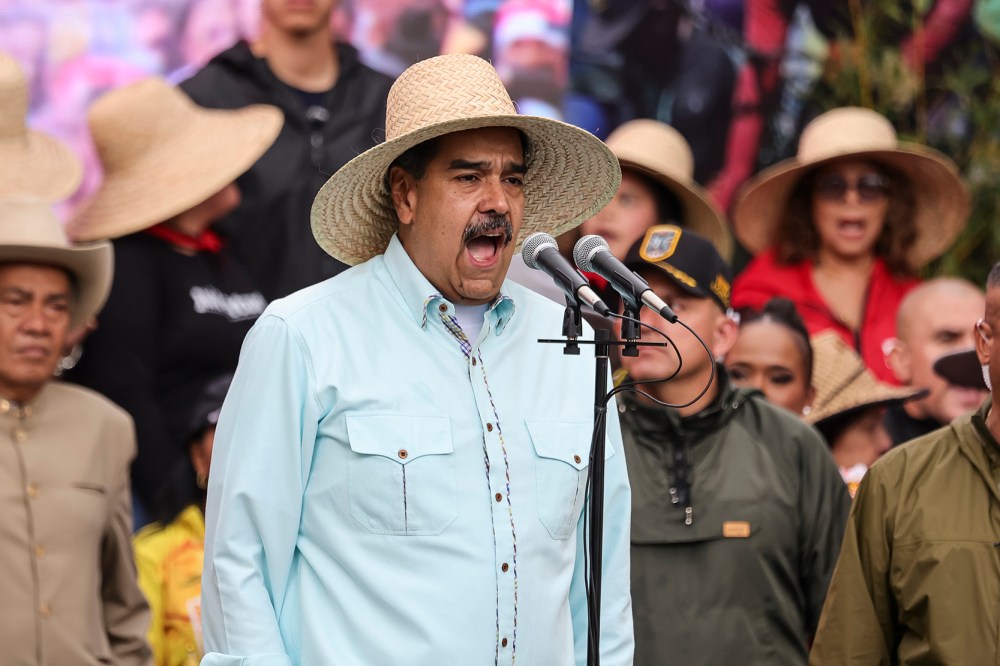
“It is simply a warmongering and colonialist pretense,” Maduro said in a speech on Wednesday. “The aim in Venezuela is a regime change to impose a puppet government that wouldn’t last 47 hours, that would hand over the constitution, sovereignty and all the wealth, turning Venezuela into a colony. It will simply never happen.”
“If your goal is to shock the economic structure of Venezuela, this does it.”
Former U.S. diplomat.
Some warn that Trump’s open statements about seizing the country’s oil could spark Venezuelan nationalism and increase support for Maduro. “Venezuela belongs to the Venezuelans, period,” an opposition member, Luis Florido, posted on X.
“The damage to the Venezuelan oil industry does not affect Maduro; it affects the heritage of all Venezuelans,” he added. “Maduro is not Venezuela. Venezuela is NOT Maduro.”
A former official with the Department of Justice who has knowledge of Venezuela said that an oil blockade could eventually cause members of the Venezuelan military to turn on Maduro. As part of his effort to maintain power, Maduro has appointed more than 2,000 generals in the Venezuelan armed forces, many of whom are believed to profit from his regime and remain loyal to him.
The former DOJ official said that could change if an oil blockade ends the flow of funds to Venezuelan military leaders. “The generals, they will turn on him with enough pressure,” the former official said.

David Rohde
David Rohde is the senior national security reporter for MS NOW. Previously he was the senior executive editor for national security and law for NBC News.