




Late in June, amid a series of disappointing headlines about Black women Olympian hopefuls, users of Black Twitter and Black Instagram started to debate whether to watch this year’s summer games.
The broader question of whether to prioritize structural racial justice at the expense of Black individuals navigating, and possibly dominating and reforming, said structure deserves further investigation.
The headlines that spurred the conversation bore similar messages:
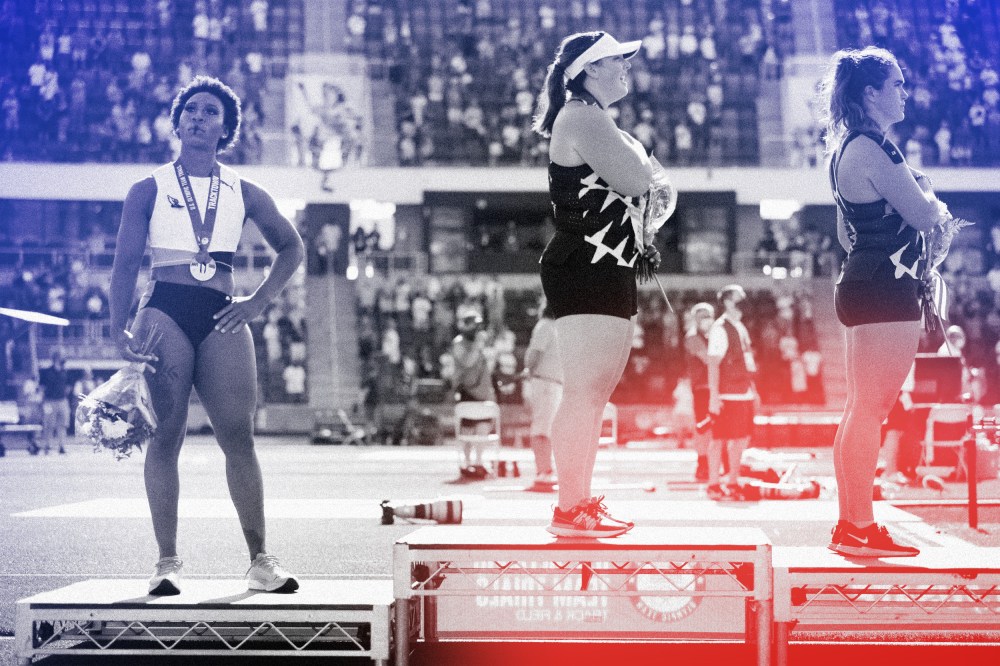
“Hammer thrower Gwen Berry faces backlash from conservatives after Olympic trials flag protest”
“Black-owned Swim Cap Brand Made For Thicker Hair Types Barred From Tokyo Olympics“
“U.S. sprinter Sha’Carri Richardson not named to relay team, won’t compete in Tokyo Olympics”
“Namibian sprinters banned from Olympics for ‘elevated’ testosterone levels”
“Brianna McNeal, Olympic 100m hurdles champ, loses appeal of five-year suspension”
While those protest calls have waned somewhat, the broader question of whether to prioritize structural racial justice at the expense of Black individuals navigating, and possibly dominating and reforming, said structure deserves further investigation.
One question that emerged from the rumblings was: What is the best way to hold the international athletic community accountable for the potential financial and social disempowerment experienced by Berry, Richardson, McNeal, Christine Mboma, Beatrice Masilingi, and pretty much any Black athlete with natural hair?
Others were quick to argue that any type of Black protest, especially one involving this year’s Black Olympians, would itself disempower the games-bound competitors when they clearly need the support of the Black community now more than ever.
Gabby Thomas, the 24-year-old runner who qualified for her first Olympic Games with the second-fastest 200-meter dash time ever (after Florence “Flo-Jo” Griffith Joyner) agreed with this. In a viral tweet that has since been deleted, Thomas wrote, “It hurts to see so many Black people choosing not to watch the Olympics this year. … There are so many Black athletes who have put in YEARS of hard work for this moment — myself included. We want your support.”
“I worry some of the anger and disdain may be misplaced,” she continued. “The ‘Olympics’ and those at the IOC have nothing to do with current events taking place.”

Thomas’ points reflect the contradictions that further complicate an already complex debate about Black participation in white spaces.
Thomas’ latter point seems to refer to the widespread backlash against the anti-doping ruling that dashed the Olympic dreams of the magnetic 21-year-old sprinter Sha’Carri Richardson. (Richardson tested positive for THC, the chemical in marijuana, which she admitted smoking to cope with the recent death of her biological mother.)
Another contentious anti-doping-related ruling resulted in a five-year Olympics ban for McNeal, 29, a hurdling gold medalist poised for her second Olympic Games. (Her case centered on a 2020 drug test McNeal claimed she missed while recovering from an abortion.)
It can be hard to push institutions to change without turning athletes into collateral damage.
Nzingha Prescod, a two-time Olympian and an advocate for racial and social justice on the USA Fencing board of directors, admitted that navigating circumstances like those that led to Richardson’s rulings can be “very tough” for athletes.


“When your lifestyle is, like, goes one way, when the rules go this way, it’s hard to coordinate that sometimes,” she told me during a recent phone call, adding, “And yeah, it’s really sad.”
But Prescod also said that Richardson and McNeal’s cases are high-profile examples of a policy that has affected hundreds of equally hopeful athletes. “It’d be unfair for them to change the rule for Sha’Carri when, you know, so many other athletes have had to lose their shot,” she said.

Richardson was not personally discriminated against, whether or not you feel the broader policy was discriminatory. But her case certainly has added to the feeling that Black elite athletes face an uphill battle.
On the other hand, as the award-winning sports journalist and author Howard Bryant told me in an email, it can be hard to push institutions to change without turning athletes into collateral damage.
This touches on the even trickier complication addressed in Thomas’ first tweet, which is how to protest anti-Black discrimination and biases in spaces and institutions that nonetheless provide financial and social capital to Black individuals.
At the center of this debate is the ideal of “the Black athlete,” an individual and — to some — a representative of the Black community.
At the center of this debate is the ideal of “the Black athlete,” an individual and — to some — a representative of the Black community. Sub “actor” or “writer” for “athlete” and you’ll find a similar debate relating to a variety of predominantly white cultural spaces and ceremonies like the Grammys, the Oscars and The Emmys. It’s even cropped up in noncompetitive spaces that yield cultural and financial capital, like TikTok.
Nuances of this ongoing conundrum can be found in an illuminating discussion started by storyteller and multihyphenate creator Naima Cochrane. Respondents noted how tricky it can be to balance the good of the collective and the good of the individual. Athletes (and actors, for that matter) may also feel differently given their own conflicts of interest.
Before saying “We should boycott the Olympics…”
— Naima Cochrane’s Burner Acct (@stillnaima) July 7, 2021
There are 60 or more Black people on the US Olympic T&F team. Over 25 women. Some having both their first and last games (like Alyson Felix).
4 BM in men’s boxing, 3 BW in women’s boxing, 1 BW in rugby (!), 2 BW in soccer…
This last point raises a critical contradiction between performative (albeit good intentioned) virtue signaling online and direct effective action. In a separate but similar example, I’ve publicly spoken out about the systemic issues of anti-Black racism throughout media and privately (in those group chats — if you know, you know) called for Black journalists to boycott predominately white publications until these issues are adequately resolved.
And yet, I’ve yet to walk it like I talk it — because I understand where the reach and resources that allow my own reporting and writing on Black communities lie, no matter how unjust that reality is.
Working and protesting within the system is easier on the part of my brain that strategizes my future. But it is also taxing on my integrity, my values and my hopes for Black liberation. (For anyone else struggling with this tension, I highly recommend reading Zakiya Dalila Harris’ new novel, “The Other Black Girl.”)
“It’s sad that people want to boycott because of, you know, structural, structural things that need to change,” Prescod told me during our conversation. “Things need to change, but … I just don’t think the answer is boycotting.”
So, what should Black athletes do? I don’t know what the answer is, but I do know that real change requires deliberate organizing, individual concessions and discomfort, and unwavering solidarity among Black folks.

Patrice Peck
Patrice Peck is an MSNBC columnist; a journalist covering the intersection of race, identity and popular culture; and the creator of the Coronavirus News for Black Folks newsletter. Her bylines have appeared in The New York Times, BuzzFeed, Ebony and other publications. She holds a degree in Black studies from Amherst College and a master's in journalism from New York University.