




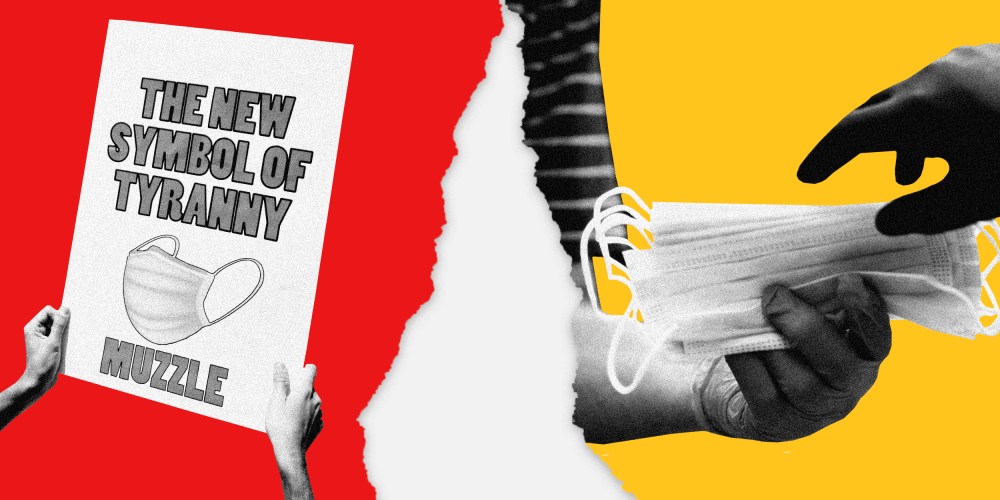
America’s Covid-19 crisis raises a big question: Are we going to do the right thing? Or, to put it in more tangible terms: Are you going to wear a mask?
The jury’s still out on that one, as evidenced by gatherings of mostly maskless White House staff members and a group of armed, angry men who are alleged to have plotted to abduct Michigan Gov. Gretchen Whitmer, outraged over the state’s coronavirus restrictions. President Donald Trump says he’s learned a lot from contracting Covid-19, but clearly not enough to stop him from holding events at the White House or to cancel campaign rallies.
We’re seeing more instances in which people’s thoughtlessness is getting others hurt or even killed in some cases — and not from the virus, but from physical violence, which is what happened in a tragic event in upstate New York when a bar patron named Rocco Sapienza asked another patron, Donald Lewinski, to put on a mask. The district attorney alleged that the non-masked Lewinksi, 65, shoved Sapienza, 80, with both hands. Sapienza hit his head as he fell to the floor, and he never regained consciousness. Lewinski pleaded not guilty to criminally negligent homicide.

But there’s also evidence that not all accountability is dead. Last week, “Saturday Night Live” uninvited its scheduled musical guest, country singer Morgan Wallen, after a video surfaced showing him partying at a bar in Tuscaloosa, Alabama — behavior that violated the show’s Covid-19 protocols. Wallen took to Instagram with a heartfelt apology. The moment was significant because his apology was not, as so many are, “I’m sorry if what I did upset you,” but rather “I am sorry, and what I did upset me.” Wallen understood where he went wrong and was genuinely remorseful for his actions and their potential consequences.


For a more historical model of accountability, back in 1951, the U.S. Naval Academy had a big problem with students who were cheating on tests, which led two midshipmen, William Lawrence and Ross Perot — yes, that Ross Perot — to create what’s now called the honor concept. The main premise of the honor concept isn’t to do right for fear of being punished, but to do right … because it’s right.
The coronavirus pandemic seems to have revealed how we truly feel about our fellow Americans.
Perhaps the academy, on the recent occasion of its 175th birthday, gives us the right word for the ideal so many of us are falling short of today as we fight a global pandemic: honor. Within the Navy’s core values (honor, courage and commitment), honor encompasses uncompromising integrity, being forthright even with bad news and making decisions without regard to personal consequences. This applies to doing the right thing even when you think no one is looking (for example, wearing a mask).
Notable Naval Academy graduates include the first American in space, Alan Shepard, the late Sen. John McCain, NBA Hall of Famer David Robinson and perhaps its most distinguished graduate: former governor, former president and Nobel Peace Prize winner Jimmy Carter.
So much of today’s news has to do with accountability and trust, and the coronavirus pandemic seems to have revealed how we truly feel about our fellow Americans. The White House physician, Dr. Sean Conley, is a Navy commander, too. Based on how much we still don’t know about Trump’s health, these values matter now like never before.

Joshua Johnson
Joshua Johnson is host of "The Week" on MSNBC. Prior to joining the network in 2019, he hosted “1A,” a show by WAMU and NPR, and co-created and hosted the nationwide public radio series “Truth Be Told,” which explored race in America. He previously taught podcasting at the UC Berkeley Graduate School of Journalism and is an active member of the National Association of Black Journalists.