




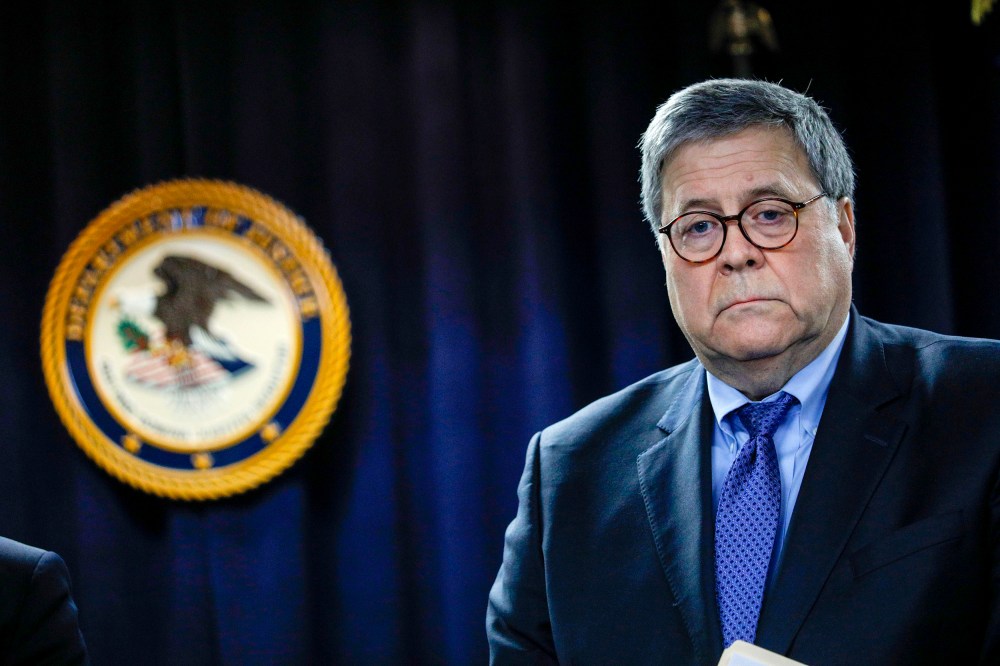
Recently-resigned Attorney General William Barr left the Justice Department just like he came in — with a lie. His lack of honesty and steadfast refusal to understand his duty to serve justice and the people, not the president’s personal and political agenda, will be the legacy of his time in office.
Barr asserted the remarkable claim that a president could not obstruct justice.
Barr landed the attorney general job after auditioning via a memo that was circulated through the Justice Department and the White House counsel’s office, in which he advocated for a previously fringe vision of expansive executive power. Barr made the remarkable claim that a president could not obstruct justice. At the time, I wrote that Barr should not be confirmed:
“No matter what Barr’s intentions, the appearance of impropriety — of ingratiating himself with a president whose desire to install a wingman as attorney general — means that the public perception will always equate Barr, if confirmed, with President Donal Trump’s desire to hold himself above the law. There will be no public confidence in decisions about potential collusion between the Trump campaign and Russia, or about obstruction of justice. Such a significant loss of public confidence will inevitably erode the credibility of the department’s work in other areas as well. The future of the Justice Department, and that of all Americans, will be impaired if it appears the department is being used as a tool to protect this president.”

I did not go far enough. Barr’s intentions, whatever they may have been, never involved being the sort of fierce, independent leader the Justice Department needs at all times. He never felt the gravitational pull of departmental tradition and integrity that would, we assume, have led him to avoid even the appearance of impropriety as he conducted department business. Instead, Barr charted a course toward actual impropriety. And in his resignation, Barr shamelessly defended his actions in a manner that would likely have made even President Richard Nixon’s attorney general, John Mitchell, blush.
Barr charted a course that ran straight into actual impropriety.
Barr was sworn in shortly before special counsel Robert Mueller concluded his investigation into the relationship between the Trump campaign and Russia. Barr stonewalled requests for public access to the report itself, instead delivering what he represented as a summary in a dramatic press conference.
Now that we’ve seen the redacted version of the report Barr was ultimately forced to release, his version can only be characterized as deliberately misleading. Barr claimed that Mueller failed to establish a conspiracy between Russia and the Trump campaign and did not conclude Trump obstructed justice. That provoked the usually taciturn Mueller to object to Barr’s summary, writing that it “did not fully capture the context, nature, and substance” of the investigation.
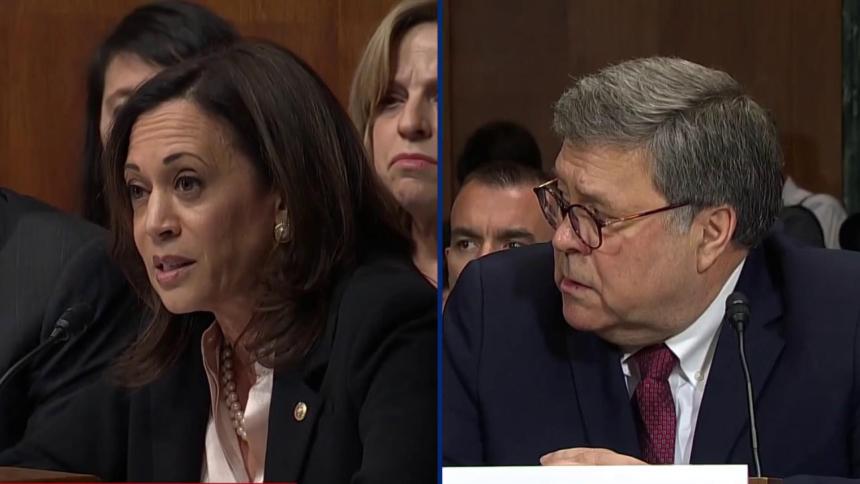
By keeping the actual conclusions of the Mueller report from public view for weeks, Barr permitted Trump to dull their impact, lulling the public into the belief the report was a “complete and total exoneration.” The report actually concluded that a great deal of relevant evidence regarding the campaign’s interaction with Russia and its representatives was withheld from investigators and that they could not “rule out the possibility that the unavailable information would shed additional light on (or cast in a new light) the events described in the report.”
By keeping the actual conclusions of the Mueller report from public view for weeks, Barr permitted Trump to dull the impact.
Additionally, Mueller laid out multiple instances of obstruction of justice by Trump, although he declined to declare that Trump should be prosecuted. (This is because of the now-infamous Justice Department memo stating that a sitting president cannot be indicted.) In other words, Mueller’s report was far from the absolution Barr represented.
Barr’s letter of resignation as attorney general, which he submitted to the president on Dec. 14, trumpeted the Trump administration’s “accomplishments” with about as much accuracy as his summary of the Mueller report.
Along his path, from start to finish, Barr undermined the Justice Department’s mission in far too many ways to detail completely here. Suffice it to say, there was an emphasis on helping the president’s cronies and enforcing his agenda. Barr moved to dismiss charges against retired Gen. Michael Flynn (despite his prior guilty plea), sought a reduced sentence for Roger Stone (which Trump subsequently commuted in its entirety) and lied about what he claimed was the resignation of former Southern District of New York U.S. Attorney Geoffrey Berman — before Berman publicly corrected him. Barr’s actions tarnished the rule of law and ignored the intention of the Founding Fathers that no man, not even and perhaps especially not the president, should be above it.

So the closing act of Barr’s tenure came as no surprise. Barr’s resignation letter is a genuflection to the president, not the expression of gratitude for the opportunity to serve that typifies departures from the Department of Justice. In it, Barr does not thank the career rank and file for their service, and instead jumps straight into the deep end, thanking Trump for the opportunity to “update” him on voter fraud just before he tendered his resignation. That should have been a short meeting, because there is no evidence of systematic voter fraud in this election and plainly none significant enough to alter the outcome. That’s just a fever dream the sycophants surrounding this president have fanned, at the expense of the republic.


If ever a president needed an attorney general who insisted on a strict separation between the Department of Justice and the White House on matters involving the prosecution of criminal cases, it was this one. But Barr was perceived both inside and outside the department as doing the president’s bidding to such an extreme that prosecutors resigned from cases, and even from the department, over concerns of abuse of power.
In February, all four of the prosecutors assigned to the Stone case resigned from it. In May, it was the Flynn case that pushed a prosecutor to step down, after Barr decided to drop it. A senior prosecutor in the Durham investigation resigned in September. With the floodgates open, veteran prosecutors signed their names to letters rebuking Barr for politicizing the Justice Department. Sixteen assistant U.S. attorneys from across the country responsible for helping protect the election signed a letter criticizing Barr for changing longstanding policies against interference in elections after the head of the election crimes unit stepped down when the changes were instituted. And Barr will be forever captured in photos, walking in lockstep behind Trump before protestors in Lafayette Square were gassed to make way for a presidential photo opportunity
Barr will go down in history as the worst attorney general of our lifetimes. He consistently chose to enable a president who did not believe in the rule of law, regardless of the damage it did to the country. Barr could have held the line, but he didn’t. Even while lying sick in a hospital bed, President George W. Bush’s Attorney General John Ashcroft understood the importance of circumscribing executive action through the rule of law.
Presidents are not kings. So there can be no laundering of Barr’s reputation as attorney general. The mistakes of his tenure must be acknowledged, confronted openly, counted one by one, fixed where possible and learned from. That is the only path forward if the Justice Department is going to resume its role as the people’s lawyers, not the president’s.
Career prosecutors, people who value the department’s independence and integrity and their own role as public servants, people who pursue their cases without fear or favor based solely on the law and the evidence, will not miss Bill Barr. He has sullied the Justice Department’s honor at the moment when it needs its integrity the most.
The country faces the dual challenges of whether and how members of the Trump administration will be held accountable for misconduct at the same time that pervasive issues of racial injustice demand transformation of the criminal justice system.
The Justice Department can only be effective if the public trusts its impartiality when it makes hard calls — and it will have to make hard calls to move forward on both of these issues. Trump and Barr have damaged the public’s faith in its prosecutors, leaving to the next attorney general the challenge of restoring the department’s integrity while facing serious questions.
