




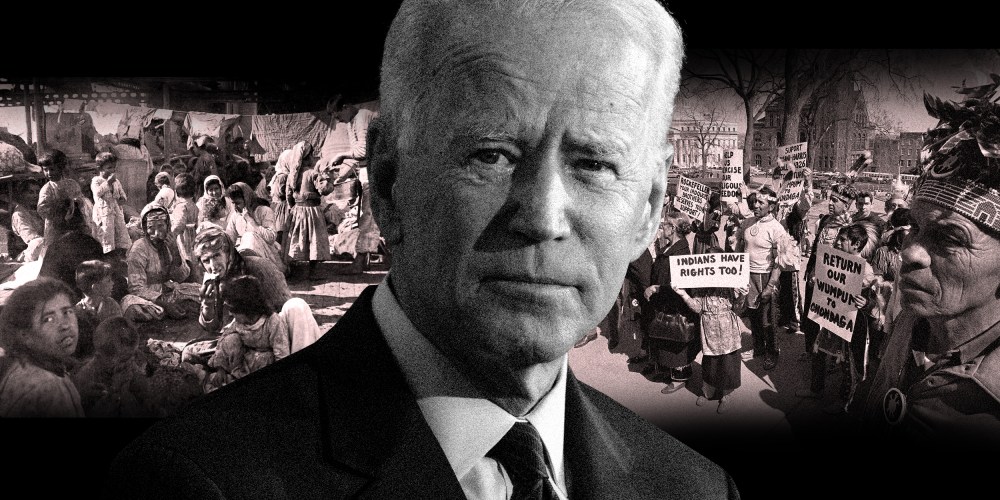
On Saturday, President Joe Biden did what no president had done before when he acknowledged that the Ottoman Empire’s massacre of the Armenian people in 1915 was, in fact, genocide.
“The American people honor all those Armenians who perished in the genocide that began 106 years ago today,” Biden said in a statement commemorating Armenian Genocide Remembrance Day. It was a move that was too long coming, put off for years to nurture what has become a crumbling relationship with Turkey.

But now it’s time for the United States to finally acknowledge a genocide much closer to home.
After Biden’s declaration, an article from 2019 began circulating on Twitter. Back then, soon after the Senate had passed a resolution recognizing the Armenian genocide, Turkey’s president, Recep Tayyip Erdoğan, had threatened to give the U.S. a taste of its own medicine:
Speaking on the pro-government A Haber news channel, he said: “We should oppose [the US] by reciprocating such decisions in parliament. And that is what we will do. “Can we speak about America without mentioning [Native Americans]? It is a shameful moment in US history.”
Setting aside his blatant whataboutism, the fact that he mentioned one atrocity only to deflect from another, Erdoğan was correct. The U.S. government’s treatment of Native Americans is a shameful moment in America’s history, one that we need to address more openly if we’re ever to move forward with any moral weight in the world. There needs to be an equivalent reckoning with America’s own sins as we speak out against those perpetrated outside our borders.
Americans in the 19th century weren’t shy about their beliefs or discriminating in their tactics to subjugate the different tribes on land that the U.S. claimed as its own. Less than 20 years after the Trail of Tears killed 4,000 Cherokees on their march west, Peter Burnett, the first governor of California, told lawmakers that “a war of extermination” that will “continue to be waged between the two races until the Indian race becomes extinct must be expected.”
There needs to be an equivalent reckoning with America’s own sins as we speak out against those perpetrated outside our borders.
Some may try to argue that what took place in the U.S. shouldn’t qualify as genocide, given that Native Americans still live here. After all, as of the 2010 census, 5.2 million people identifying as American Indian and Alaska Natives lived in the U.S., either alone or in combination with one or more other races. That’s more people than live in Ireland or New Zealand.
But Raphael Lemkin, who coined the word “genocide,” was clear from the start that a people need not be annihilated fully for his word to apply. “It takes centuries, if not thousands of years, to create a national culture but Genocide can destroy a culture instantly, like fire can destroy a building in an hour,” Lemkin once wrote.
White Americans were the fire Lemkin warned of, blazing through dozens of Native cultures until only the most resilient structures remained, surrounded on all sides by ash and burned-out frames. From decades of forced resettlements to scores of treaties made and broken, American history is littered with attempts to eradicate Native groups from America’s borders, a policy of ethnic cleansing and forced cultural amnesia that lasted well into the 20th century.
Former Sen. Rick Santorum, R-Pa., inadvertently made that policy of erasure sharply clear Friday in a speech about religious freedom to the Young America’s Foundation. Santorum, comparing the U.S. to older countries like Italy and China, claimed that America is different because their cultures evolved slowly over time. In contrast, Americans “birthed a nation from nothing.”
“I mean, there was nothing here,” he said. “I mean, yes we have Native Americans, but candidly, there isn’t much Native American culture in American culture,” Santorum told his audience.
CNN’s Rick Santorum: “We birthed a nation from nothing. I mean, there was nothing here. I mean, yes we have Native Americans but candidly there isn’t much Native American culture in American culture” pic.twitter.com/EMxOEYDbg7
— Jason Campbell (@JasonSCampbell) April 26, 2021
The response from the National Congress of American Indians was rightfully blistering, especially toward CNN, where Santorum is a paid commentator. “Make your choice,” it wrote in its statement to HuffPost. “Do you stand with White Supremacists justifying Native American genocide, or do you stand with Native Americans?”


When I asked the National Congress of American Indians’ prez for comment on Santorum, I did not expect so much fire. Wow.
— Jennifer Bendery (@jbendery) April 26, 2021
Full statement below.
“Make your choice. Do you stand with White Supremacists justifying Native American genocide, or do you stand with Native Americans?” pic.twitter.com/5Tot8CfgBL
And if you think that acknowledging that history doesn’t matter today, I point you to China’s persecution of its Uyghur population. The Chinese government has built massive detention centers around Xinjiang, where its mostly Muslim occupants are being trained to reject their culture and religion through a program of abuse, deprivation and force-fed propaganda. Beijing has also recently been accused of using Uyghurs as forced labor to pick cotton, drawing backlash from Western corporations, which have in turn been blacklisted by Chinese censors.
China has claimed that these facilities are merely vocational training centers, even though the few detainees who have escaped and spoken out describe a mass campaign to eliminate all traces of Uyghur culture — which is exactly what Lemkin described. After years of dithering, the U.S. has finally decided to call what’s happening in China what it is. Just last month, Secretary of State Antony Blinken said China “continues to commit genocide and crimes against humanity in Xinjiang.”

For the last three years, I’ve been fascinated by the parallels between these detainment camps in Xinjiang, with their “re-education,” and the Native schools that were run in the U.S. in the 19th century. The Carlisle Indian Industrial School in Carlisle, Pa., actively recruited children from Native tribes to teach them Western ways, shearing their long hair and forcing them to take on new, meaningless names. Under the tutelage of the white military instructors, the children and young adults created inauthentic “Native” crafts for sale at local and international fairs.
Chiefs sent their children east to learn European ways out of desperation, because of hunger and other suffering in the face of the U.S. military’s pacification campaigns. And yet the school’s founder, along with other well-meaning — but still racist — white Americans, were sure that their facilities were the only hope for survival for Native peoples, encouraging their swift assimilation into the predominant culture. This belief — “Kill the Indian in him and save the man” — was the mantra of a people intent on wiping out another’s history and spirt.
When the U.S. commits atrocities against its own, the world notices. The horror at realizing that the Nazis built their eugenic and racist policies using America’s treatment of Blacks and immigrants as a template doesn’t diminish over time. China may not have directly modeled its methods on the American Indian schools, but the effect is the same.
There have been a few halting efforts to truly face down America’s past. Congress slipped an apology into the 2009 National Defense Authorization Act, citing “years of official depredations, ill-conceived policies, and the breaking of covenants by the federal government regarding Indian tribes.” California Gov. Gavin Newsom came closer in 2019:
“It’s called a genocide. That’s what it was. A genocide. [There’s] no other way to describe it, and that’s the way it needs to be described in the history books,” Newsom said at a blessing ceremony for a Native American heritage center. “And so I’m here to say the following: I’m sorry on behalf of the state of California.”
But that’s not the same as an acknowledgment on the level of Biden’s last weekend. He has already appointed the first Native American Cabinet member, Interior Secretary Deb Haaland. In doing so, he placed Haaland in charge of the Bureau of Indian Affairs. I wrote to the bureau Monday, asking whether Secretary Haaland is in favor of acknowledging the treatment of Native groups here as genocide. I hope that she does — and that Biden follows suit.
Recognizing the Ottoman genocide of Armenians was the right thing to do, and it has been for decades. So, too, is it right to speak the truth about our own country’s genocidal efforts, if not for the clearing of our collective conscience, then so we may more forcefully speak out against those who would follow in our footsteps.

Hayes Brown is a writer and editor for MS NOW. He focuses on politics and policymaking at the federal level, including Congress and the White House.