




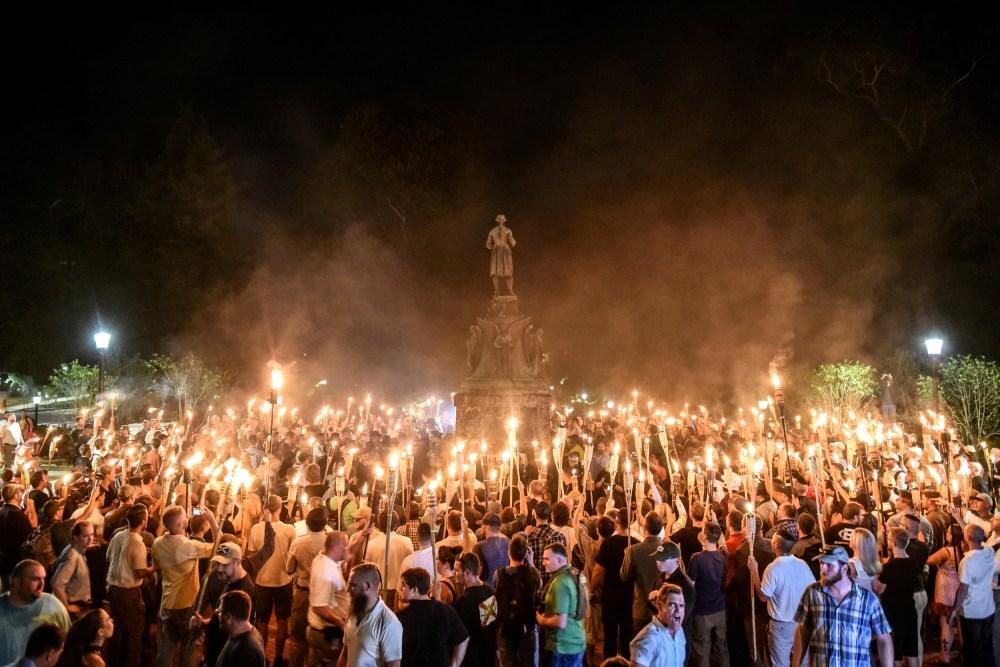
A historic civil trial starts Tuesday in the federal lawsuit against the organizers of the 2017 “Unite the Right” rally in Charlottesville, Virginia. The case aims to hold two dozen leaders of white supremacist and extremist groups accountable for conspiring to commit violence at that rally. The lawsuit has already “crippled” several white supremacists and has driven others out of the movement.
This is the first time that victims of race-based extremist violence have sought to hold multiple organizational leaders accountable for the harm they experienced.
A previous criminal trial has already led to life imprisonment for the driver who killed Heather Heyer and injured dozens more when he drove into a crowd of counter-protesters at the rally. But now, nine more victims of the violence are suing the rally’s organizers — relying on the post-slavery era Ku Klux Klan Act, which was established to protect former enslaved people from vigilante KKK violence and allows victims to sue in federal court.
This type of legal action, spearheaded by the nonprofit Integrity First for America, is unusual and historic in multiple ways. Although civil litigation has long been a strategy used to bankrupt and dismantle white supremacist groups — most notably in cases brought by the Southern Poverty Law Center against the Ku Klux Klan and Aryan Nations — this is the first time that victims of race-based extremist violence have sought to hold multiple organizational leaders accountable for the harm they experienced.
The case is rooted in the plaintiffs’ claim that the defendants actively planned and coordinated illegal violent activity and conspired to engage in racially motivated violence in Charlottesville. Over the coming weeks, the jury will hear testimony and analysis of substantial leaked data and more than five terabytes of evidence from online chatroom logs, audio recordings and other online discussions that took place in the weeks leading up to the rally. That evidence details discussions about the use of tactics like vehicle ramming and how to instigate violence in ways that might allow a claim of self-defense. The chats were viciously violent, racist and antisemitic, including violent fantasies about driving through crowds and cracking skulls.

The analysis of those chats also has the potential to break new ground by introducing a legal record of the ways that white supremacist extremists use cloaked speech and coded language to plan and describe actions in ways that make them seem more innocuous than they are. There has been a well-documented explosion in recent years in the use of coded speech and “double speak” phrases across the far right. Such speech — along with humor, irony and satire in memes and jokes — is a strategy to create plausible deniability about racist and antisemitic statements.


The defendants have made similar arguments in this case, claiming they were “just joking” and that their views are protected by free speech. But First Amendment protections do not excuse violence. And in March, the court denied the Charlottesville defendants’ attempt to exclude expert testimony from two professors, Kathy Blee and Pete Simi, about white supremacists’ use of coded speech. In their 60-plus-page report, Blee and Simi explained that the defendants engaged in a “coordinated strategy to obfuscate their aims” by using “double-speak” and “just joking” tactics.
First amendment protections do not excuse violence.
The court’s opinion allowing the expert testimony to proceed cites examples of these tactics, including a neo-Nazi “Style Guide” that instructed followers to use language that makes it difficult for people “to tell if we are joking or not.” One of the defendants in the Charlottesville lawsuit talked in a 2017 podcast about the effectiveness of using humor to draw people into the movement and to keep “our opponents off balance” as they struggled to distinguish between “what things we’re absolutely serious about, and what things we’re joking about.” If the expert testimony in the coming weeks covers the same issues raised in the written report, the trial has the potential to break ground in documenting the way that coded speech, jokes and double-speak can incite racist violence, all within the guise of “just joking.”
This isn’t the first time that coded speech has come up in legal cases. Expert testimony in gang violence cases has shown how coded language is used to refer to drugs or planned murders. There is some precedent in cases involving white supremacists, too. Taylor Dumpson, for example, won a landmark $725,000 judgment against the neo-Nazi Andrew Anglin after Anglin was found guilty of inciting a racist troll storm of harassment by encouraging his followers to give Dumpson a “warm welcome” and providing links to her social media pages.

The Charlottesville trial offers a chance to show that there are consequences for organizing and planning violence, including in ways that involve cloaked speech. Even before the trial began, the lawsuit has had an impact. Seven of the defendants, including two Ku Klux Klan groups, have already received default judgments. The financial cost of the lawsuit has driven other groups into financial distress or bankruptcy, while others have rebranded their organizations under new names. And the 150-year-old Ku Klux Klan Act being invoked in the Charlottesville case is now being used in at least two other pending cases, including a federal lawsuit against individuals for involvement in the Jan. 6 Capitol attack.
These are critical outcomes. As the trial gets underway, we can expect many more impacts to come — including the potential to firmly establish the dangerous ways that coded racist and cloaked speech can threaten individuals and incite violence. Hiding hate in a meme, a joke or an innuendo doesn’t create the plausible deniability that white supremacists hoped for. On the contrary: When coded speech demonstrably incites violence, the perpetrators of that violence must be held accountable. The Charlottesville trial offers an opportunity to demonstrate that.

Cynthia Miller-Idriss is an author and expert on extremism.