




Last week, a friend of mine posed a question on Slack: “Has Twitter gotten worse or have I just gotten tired of it?”
Twitter had become, for lack of a better word, an online hellscape.
This was notable coming from a digital journalist, indicative of an existential exasperation with a social media platform that has become baked into the fabric of the career path. The message prompted several more of us, all writers, all Very Online, to chime in about our own tweeting exhaustion.
The consensus seemed to be that we had collectively reached some kind of invisible wall. Twitter had become, for lack of a better word, an online hellscape — uninteresting, draining, utterly devoid of joy. Maybe by 2022 we’d just delete our accounts?
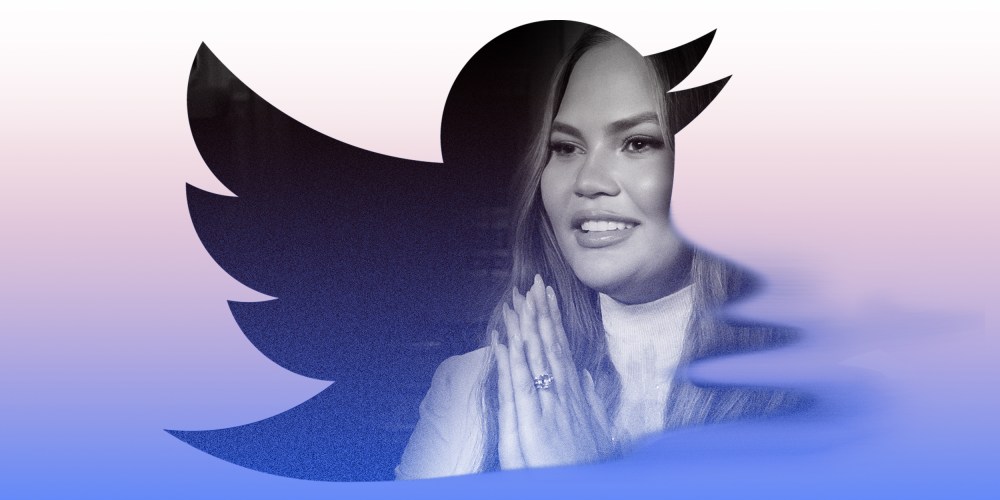
The next day, Chrissy Teigen did just that. The model and entrepreneur, known for her witty observations and cutting clapbacks — she’s often been referred to as the unofficial “Queen of Twitter” — announced that she would be leaving the platform for good.

In a nine-tweet thread, she explained that Twitter “no longer serves me as positively as it serves me negatively” and that the fear of saying something that might upset people, combined with a desire to be liked, had “made me somebody you didn’t sign up for, and a different human than I started out here as!”
“For years I have taken so many small, 2-follower count punches that at this point, I am honestly deeply bruised,” she tweeted. Thus, it was time for her to go.
Teigen later clarified on Instagram that she had not left the platform because of the “trolls” but because of her own reaction to the very feedback loop that drives Twitter’s success. “Someone can’t read that they disappointed you in some way every single day, all day without physically absorbing that energy,” Teigen wrote. “I can feel it in my bones.”
That last part felt achingly familiar.
In some ways, social media platforms like Twitter have leveled the playing field, allowed for the amplification of marginalized voices and lessened the power of traditional gatekeepers.
Twitter’s strength lies in its accessibility: the layperson’s ability to interact with public figures and corporate entities, the ability of celebrities to tell their own stories without their being refracted through the prism of media, the ability of grassroots organizers to amplify their messages far beyond a scope they could have dreamed of historically. In some ways, social media platforms like Twitter have leveled the playing field, allowed for the amplification of marginalized voices and lessened the power of traditional gatekeepers.
But Twitter has also contributed to an economy of constant availability and entitlement to strangers’ time, energy and emotional labor. Even one’s “fans” and “friends” become part of the exhausting cycle, constantly weighing in on everything you say, which inevitably is imperfect at least sometimes.

The “disappointment” that Teigen articulated can become crushing. Messages repeat. Originality depletes. Nuance dies. The loudest voices often are the most simplistic, able to whip up their bases into a frenzy by stating the obvious or, worse, spreading fear and hatred, like former President Donald Trump did for five years before he was finally banned from the platform in January.
Online harassment is like death by a thousand cuts.
Maybe that’s why many of us, like Teigen, are starting to feel like the bad outweighs the good. After more than a year of being trapped inside, isolated and dependent on screens and social media to facilitate a paltry imitation of real-world socializing, the voices on Twitter feel louder, less compassionate — and, frankly, less useful.
I used to take great pleasure in crafting tweets: 140 (and then 280) characters arranged just so, primed for maximum impact (i.e., the number of retweets and replies and faves). I made Twitter friends, connected with people whose stories were worth telling and harnessed the ability to use my platform to amplify my own work.

But these days, even the act of mindless scrolling feels laborious. When I sign on, I brace myself for nasty messages — lately, in the wake of being laid off by BuzzFeed, it’s been a barrage of men telling me to “learn to code” or “try OnlyFans” or “learn to code because you’re too ugly to be on OnlyFans.”


These messages are not wounding; I learned long ago to ignore the petty pile-ons of anonymous men, so small and pathetic that they can’t even craft an original insult. But they are depleting. And last week’s news also left me with this question: If online harassment was enough to get a bona fide celebrity like Teigen to leave Twitter, how do the rest of us stand a chance?
If online harassment was enough to get a bona fide celebrity like Teigen to leave Twitter, how do the rest of us stand a chance?
Most public people who have been forced into unholy alliances with social media platforms to keep publishing their work, especially journalists, have experienced some form of online harassment. And for women and people of color, that harassment can be particularly severe. (A 2017 study found that a female journalist or politician was harassed on Twitter every 30 seconds and that Black women were 84 percent more likely than white women to be mentioned in abusive or problematic tweets.)
One doesn’t need to look hard to find recent real-world examples that encapsulate the depths of the problem: At the end of February, Washington Post reporter Seung Min Kim received a flood of racist, misogynist messages after a photo circulated of her asking Sen. Lisa Murkowski for comment about a tweet, an action that is routine for journalists.
Weeks later, New York Times reporter Taylor Lorenz ended up on the receiving end of a round of online death threats after Fox News’ Tucker Carlson mocked her on his show for tweeting about previous online harassment on International Women’s Day.
No amount of blocking or muting can blot out the overwhelming hum of constant hatred — or even dull disappointment; the disappointment is brutal! — flooding your mentions and your DMs. Online harassment is like death by a thousand cuts. Over time, the wounds get deeper; the proverbial bruises spread. It becomes increasingly hard to ignore, no matter how thick and callused your metaphorical skin is.
When even talking about harassment begets more harassment, who wouldn’t be tempted to throw up their hands and quit a platform where so much of this never-ending, often negative feedback originates?
Some of us risk losing access to professional opportunities and income if we bow out. But for Teigen, a celebrity who has more than established herself off Twitter — and who still has access to 34.4 million followers on Instagram — the benefits of quitting far outweighed the risks.
The day after her Twitter departure, Teigen was back on Instagram, showing off a head of ice blue hair and promoting her new cleaning brand with Kris Jenner. “I’m ok really!!!” the caption on one of her videos reads.
I believe her.

Emma Gray
Emma Gray, a freelance journalist focused on the intersection of gender, culture and politics, is the author of "A Girl's Guide to Joining the Resistance." She is a co-host of the podcast “Love to See It” and a co-author of the newsletter “Rich Text,” and she has spent the last 10 years as a senior reporter and editor at HuffPost.