




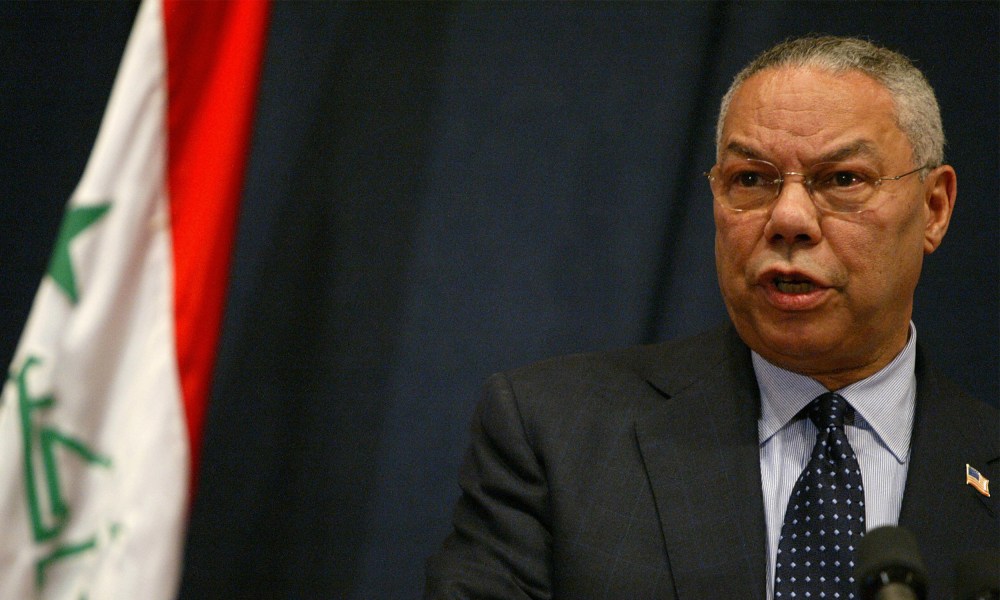
Colin Powell, who died Monday due to complications related to Covid-19, commanded respect from Washington elites and the broader public across the political spectrum — an extraordinary feat that stemmed from his reputation for discipline and fairness. The Harlem, New York-born son of Jamaican immigrants, Powell became a four-star general and the first Black secretary of state and chairman of the Joint Chiefs of Staff.
Unfortunately, Powell marshaled that reputation and power in service of a terrible misdeed: making the Bush administration’s most powerful case for the Iraq War. Powell went on to express at least some regret for his part in the invasion, and his legacy cannot be reduced to this one chapter of his career. But in this instance, his judgment was so poor and his actions were so consequential that any discussion of his legacy must include a reckoning with his complicity in one of the most heinous foreign policy decisions in modern American history.
The Bush administration chose Powell to address the U.N. Security Council in February 2003 precisely because he was immensely popular.
In the run-up to the Iraq War, Powell was skeptical of the wisdom of invading Iraq and argued in high-level meetings for the U.S. to work on coalition-building against Iraq at the United Nations instead of rushing to invade it. In private conversations, he described invading the country to topple Saddam Hussein as foolish. But he never expressed outright opposition to the president.
Powell once famously told Bush during a private dinner in August 2002 that invading Iraq could go wrong and define his presidential legacy. “You break it, you’re going to own it,” he told Bush in a widely cited line. But when Bush asked him point-blank, “What should I do?” Powell did not say he thought the U.S. should not invade Iraq. Instead he suggested going to the U.N.
Eventually the U.N. became the site of the United States’ most powerful and agenda-setting case for the Iraq War, and it was Powell who made that argument. The Bush administration chose Powell to address the U.N. Security Council in February 2003 precisely because he was immensely popular, had bipartisan appeal and was regarded as a straight shooter.
This was another major juncture at which Powell could’ve acted on his reported misgivings. He could have declined the order — a decision that very likely could have precipitated a resignation and, in the case that it triggered other resignations, potentially pushed the Bush administration’s Iraq agenda into a tailspin. This wasn’t unthinkable: While Powell is known for being an understated statesman deferential to presidential power, he once threatened to resign over the prospect of out gay people being allowed to serve in the military under the Clinton administration.

Instead, Powell gamely took on the task of being the face of the Bush administration’s case for invasion to the international community, enumerating the CIA’s alleged evidence of Hussein’s weapons of mass destruction and links to Al Qaeda. He immediately scrapped the speech materials that were first given to him — which he described as “bull—-” in part because of how poorly it was argued — and worked directly with the director of the CIA at the time, George Tenet, to build what was meant to be an airtight case for describing Hussein as an intolerable threat to the world.
It would later turn out that Powell’s more refined and rigorous version of the speech was also, well, horse manure. While in many mainstream media accounts Powell is portrayed as a victim of poor intelligence — and he himself benefited from implying this was the case — there are, in fact, many indicators that he knew he was using poor intelligence and actively manipulating it to strengthen the case for war. As The Intercept’s Jon Schwarz wrote in 2018, Powell obscured his private doubts and projected false confidence about the case for Iraq by knowingly exaggerating, cherry-picking or distorting questionable intelligence despite warnings from the State Department’s Bureau of Intelligence and Research about the credibility of the claims he was using. Even Powell’s own chief of staff at the time later confessed that “it didn’t seem to matter to us that we used shoddy or cherry-picked intelligence” to make the case for war. Across the board there was a kind of epistemological corruption: scrounge up information that rationalized war. As the CIA fed intelligence to the Bush administration’s top officials, some operated with the assumption that Bush was working backward from the presumed conclusion that an invasion was just and simply wanted some intelligence to back up that agenda. And many Bush administration officials simply lied about the actual intelligence they were getting if it interfered with the case for toppling Hussein. Across the board there was a kind of epistemological corruption: scrounge up information that rationalized war. Again, Powell’s legacy does not rest solely on his actions regarding the invasion of Iraq. But when it came to that momentous decision, his behavior was shameful. In one of the most important moments of his career, his intelligence and prudence as a thinker and a leader were used to bolster a war of aggression rather than to thwart it. The fact that Powell apparently knew all along it was a mistake doesn’t make it less of tragedy, but more of one.
Zeeshan Aleem is a writer and editor for MS NOW. He primarily writes about politics and foreign policy. 

