




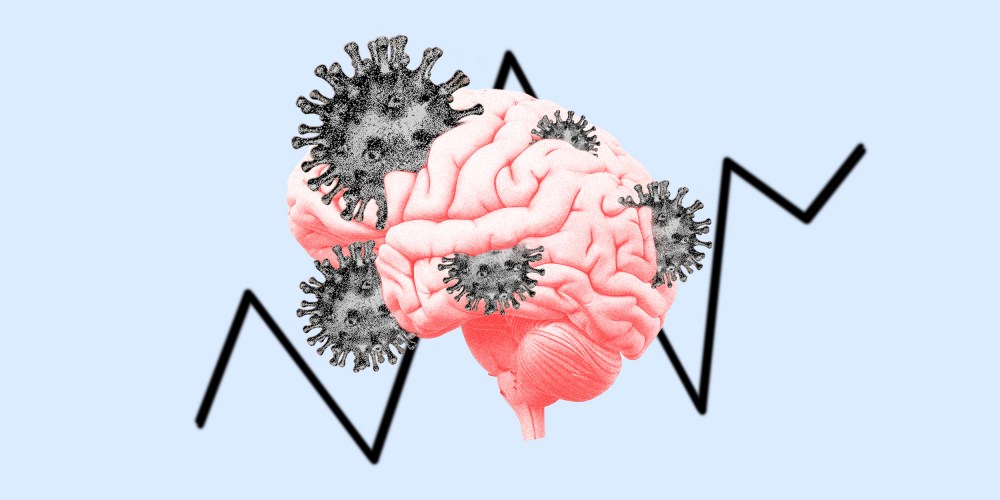
The past year has left us feeling like an overstimulated nerve: We’ve been rubbed raw, our sensors deadened, threatening to go fully numb as Covid-19 has killed more than 300,000 people in the United States. It’s why, even as the pandemic is at its worst point yet, with an average of more than 2,000 deaths a day, it doesn’t feel the same as it did in the spring.
It turns out your brain literally cannot handle what’s happening.
The (kind of) good news: If you’re feeling disconnected from the horror that’s taking place every few seconds around the country, you’re not alone. The bad news: It turns out your brain literally cannot handle what’s happening — the scope of the pandemic is too big for humans to comfortably process.
That’s because the human brain isn’t wired to process large numbers. And by large numbers, I don’t mean things that can be counted in the billions or the quintillions — though those are definitely super difficult to wrap your mind around when you’re thinking about things like the size of the federal budget or how many stars are in the Milky Way.
No, I’m talking about large numbers like, well, anything bigger than three. Yes, three.
That’s what I learned from talking with Daniel Casasanto, an associate professor of human development and psychology at Cornell University. His work at the Experience and Cognition Laboratory involves studying cognitive diversity, or how different people experience the world as reflected in our brains.
Tracking the difference between approximate amounts bigger than three is easy enough that human babies and animals can do it, he told me, so long as the ratio between them is big enough. (Like, say, a pile of food that’s much larger than the one next to it.) But when it comes to large exact numbers, like 48 or 3,472? Those we don’t handle very well.
“Large numbers are weird: We invented them very recently in human history,” Casasanto said. Being able to understand large, exact numbers is “an extremely recent, rare and hard-won ability that we never got very good at,” he said. We just don’t have a deep understanding of what those numbers mean, especially when we aren’t able to compare them next to something else.
We make up for that through the use of metaphors in our language to find a way to compare this abstract idea — “seven-ness,” as Casasanto put it — to something concrete, like the idea of seven apples that we can see and touch. Or we use spatial terms — big, small, high, low — as a way to think about a number with an easier reference point in mind.
Being able to understand large, exact numbers is “an extremely recent, rare and hard-won ability that we never got very good at.”
That makes it hard, though, to conceptualize just how bad things are as the coronavirus has surged — 200,000 new cases a day isn’t easily pictured, even while you understand that it’s “a lot.”
Some research even suggests that our inability to understand large numbers plays into how we react to mass deaths. Paul Slovic, a psychologist at the University of Oregon, has researched the “psychic numbing” that humans experience when confronting mass atrocities. What he found is that “the statistics of mass murder or genocide, no matter how large the numbers, fail to convey the true meaning of such atrocities.”
“The numbers fail to spark emotion or feeling and thus fail to motivate action,” he said.


In part that’s because the bigger the number of people affected, the less it feels that any response a single person can make does much to help. A study that Slovic and other researchers published in 1997 had subjects imagine they were deciding which of four projects to fund. Two of the projects would provide clean water to save the lives of 4,500 hypothetical refugees in one of two camps — the first held 11,000 people; the larger was home to 250,000 people. Even though the same number of people would have been saved in each camp, subjects were less willing to fund the project at the larger camp.
You can see why that’s a problem when you’re trying to keep track of something as massive as a pandemic, especially when you’re trying to persuade people to change their behaviors to stop the spread.
Some steps are being taken, though, to break through the fog. First, there’s been a surge in memes and tweets trying to contextualize the sheer number of the deaths that are taking place. One published on Dec. 8 compared the pandemic deaths to the deadliest single days in U.S. history:
Hard to believe we are here. And that it’s going to only get worse. Stay HOME. Wear a mask.
— Carey B (@CareyComments) December 8, 2020
(Yes, I’m the original creator.) pic.twitter.com/Edo3p4E7fW
Another, from MSNBC producer Adam Weinstein, compared the recent death toll to the lives lost at Pearl Harbor on the anniversary of the attack:
U.S. DEATHS, PEARL HARBOR, 7 DEC 1941: 2,403
— Adam Weinstein (@AdamWeinstein) December 7, 2020
U.S. DEATHS, COVID, 1 DEC 2020: 2,473
U.S. DEATHS, COVID, 2 DEC 2020: 2,733
U.S. DEATHS, COVID, 3 DEC 2020: 2,706
U.S. DEATHS, COVID, 4 DEC 2020: 2,563
U.S. DEATHS, COVID, 5 DEC 2020: 2,445
Casasanto said mapping onto graphics also helps leverage our reliance on space to comprehend numbers. There’s a reason The New York Times’ front page listing the first 100,000 people to have died of Covid-19 hit so hard in May — it transformed an abstract idea into something concrete, making it easier to see the horror in a way the number alone didn’t quite manage to.
The front page of The New York Times for May 24, 2020 pic.twitter.com/d14JhFp4CP
— The New York Times (@nytimes) May 24, 2020
Casasanto used the example of a graphic showing a church, standing in for an entire 500-person congregation. “You put 600,000 churches on a page, that’s going to have a lot bigger impact, thinking about all of those churches upon churches,” Casasanto told me. “Imagine a whole church congregation dying. Now imagine all of those church congregations dying.”
And finally, the less abstract a number is, the more empathy it evokes. We may never get a collection of all 300,000 faces of the people we’ve lost this year. For now, it helps to focus on their names, instead of just the number that represents them.
That’s why I’m grateful for outlets like BuzzFeed News and NBC News, which continue to tell the stories of as many people who have died this year as they can. Beyond serving as memorials to the dead, these obituaries serve a broader function, keeping us tethered to the human cost of the pandemic.

Hayes Brown is a writer and editor for MS NOW. He focuses on politics and policymaking at the federal level, including Congress and the White House.