




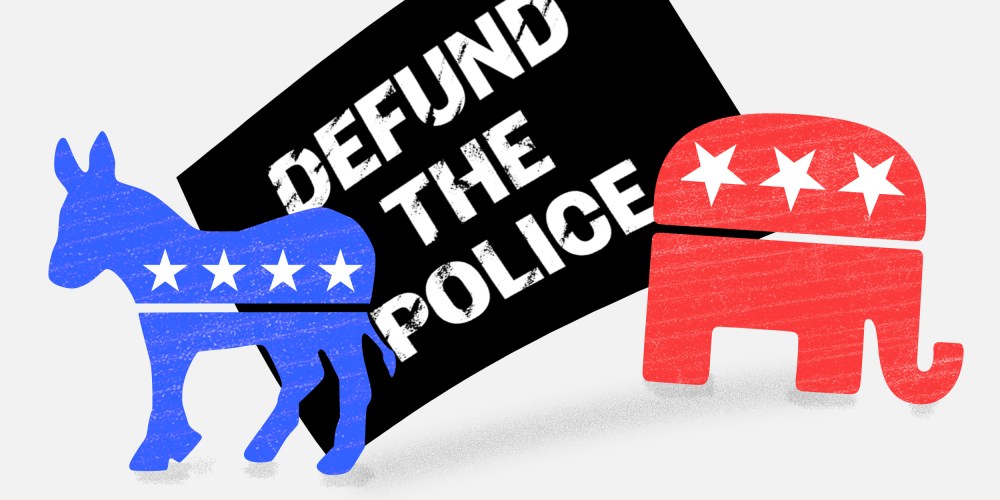
The Democrats are rolling out a counterintuitive new messaging strategy in anticipation of the 2022 elections: Republicans are defunding the police. It’s an attempt by Democrats to counter attacks from the GOP about being weak on law enforcement; liberal lawmakers hope they can flip the right-wing narrative and argue that the legislative record shows the Democratic Party is in fact the fiercest ally of the police.
Liberal lawmakers hope they can flip the right-wing narrative and argue that the legislative record shows the Democratic Party is in fact the fiercest ally of the police.
Unfortunately this playbook is too cute by half to work well. In all likelihood it won’t have the power to change minds. And by giving credence to what has always been a bad faith line of attack from the Republicans, it could make future internal debates over the scope of criminal justice reform all the more difficult.
Akela Lacy reported in The Intercept on Wednesday that Democrats have already started embracing the narrative that the GOP is to blame for defunding the police because every Republican in Congress voted against the American Rescue Plan — the massive coronavirus relief bill passed in March that provided billions of dollars for funding local police departments. Democrats are also arguing that the GOP’s attempt to avoid responsibility for the Capitol riot — an attack that resulted in brutal injuries and death for Capitol Police officers — reflects apathy toward law enforcement.
Democrats have accused Republicans of hypocrisy on defending police funding in the past, but the messaging is looking increasingly systematic. Several Democratic members of Congress — like Reps. Ted Lieu of California, Val Demings of Florida and Madeleine Dean of Pennsylvania — have been pushing this new message, as has the Democratic National Committee.
“Republicans have spent an entire year essentially lying about what Democrats support and what Democrats have voted for,” a Democratic aide told The Intercept. “The fact that Democrats have really settled on a line here to push back on it, and to really go on offense, excites Democrats.”

But as the Democrats prepare to double down on their new line of attack on Republicans, they should ask themselves two questions: Will this work, and is it worth it? On both fronts, there is good reason for skepticism.
The notion that Democrats can wrest the pro-police mantle from Republicans is far-fetched. The contours of the debate right now have little to do with staffing levels during economic recessions or how much police officers’ lives are respected or honored as they navigate their very difficult jobs. In reality, the debate is about what role the police should play in our society and what communities they’re meant to be protecting.
The heart of the matter is a racialized culture war over “law and order” — a reactionary concept with deep roots in American history that was popularized by Richard Nixon’s 1968 presidential run. Under the law-and-order ethos, aggressive policing represents a bulwark against social change and struggles for racial equality, and is seen as a way to deal with poverty and social dysfunction through imprisonment and surveillance. The law-and-order ethos was a critical tool in the Southern Strategy toolkit, an electoral strategy that sought to win over white voters in the South by appealing to racism against Black Americans.


Democrats simply cannot win the “who’s more aligned with the police” debate unless they want to lean into the kind of white racial resentment politics that Republicans have mastered to monopolize the white conservative vote. That would mean giving up any ambition of reforming policing, dropping their commitment to multicultural democracy and turning their backs on anti-poverty programs as a way to deal with inequality. Fortunately, the Democrats are not going to do that. But that’s bad news for this new pro-police pivot.
The other reason the Democrats’ strategy is unlikely to be effective is the fact that Republican narratives about liberal positions on policing were never grounded in reality in the first place. It’s unclear how countermessaging or accusations of hypocrisy can overcome such an entrenched partisan mythology.
After the police killing of George Floyd in 2020, the Democratic establishment called for reforms but swiftly disavowed any association with “defund the police” movements, and as an analyst for Data for Progress noted in The Appeal, “the movement to defund the police went essentially unrepresented at the ballot box.” In fact, Sen. Bernie Sanders, I-Vt., implied that police should be given more funds.
But that had no bearing on the messaging surrounding the presidential race: During the run-up to the 2020 elections, then-President Donald Trump and the Republicans consistently lied about the Democrats’ position on policing and portrayed them as radical police abolitionists. In other words, it’s hard to see Democrats changing Republican voters’ minds when the GOP and right-wing media conflate any criticism of police with abolitionism.
In addition to all this, though, the Democrats should consider the potential costs they could incur by playing this game.
In addition to all this, though, the Democrats should consider the potential costs they could incur by playing this game. While it’s understandable that mainstream Democrats wanted to avoid being associated with the “defund” slogan in the run-up to the election, the ideas the movement stands for — reallocating some funding from the police to other social services and delegating many police duties to other agencies — are good ones that have already been adopted to some extent by the growing left wing of the Democrats. And it’s safe to say these ideas are going to keep coming up each time viral incidents of police brutality spur debates about how policing should change.
Democrats don’t have to adopt any defund-type slogan, but they should take the ideas seriously if they want to eventually create a more humane criminal justice system. They’ll be best-positioned to do that if they stake out a real progressive position on policing instead of replicating the GOP’s bad faith playbook in an unconvincing style.

Zeeshan Aleem is a writer and editor for MS NOW. He primarily writes about politics and foreign policy.