




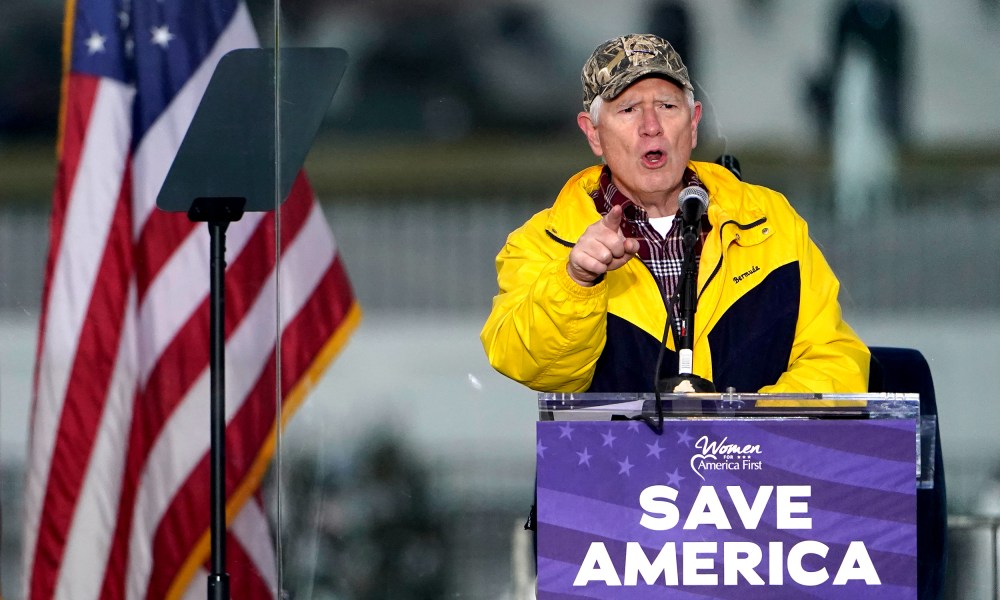
This week the Department of Justice let Rep. Mo Brooks, R-Ala., know it is not going to be his wingman. At least, not in the context of defending him against California Democratic Rep. Eric Swalwell’s lawsuit.
Swalwell alleges that Brooks should be held liable for inciting the insurrection in the Capitol. But the DOJ’s decision means Brooks is likely to be left defending himself against Swalwell’s allegations. It also means former President Donald Trump, who is also named as a defendant in the suit, could face the same fate. So much for having the DOJ as Trump’s ride or die.
The DOJ’s decision means Brooks is likely to be left defending himself against Swalwell’s allegations.
The DOJ’s decision not to step in has implications beyond Brooks and Trump, however. It also could impact when and how future presidents and members of Congress can be sued.
First, the details of Swalwell’s suit, which he filed against Brooks, Trump, Donald Trump Jr. and Rudy Giuliani. Brooks, as we may remember, gave a speech on Jan. 6 in which he exclaimed, “Today is the day American patriots start taking down names and kicking ass!” He also told Slate he wore body armor because he was told there might be violence. Nevertheless, Brooks wanted the charges against him to be dismissed, citing the 1988 Federal Employees Liability and Tort Compensation Act (aka the Westfall Act).
On its basic level, the Westfall Act provides that if federal employees are sued for torts (acts that can lead to civil liability) committed within the scope of their employment, then the employee is dismissed from the case and the federal government steps in and acts as the defendant. In that case, the suit would also be transferred to federal court because the plaintiff is now suing the federal government under the Federal Tort Claims Act. This protection makes sense for federal employees who might otherwise face crushing legal bills to defend against lawsuits that are filed just because those employees are doing their jobs.

For the Westfall Act to apply, the first question is whether a person is considered to be a federal employee, and the second is whether an act is performed in the scope of her employment. The attorney general makes this determination, but if the decision is challenged in court, a federal judge will weigh in.
This two-step dance can lead to confusion. A legislative solution is in order.
Despite Brooks’ assertion that Westfall Act protection should apply to him, the DOJ concluded that Brooks was not acting in the scope of his employment when he helped whip up an angry crowd on at the Ellipse. Instead, the DOJ described the rally as akin to a campaign rally. The DOJ pointed out that if the allegations against Brooks are shown to be true, they “plainly fall outside the scope of employment for an officer or employee of the United States: conspiring to prevent the lawful certification of the 2020 election and to injure Members Congress and inciting the riot at the Capitol.”
Brooks can still request that a federal court determine that he was acting within the scope of his employment, however.

The DOJ unmistakably signaled that Trump similarly will not be protected: “Inciting or conspiring to foment a violent attack on the United States Congress is not within the scope of employment of a Representative — or any federal employee — and thus is not the sort of conduct for which the United States is properly substituted as a defendant under the Westfall Act.”


Every jurisdiction has laws on the books that determine when an employee is acting within the scope of her employment, in part because this determines when employers can be on the hook for actions taken by their employees. But Congress needs to provide more guidance about when the president and members of Congress can be sued. Relying on the DOJ and individual judges has led to arguably inconsistent conclusions.
For instance, journalist E. Jean Carroll sued Trump for defamation back in 2019. Carroll alleged that when Trump denied that he sexually assaulted her, he was lying and the lies amounted to defamatory statements. While Trump was still in office, Attorney General William Barr’s DOJ argued that Trump should be dismissed from the suit and the DOJ should be able to stand in as the defendant in the case. Because the federal government cannot be sued for defamation, this argument, if successful, would end the case.
A federal judge rejected the DOJ’s argument, however, with the judge concluding that Trump, as president, should not be considered a federal employee within the meaning of the Westfall Act and that Trump’s denials were not within the scope of his employment. Shortly after that decision, Trump lost the election, but in a move that was surprising and disappointing to some, Attorney General Merrick Garland carried on with this approach and asserted that it should be able to stand in for Trump. The DOJ has continued to argue that Trump’s denials of sexual assault allegations were statements made in the scope of his employment.
It is hard to square the DOJ’s approach to these two different cases. On the one hand, we have the DOJ’s conclusion that a president’s denial of allegations of a long-ago sexual assault fall within the scope of employment. (Admittedly there is some case law regarding a member of Congress facing a defamation claim to support this conclusion.) On the other hand, we have the DOJ’s decision that Brooks, speaking at a political rally about the certification of a presidential election, is not within the scope of employment.
What is the solution? The DOJ made what looks like a bad call in the Carroll case and the right decision in the Swalwell suit.
What is the solution? The DOJ made what looks like a bad call in the Carroll case and the right decision in the Swalwell suit. This is a problem for a host of practical reasons, including whether and how these cases can proceed.
The Supreme Court knows who should answer this question. After a 1988 decision about the scope of a federal employee’s immunity from state civil suits, the U.S. Supreme Court explicitly told Congress to provide some legislative guidance. As a result, lawmakers passed the Westfall Act.
Now it is the moment to clarify that act to provide more consistent guidance. In particular, Congress can provide counsel regarding when the president is considered a federal employee and under what circumstances the president and members of Congress should be viewed as acting within the scope of their employment as elected representatives.

Jessica Levinson is a Loyola Law School professor and MS NOW columnist.