




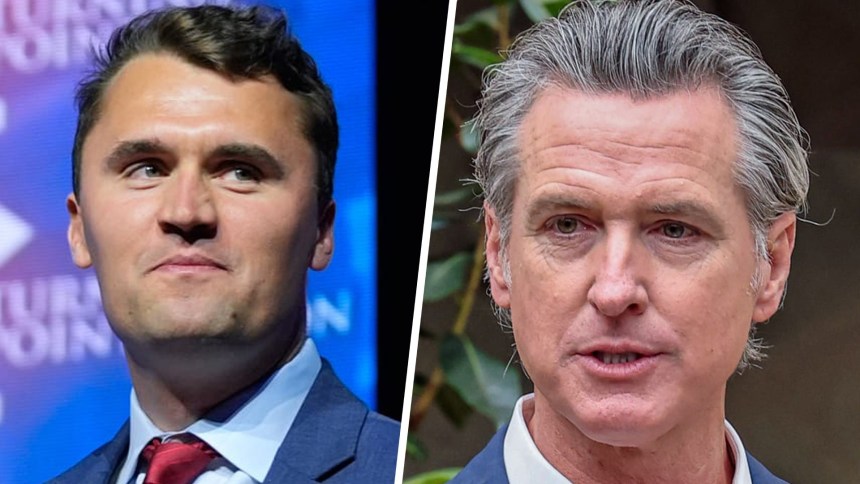
During an interview last week at the Dealbook Summit, California Gov. Gavin Newsom, a likely Democratic candidate for president in 2028, said Democrats need to be “more culturally normal” and “a little less judgmental” if the party is to win future elections.
Newsom did not expound on what “culturally normal” means, but his comments were not made in a vacuum. They come in the context of a debate that straddles the political spectrum but has been most visible with moderate Democrats such as Newsom preaching “cultural moderation” to parts of the progressive left whom they believe focus too much on so-called identity politics.
In recent months, the issue at the center of the cultural moderation debates has been transgender people’s rights.
When pressed for examples in the past, people who hold the position that Democrats should be more culturally normal have singled out movements such as “Defund the police” because that phrase had very little support, even in Black communities. But in recent months, the issue at the center of the cultural moderation debates has been transgender people’s rights to education, public accommodations, parental rights and, increasingly, medical care.
Newsom, in a March episode of his podcast “This Is Gavin Newsom,” said that “it’s deeply unfair” for trans girls and women to compete in women’s sports. He appears to be of the view, according to some of his critics, that if most Americans object to the idea of trans rights, then Democrats should be OK with letting those rights be contracted or denied all together. The rebuttal is that abandoning a marginalized population will make it hard, if not impossible, for Democrats to win.
The conflict is an offshoot of the absurd debate between people whose approach to politics focuses on class and those who focus more on so-called identity issues, including race, gender, ethnicity and sexual orientation. I call the debate absurd because nobody lives in neat silos and we all contain multiple blended identities at once. I hold the position that all politics is identity politics, that class is an identity that shapes and is shaped by other identities like race and gender, and all of these identities profoundly affect how one navigates the economy. For example, the cost of eggs is harder to afford if you can’t get a job because you are transgender, have a disability, are a single parent or are the wrong skin color.


On the one hand, Newsom’s appeal to cultural normality can be understood as a dispassionate calculus inherent to politics. Ezra Klein said in an interview with the New Yorker Magazine Radio Hour that “Politics is about building coalitions capable of winning power and making the decisions you need to do to do that.”
Klein is right. Political coalitions are about winning elections to get, use and keep power, and voters, as a rule, do not support parties when they oppose that party’s positions. If people don’t vote for you, you lose. And when you’re out of power, you can’t do anything including protecting civil rights.
On the other hand, the previously mentioned rule about voters very much applies to concerns about protecting their civil rights. I have long argued that civil rights should be thought of as a chain as strong as its weakest link. So when the dispassionate political calculus involved in building coalitions is at play, we have to ask: If a politician is willing to deny a group’s civil rights when the national mood makes such support politically inconvenient, why should any community that has ever been out of favor feel secure in their own civil rights?
There’s also the problem of offending those people who aren’t “culturally normal.” What is Newsom’s pitch, say, to people who refuse to be part of their coalitions, either because they’re being marginalized or because they’re standing in solidarity with those who are? I’m not a political consultant, but I doubt that asking marginalized groups to sacrifice their civil rights in a spirit of “normalcy” will engender trust or a desire to join that coalition.
As we head into 2026 and draw closer to the cultural flashpoint that will be the midterm elections and the beginning of the march toward the 2028 primary season, the discourse around cultural moderation will only increase. As Democrats run for Congress and jockey for position in the 2028 Democratic presidential primary, Newsom’s comments serve as a preview of a debate we’ll hear more of: Is it better for Democrats to vow to protect everybody’s rights and risk being accused of being outside the norm or sacrifice some people’s civil rights in hopes of winning the swing states?

Nicholas Mitchell
Nicholas Mitchell is an assistant professor of curriculum studies at the University of Kansas. He is a curriculum theorist whose scholarship focuses on the intersection of education theory, policy and practice. He is the author of "On Bigotry" by Bloomsbury Publishing.