





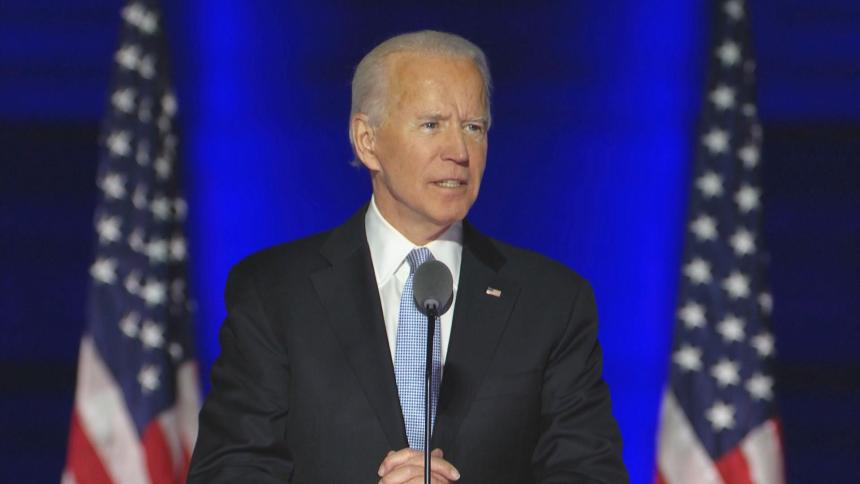
In his speech on Saturday night, President-elect Joe Biden exhorted us to “let the grim era of demonization in America begin to end here and now.” As a premise, Biden added, “I pledge to be a president who seeks not to divide, but to unify.”
Trust and credibility must be established before anyone can agree to take the giant step toward seeing the validity of the other side.
For those lofty goals to become reality, they will have to move from the abstract to the personal. That means each of us must figure out how to overcome four years of a kind of “cold war” that’s played out among Americans.
Many of us have been so focused on the election outcome that we’ve neglected putting as much thought into the election aftermath. I’m not referring to preparing for the possibility of violence, or a president who refuses to leave, or endless court battles over mail-in ballots. There’s been plenty of talk about those worst-case scenarios. The topic of this column is considered by some to be even more unpleasant than those potentialities: I’m talking about how to approach a post-election dialogue with the other side. Whether we need to simply survive a Thanksgiving dinner discussion or contemplate how our country survives and thrives beyond our present polarization, we’re going to have to talk to one another again for the good of our families, and the security of our communities and our nation — no matter who won the election.

A career spent working and leading counterintelligence operations, and ultimately becoming the nation’s top spy catcher, taught me a few things about how to recruit a staunch adversary. I’m sharing these insights with you because, as we say in the intelligence community when determining someone’s need for sensitive access, you have a “need to know.”
From national security and safety, to intra-family relationships to church congregations, we’ve been torn asunder by persistent and pervasive polarization. While the FBI director tells us that the top violent domestic threat is from white nationalist extremist groups espousing white supremacy, the attorney general claims antifa and Black Lives Matter represent a “highly organized” and “new form of guerrilla warfare.”
From national security and safety, to intra-family relationships, to church congregations, we’ve been torn asunder by persistent and pervasive polarization.
The issues that divide us are deep and not likely to vanish now that we’ve elected Biden as the next president. In fact, manifestations of this great divide may multiply after the election as the losing side perceives that hope is lost, the process has failed them, and matters need to be taken into their own hands.
“Unfortunately, I don’t think national healing is as easy as changing the president,” said Jaime Saal, a psychotherapist at the Rochester Center for Behavioral Medicine in Rochester Hills, Michigan. That’s why we need to start thinking now about how we de-escalate after a painfully close election by engaging people in discussions we previously saw little value in attempting.
In the counterintelligence world, unlike the criminal enforcement arena, indictment or conviction is not always the prime objective; not even close. In fact, when it comes to neutralizing a foreign intelligence officer, something called “recruitment-in-place” (RIP) is the paramount goal and could even become the pinnacle of a successful counterspy’s career.
These endeavors frequently fail — but when one works, it is a beautiful thing. Any recruitment of a foreign intelligence officer is a clear win for team America. It means that we cultivate a relationship with someone who has spent their entire lives believing we are an evil enemy intent on destroying them, and we convince them to see our side of things for whatever reasons motivate them.
Some recruitments result in defection or a brief term of cooperation. Defectors eventually exhaust their capacity to share actionable intelligence — they run out of ways to help us because they’ve walked away from their side. That’s great, but it’s not the ultimate scenario. A successful RIP takes this one giant step further, because a RIP agrees to remain in his or her current role while continuing to reap the benefits of working with us.
A truly healthy two-party system must have adherents who maintain their respective ideologies but who also can understand the other side.
I’m not suggesting that a Republican is supposed to defect from their party nor that a Democrat should abandon their positions. In fact, I’m proposing that a truly healthy two-party system must have adherents who maintain their respective ideologies but who also can understand the other side, and dare I say, even communicate in mutually beneficial ways. If a counterintelligence agent can persuade a nemesis to betray his motherland, then surely Americans can figure out how to get one another to at least see their side of things. So how do the intelligence professionals engage their recruitment targets? And, what would this look like when applied on a personal level to our political differences? Here are three of the core components:


1. Most people are not purely evil
I know this is a tough one, but it’s true. Even when counterintelligence officers go up against a spy from an adversarial nation whose goal is to undermine everything we stand for, we remind ourselves that this one person can’t possibly love absolutely everything about their leader, their peer group, or the agency for which they work. They may have kids, pets, hobbies, a favorite ice cream, movie or book — just like we do. They go through tough times, wrestle with personal demons, fall in love, lose loved ones, get sick, and hate traffic jams just like anyone else. This doesn’t mean their president, prime minister or king isn’t a cruel tyrannical dictator; or that their government isn’t hellbent on destroying us. Nor does it mean that these people don’t have dangerous ideas. It just means that until Democrats stop seeing Republicans, and Republicans cease seeing Democrats, as evil incarnate, we’re never going to hear one another let alone speak with one another.
2. People must be met where they are
If “all politics is local,” then all intelligence recruitments are personal. A counterintelligence professional isn’t just asking their target to work for America; in a very real sense they’re asking the person to work for them. That means trust and credibility must be established before anyone can agree to take the giant step toward seeing the validity of the other side. That kind of trust comes first from listening, then from identifying the other guy’s needs, desires and fears. In many cases, this may mean taking baby steps toward simply letting them know that you’re there and you’re available. This works in the spy game, and it can work in countering our personal political divides.
3. Humans are naturally attracted to the same universal concepts
The notions of fairness, dignity and respect transcend cultures and nations. The challenge is to present the features of your ideology in a way that highlights those innately appealing to your components. Convincing a Communist Party member that America offers the greatest chance for everyone to reach their potential might be easily demonstrated by the fact that a Black man raised by a single mother became our president. Maybe Republicans can assert that President Donald Trump finally injected fairness into a previously imbalanced trade relationship with China. Perhaps Democrats might state that the policies of President Barack Obama brought dignity to the LGBTQ community. When it comes to dialoguing with whoever we think is on the “dark side,” the universal concepts behind the issues are important.
I hold no false illusions. The fissures in our families, our communities and our nation are deep and painful. But I’m betting on the belief that our democracy, and our people, are bigger and better than that which divides us. Spy catchers know that our nation is bigger and better than any adversary — we just need to help the person from the other side see that for themself.
