




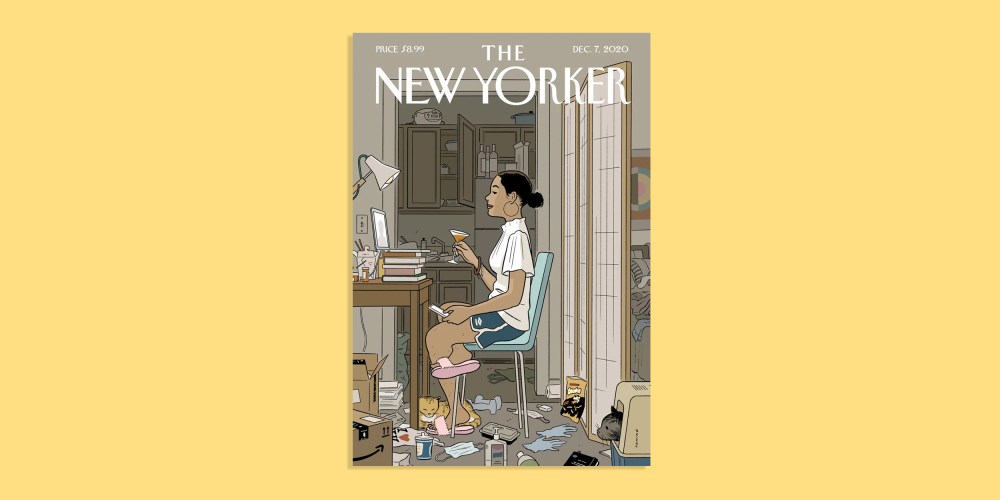
It’s not uncommon for a New Yorker cover to be seen by millions, but it’s somewhat uncommon for so many to feel seen by it.
But that’s what happened with the magazine’s Dec. 7 issue. Created by artist Adrian Tomine and titled “Love Life,” the cover illustration shows a young woman on what looks like a video conference call, holding her phone in one hand, a cocktail in the other. She’s dressed in an office-appropriate blouse on top, a pair of slouchy athletic shorts on the bottom. Her legs are unshaven.
When we feel lonely, we tend to believe everyone else feels connected. When we feel sad, we tend to think everyone else is happy.
Outside the shot, she is surrounded by a very specific pandemic-full mess; we see an empty bag of Cheetos next to some surgical gloves strewn on the floor, a few unopened Amazon packages, a sink fully of dirty dishes, stuff crammed into a one-bedroom apartment.
The illustration hit home for a lot of people. In fact, when Iasked people to tag themselves as different objects in the illustration on social media, I didn’t expect the pace or fury of responses.
tag yourself i’m the prescription pills
— Liz Plank (@feministabulous) December 1, 2020
next to the takeout
cover art by: adrian tomine pic.twitter.com/u9uR0HJpUC
The replies were immediate:
I’m the hairy legs.
— Rachel Tan (@EyeBleachNeeded) December 1, 2020
While every tweet was different, they were all shouting the same thing: It feels good to know that the unique thing I’m feeling is felt by others, too. Tomine’s cover validates our experiences.
I’m the chopsticks sticking out of the takeout.
— Vashti Vale (@VashtiVale42) December 1, 2020
While we all know rationally that these are some of the darkest times in recent history, our brains tend to individualize our suffering. When we feel lonely, we tend to believe everyone else feels connected. When we feel sad, we tend to think everyone else is happy.
I’m the roll of paper towels lodged between the wall and room divider who’s given up all hope of being useful.
— lucy jones (@ljonesie) December 1, 2020
People with chronic depression can often feel like they are faulty and that their experience or helplessness and their lack of motivation is not shared by other people — even though of course that’s a fallacy.
I am seen.
— Akilah Hughes (@AkilahObviously) December 1, 2020
This human tendency explains why peer-led self-help support groups like Alcoholics Anonymous can be so effective. Simply being surrounded by other people who face the same obstacles and express similar emotions has been shown to help those living with addiction or mental illness develop greater self-esteem, feel more connected to others and ultimately achieve a state of recovery.
The illustration didn’t just validate our dispiriting experience, it helped us stop over-personalizing it.
While the New Yorker cover thread wasn’t exactly an organized support group, the online commentary unintentionally became one. For a moment, everyone who thought they were alone in the dark turned on the light and realized the room was packed with thousands of other people who felt the same. The illustration didn’t just validate our dispiriting experience, it also helped us stop over-personalizing it. It felt good to be seen, but what felt even better was to know that everyone else did, too.
The illustration also pointed out a unique problem: In addition to the mess created by the pandemic, trying to hide it creates a whole other, and potentially even bigger, quandary.
We have inadvertently developed a false Zoom self that we present to co-workers, potential dating partners or even family and friends. This false Zoom self looks nothing like the inner — and frankly, outer — experience. It’s easy to project perfection in a 13-inch digital screen that looks nothing like the lives we are actually leading.


The false self is not a new concept. It was developed by renowned psychoanalyst and psychiatrist Donald Winnicott as a fabricated version of the self that children create to avoid experiencing trauma and chronic chaos or unpredictability in the world around them.
Sound familiar? This pandemic has heightened our impulse to hide from others and to craft a variation of ourselves that feels as sanitized as our hands the minute we walk out of the grocery store. But of course, while we think this will make us more acceptable, it further disconnects us from the very people we want to feel close to.
This summer, I often wished for a mental illness filter that could hide my high-functioning depression. Turns out Zoom hasn’t figured that one out yet.
By chronically presenting a false Zoom self, you may start to believe that your real self in fact warrants hiding. You may even start to identify with your created self. It’s like we’ve all been in a major car accident, but instead of stopping and caring for our injuries, we never hit the breaks and just kept belting out show tunes with the windows rolled down, creating a chain reaction of subsequent unnecessary accidents.
In her book “Trick Mirror,” author Jia Tolentino writes, “I have felt so many times that the choice of this era is to be destroyed or to morally compromise ourselves in order to be functional — to be wrecked, or to be functional for reasons that contribute to the wreck.”
The New Yorker cover didn’t just show someone struggling, it showed someone struggling to pretend like they weren’t. It’s easy to adjust the height of the computer to hide the extra weight we’ve put on in quarantine or brighten the ring light to conceal our insomnia- or night-terror-induced dark under-eye circles. This summer, I often wished for a mental illness filter that could hide my high-functioning depression. Turns out Zoom hasn’t figured that one out yet.
Finally, what struck me about the cover is how we’re all basically living in our own filth. It showed us that we are cleaning up for others, but not always for ourselves. The priority isn’t taking care of oneself, but taking care of others’ perceptions of us. It’s a classic modern American story of deceit and self-preservation. It’s keeping up with the Joneses, global pandemic edition.
But what if we don’t have the luxury of presenting a false Zoom self? A few weeks ago, I spoke to an elementary school arts teacher who worked in a low-income neighborhood outside Los Angeles and she told me that the kids whose cameras were off or on mute were always the ones that tended to be in the most precarious and difficult living situations. She learned to stop asking them to put their cameras or mics on when she realized that when they did, the screaming and chaos around them was the reason they weren’t participating like the other children.
Unlike grown-ups, these kids don’t have the ability to fake serenity. And even for adults, especially those living in violent homes, with no escape from skyrocketing rates of domestic violence or sexual abuse, there’s no ring light bright enough to hide their intolerable physical and psychological suffering.
The upside is that 2020 will leave us with some undeniable truths to hold on to. Family or community really is the most important thing. Leggings most definitely are pants. And we should be kinder to each other because we have no idea what someone’s Zoom background is hiding.

Liz Plank
Liz Plank is an award-winning journalist and author, was the host of "Positive Spin." Her book, "For the Love of Men: A New Vision for Mindful Masculinity," was published in 2019.