




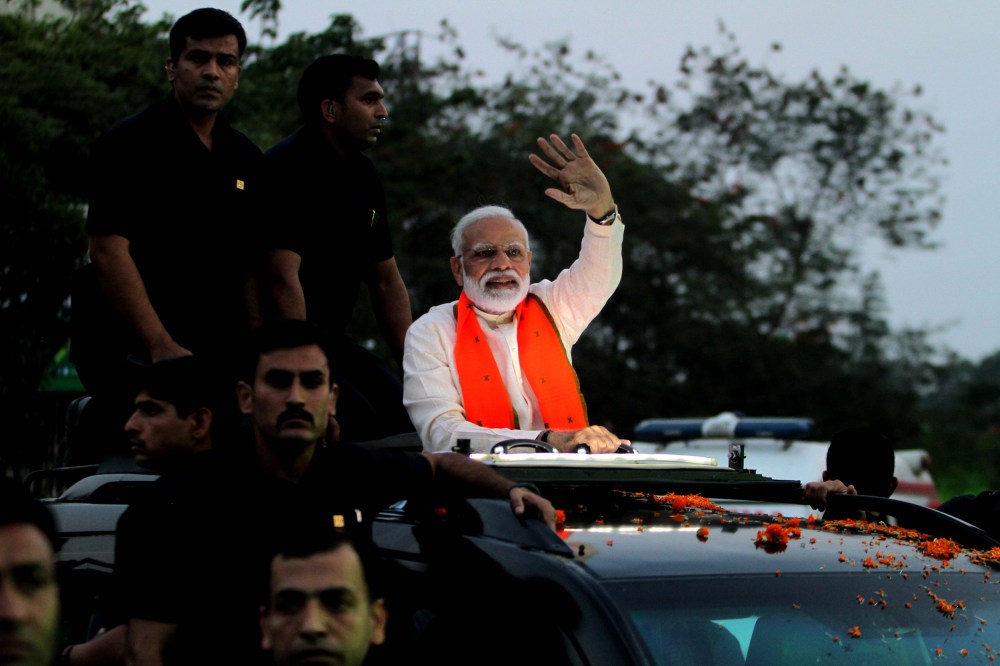
India’s Covid-19 surge is horrifying in its scale and intensity. A new variant of the disease has ripped through the second-most populous country on Earth, leaving crematoriums unable to keep pace. On Saturday, the daily new case count rose above 400,000 for the first time. And Prime Minister Narendra Modi, head of the Hindu nationalist Bharatiya Janata Party, or BJP, is finding that the popularity that propelled him to a landslide victory just two years ago is withering as the crisis worsens.
A new variant of the disease has ripped through the second-most populous country on Earth.
Strongmen, populists and nationalists stubbornly refused to move quickly against the coronavirus during the first wave of the pandemic a year ago, even as their people succumbed to the virus and death tolls mounted. In response, they did whatever it took to survive politically, denying the pandemic’s severity or finding scapegoats.
It was disheartening to me when, as 2020 ended, it looked like the failures of nationalists to contain Covid-19 in countries like India, Brazil and the United Kingdom would be met with shrugs from their voters. Yes, President Donald Trump lost his re-election campaign here in the U.S. — but he seemed to be an outlier at the time. Modi, Jair Bolsonaro of Brazil and British Prime Minister Boris Johnson, their parties or both maintained at minimum a plurality of support.

But as second waves have hit these countries, with new strains cropping up in each, it looks like these leaders’ Teflon coating may finally be too chipped to remain effective. It’s too early to say which — if any — of them will follow Trump out of power. But the fact that they’re all struggling much harder this time to find others to blame has me thinking that the former president may have been a bellwether.
Much like Trump did last year, Modi ignored scientists’ pleas in favor of holding massive rallies as voting in local elections began in late March, just as the new surge was beginning. “Everywhere I look, as far as I can see, there are crowds,” he approvingly told the thousands who gathered in West Bengal, his party’s primary target for a big win.
Much like Trump did last year, Modi ignored scientists’ pleas in favor of holding massive rallies.
If that wasn’t Trumpian enough a comparison, his government was insisting as recently as a few weeks ago that the crisis was nearly over and betting on a vaccination campaign to prevent having to deal with politically unpopular mitigation methods. It was that thinking that kept Modi from canceling a religious festival that drew millions of people to the banks of the Ganges River and potentially alienating his party’s Hindu nationalist base.
Modi has maintained his popularity outside that base by providing essential services to historically overlooked areas, strategically fostering a sense of empathy and connection with voters and always giving the impression that even when he makes mistakes, he is trying his best. But the crisis has blunted Modi’s effectiveness in all of these areas. He has offered no national condolences for the people dying every day in the second wave. And the results announced Sunday, the ones Modi risked his country’s health to achieve, had to have been a disappointment — while the BJP logged an admirable performance, the local ruling party still managed to hold off Modi’s onslaught in West Bengal.


Looking out from India, we see more of the same from Modi’s fellow nationalists. In Brazil, Bolsonaro spent most of last year blithely riding out the second-highest coronavirus death toll in the world. Last week, though, Brazil passed 400,000 Covid-19 deaths, with more Brazilians dying of Covid-19 this year than in all of the last. His approval rating plummeted from 41.2 percent in October to 32.9 percent in February, and it could drop further as the country’s Senate begins investigating his handling of the pandemic. Both of the likely left-wing candidates in next year’s presidential election are polling ahead of him in a potential runoff.
Johnson isn’t faring much better in the U.K. He is dealing with allegations that he told aides last year that seeing the “bodies pile high in their thousands” would be better than issuing a third national lockdown. He denies that he ever said it, but in the aftermath, the Conservative Party has taken a sizable hit in the polls. Not great timing, as several local elections Thursday will show how much the scandal has hurt the Tories.
The question isn’t whether the mismanagement of Covid-19 will damage these leaders. It’s how lasting the impact will be.
The question isn’t whether the mismanagement of Covid-19 will damage these leaders. It’s how lasting the impact will be — and whether they bring their parties down with them. So far in the U.S., even after Trump’s loss and semi-exile to Florida, rank-and-file Republicans have yet to reject his approach to the crisis. The GOP also still holds regional power in large swatches of the U.S. The Tories in the U.K. are likewise still outperforming Labour in polling ahead of the next parliamentary elections.
It’s possible that with the benefit of time Modi and the BJP will manage to do the same — he is likely not to have to run for re-election until 2024.
But today, right now, his politicking as his country struggles for breath has led to the worst of both worlds for India and the BJP alike. It’s hard to see how India’s voters can forget this national tragedy and Modi’s role in exacerbating it any time soon.

Hayes Brown is a writer and editor for MS NOW. He focuses on politics and policymaking at the federal level, including Congress and the White House.