




“Are you really allowed to say that?” I frequently get asked a version of this question from my law students when I teach privacy law.
The important question here isn’t whether something terrible happened to Hill.
And typically, I offer some iteration of this: “While we certainly feel sympathy for the person whose private life has been revealed to the public, we live in a society in which we are often more concerned about protecting the press’ right to share and the public’s right to know.”
This explanation can leave my students feeling understandably dissatisfied. During our semester, we talk about plenty of people whose intimate details are shared with the public and whose lives have been forever changed as a result. These are often people who will face embarrassment, humiliation and potentially even being ostracized from family, friends and colleagues — and yet may have no recourse under the law.
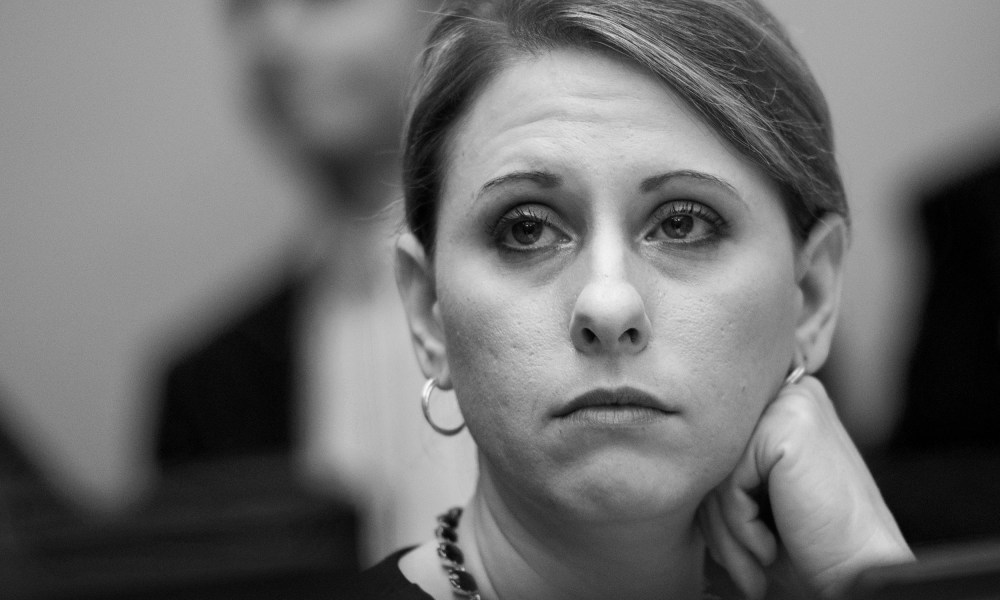
One of those people is likely to be former congresswoman Katie Hill, a Democrat who was largely viewed as a rising star in California politics. But her rise to power and hard-fought election win had nothing on her spectacular fall and resignation from Congress. She resigned after intimate photographs of her were published online without her consent, including one image of Hill nude brushing the hair of a paid female campaign staffer, and another of Hill holding a bong.

The important question here isn’t whether something terrible happened to Hill. If the allegations she made against her ex-husband in a complaint are true, Hill was subjected to years of abuse. There is no excuse for the grotesque behavior alleged here. But the legal question is whether California law gives Hill recourse for the distribution of these images. And the answer to that is nearly certainly “no.”
The legal question is whether California law gives Hill recourse for the distribution of these images. And the answer to that is nearly certainly “no.”
Jennifer Van Laar, a former Republican political strategist and journalist, published those images of Hill on the conservative website Red State, and shared those images with the British media outlet the Daily Mail. Van Laar said she got the images from a third party, not from Hill’s ex-husband, Kenneth Heslep.
Van Laar has argued that prior to the distribution of the images, she did not have any contact with Heslep or Joseph Messina, a conservative radio show host, which could potentially undercut Hill’s claim that there was a conspiracy to distribute the images.
Now, Hill has sued Heslep, Red State, the Daily Mail, Van Laar and Messina for, among other things, distributing intimate images of her without her consent. (I’ll keep this column fairly family friendly and leave for another day whether these images really qualify as intimate under California’s law, something subject to dispute in the case.)
The short version of the law is that it allows individuals to sue someone who intentionally distributes images or recordings of them that include intimate body parts or show them engaged in sexual behavior under circumstances in which they had a reasonable expectation that the image or recording would remain private.
It may be that many voters have absolutely no problem with Hill’s behavior. But that is not the legal test.
However, there are two specific defenses to liability in the law that may be fatal to Hill’s case, and this is likely why a Los Angeles judge may be on the brink of dismissing many of Hill’s causes of action.
First, there is a specific defense for material that “constitutes a matter of public concern.” This defense is required under the First Amendment. Otherwise, by definition, we would penalize people for distributing material that is of public concern. In this case, the articles concerned Hill’s alleged affair with a campaign staffer and the use of marijuana, which is still illegal under federal law.


At the time the images were taken, Hill was a candidate for federal office. By putting herself and her qualifications for office in the public eye, Hill will have a hard time arguing that the public had no legitimate interest in seeing these images.
Now, it may be that many voters have absolutely no problem with Hill’s behavior. But that is not the legal test.

The former congresswoman has argued that the media outlets could have told their stories a different way — specifically, without the images. It is certainly possible to tell a similar story by using only words. But the First Amendment allows media outlets, whether or not they are biased, to choose how they want to tell their stories. As long as an outlet does not run afoul of other applicable laws, the First Amendment stands as a protection to provide outlets with the room to choose which stories to tell and how to tell them.
The First Amendment allows media outlets, whether or not they are biased, to choose how they want to tell their stories.
Second, there is a defense for material that was “previously distributed by another person.” This means that if person A, let’s call him Angry Andy, takes intimate images of you and distributes them, and person B, let’s call him Belligerent Bob, publishes those same images on his website, only Angry Andy can be liable. Belligerent Bob is in luck, because the images are considered to be previously distributed. In this case, it appears that Heslep is Angry Andy, and the other defendants are more akin to Belligerent Bob.
A problem for Hill then is that her ex-husband, Heslep, is likely the only person who can be held liable under the law. And even that is not a slam dunk.
Hill’s case is important for more than just the parties involved and the salacious tale of one politician’s rise and fall. It shows us the surprisingly limited reach of privacy law. It similarly shows us the vast protection we give to those who distribute intimate images. It shows us that once you become a public figure, particularly a voluntary public figure like Hill, much of what you do may be legally deemed of public interest.
And at its core, this case shows us that more often than not in our society, we worry about censorship more than we worry about privacy rights.

Jessica Levinson is a Loyola Law School professor and MS NOW columnist.