




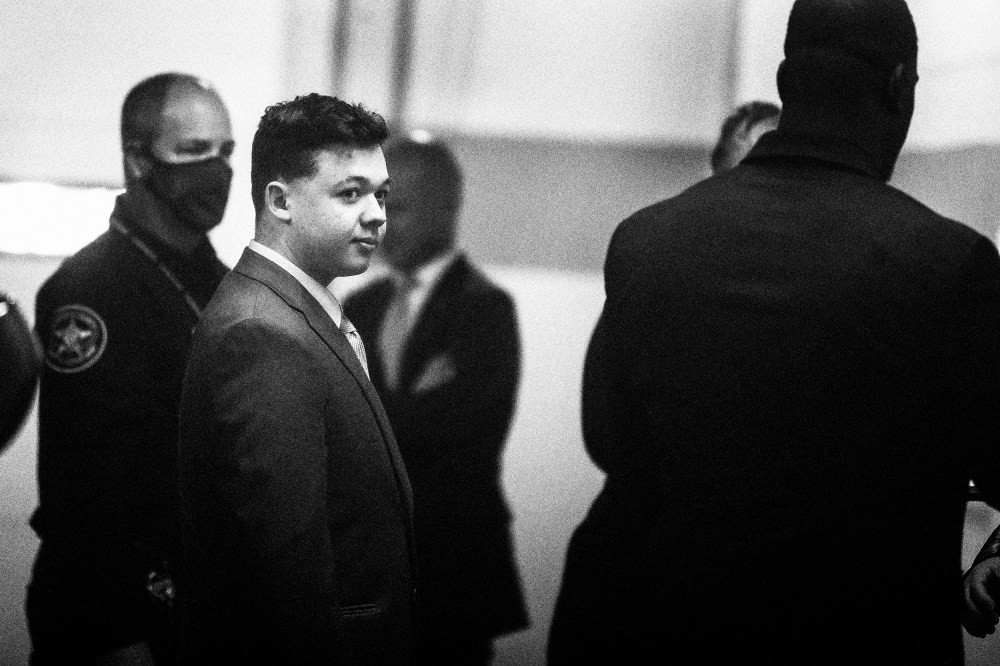
A jury in Kenosha, Wisconsin, has begun hearing evidence that will help them decide whether Kyle Rittenhouse is guilty of reckless or intentional homicide in the shooting of three people during August 2020 racial injustice protests, or if he acted in self-defense.
During the past five years we have seen a significant rise in political violence in the U.S.
What’s really on trial, though, is citizen vigilantism. At a moment when Americans’ willingness to use political violence has already skyrocketed, this trial’s outcome risks legitimizing individual violent action and galvanizing civilians who are unhappy with the direction of the country to take matters into their own hands. This is especially true for the political right, who have embraced Rittenhouse as a patriotic martyr.
During the past five years we have seen a significant rise in political violence in the U.S., driven in large part by support for violence and violent action itself from the right. Nearly 4 in 10 Republicans — compared to an already troubling 3 in 10 Americans overall — say the use of political force is justified if elected leaders won’t protect America. These findings are consistent with other data showing that a majority of Republicans now believe that force may be necessary to save “the traditional American way of life.”
These attitudes are mirrored in actual political violence. The FBI has reported that domestic terrorism investigations have more than doubled since spring 2020, with the greatest threat coming from white supremacists and unlawful militia groups. Much of this violence comes from individuals who self-radicalize online, assemble rather spontaneously into loosely organized groups or mobilize into violence based on concepts including the “boogaloo” (code for a second Civil War) or “three percenters” (which refers to the false claim that it took only 3 percent of the American Colonists to successfully rise up against the British).

The outcomes of such mobilization are serious. Over the past few years, we’ve seen repeated incidents of lethal street violence, armed protests at state capitals and attacks on law enforcement and elected officials. We’ve also seen violent plots organized by paramilitary groups and unlawful militias including the Oathkeepers, street-gang movements such as the Proud Boys and heavily armed, self-radicalized lone actors. Armed “patriot” volunteers assembled at the southern U.S. border in 2018 to “support the Border Patrol,” livestreaming their activities over social media as they threatened migrants.


This is the backdrop to Rittenhouse’s trip to Wisconsin. In August 2020, a Kenosha-based paramilitary group issued online calls for help to protect local businesses from those protesting racial injustice in the wake of a police shooting that left a Black man paralyzed from the waist down. Rittenhouse, then 17, traveled from Illinois armed with an AR-15 style rifle. During the course of the evening, he shot three people, killing two of them.
Rittenhouse became a cause celebre for the right, who rallied around him as a patriotic defender of liberty and a peacekeeper who had been unjustly charged. His image became a meme and a T-shirt icon used to taunt racial injustice protesters with the slogan “F— Around and Find Out.” A legal machinery lept to his defense through the Fight Back foundation, which evolved into a bigger project to support “law-abiding citizens” who want to protect their communities and take the “country back.” Fundraising sites and hashtags urged supporters to “free Kyle” — along with donations and purchases of merchandise and apparel sold by his family — that ultimately raised the $2 million in bail that was posted for his release from jail.
Celebrating citizen vigilantism is dangerous.
Celebrating citizen vigilantism is dangerous. It’s considerably harder to communicate that to the public when legal authorities fail to condemn or prosecute unlawful militia engagement. Worse, in some cases, law enforcement actively support or participate in paramilitary or militias themselves. During the Kenosha protests, local law enforcement officers legitimized vigilantes and unlawful militia presence by thanking them for being there. One well-circulated video showed a police officer in an armored vehicle tossing a water bottle to armed militia members, saying, “We appreciate you guys.”
The good news is that there is tremendous concern about rising vigilante violence, both from policymakers and from experts who are working to educate the public about laws that prohibit such violence. In Wisconsin, for example, state law prohibits paramilitary organizations and forbids civilians from acting like a public officer or from assuming peacekeeping or law enforcement functions. Individuals can defend their own property and selves from harm, but they cannot join forces with others in an organized, unlicensed way and usurp the official role of law enforcement. Earlier this year, in the wake of the killing of Black jogger Ahmaud Arbery, the state of Georgia repealed its citizens’ arrest law — after Gov. Brian Kemp referred to it as “antiquated” and “ripe for abuse” in ways that enabled “sinister, evil motives.” (Three white men are on trial for murder in Arbery’s killing.)
Vigilantism and political violence are serious threats to the stability of our democracy and the safety of our citizens. Encouraging a heavily armed populace to take matters into their own hands is a recipe for disaster. It is critical that we all draw a clear line around the illegality of vigilante violence and unlawful militia activity — and actively challenge those who falsely frame vigilantism as patriotic defense.

Cynthia Miller-Idriss is an author and expert on extremism.