




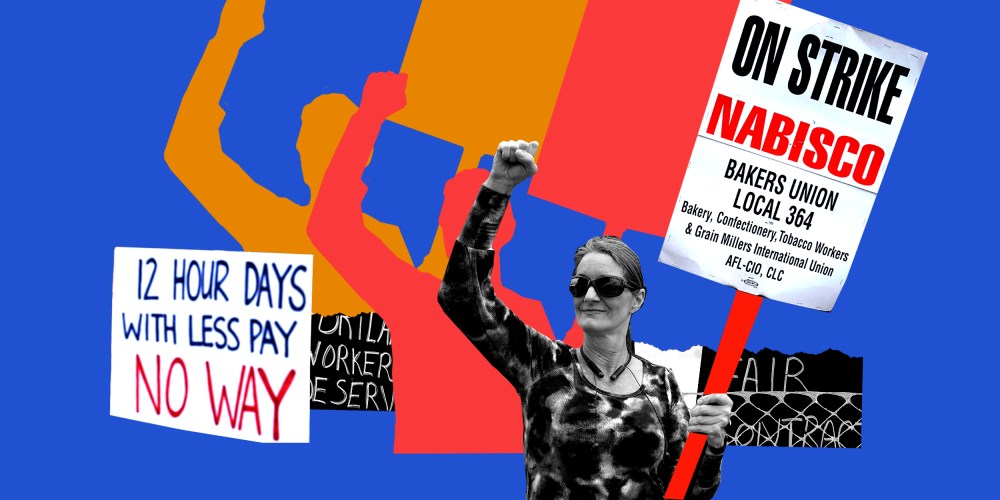
This Labor Day, as you’re setting up the spread for the traditional end-of-summer barbecue and one last trip to the pool, here’s a suggestion: Leave the Oreos on the grocery store shelf.
The same goes for the Chips Ahoy! cookies, Ritz crackers and, uh, whatever Fig Newtons are. Nabisco produces all of these snack-time staples — and in five states, factory workers who actually make them have been on strike since Aug. 10.
That strike began when about 200 unionized workers walked out of a bakery in Portland, Oregon, and it now includes about 1,000 workers employed at bakeries and distribution centers in Colorado, Illinois, Georgia and Virginia. The workers are represented by the Bakery, Confectionery, Tobacco Workers and Grain Millers International Union, the same union that backed a 19-day strike at a Frito-Lay plant in Kansas this summer.
The striking workers say that Mondelez, the company that owns Nabisco, is exploiting them after their contract expired in May:
Union leaders say Nabisco is trying to squeeze more hours out of its staff while paying less overtime, even as some workers are taking 16-hour shifts to help meet a pandemic-fueled surge in snack food sales. They also are raising concerns over two recent factory closures in Georgia and New Jersey, which the union says is part of a broader campaign to move low-wage work to Mexico. And they’re calling on the company to restore their pensions, which were supplanted by a 401(k) plan three years ago.
“A lot of folks were very close to retirement, and were able to do so under the old plan, but when the company pulled out that basically meant that they had to continue working. They were no longer eligible to retire,” Mike Burlingham, vice-president of the local union in Portland, told The Guardian. “It impacted all of us in a way that we can no longer count on this as being a place we can retire comfortably from.”


The proposed 12-hour shifts at certain factory lines call to mind the conditions that initially sparked the labor movement.
These changes are being suggested from management even as the company is performing well financially — Mondelez reported a 12 percent growth in revenue in the last quarter compared to the same time last year. Profits were up, too, thanks in part to “manufacturing productivity,” according to a company press release. And the chairman and CEO of the company, Dirk Van de Put, had a total compensation of $16.8 million last year while staffers were putting in double shifts.
(The company said in an Aug. 16 statement that it tried to negotiate in good faith with the workers, but the union rejected its offers.)
The proposed 12-hour shifts at certain factory lines call to mind the conditions that initially sparked the labor movement. Labor Day itself arose from a one-day strike in New York City in 1882, where thousands of workers marched from City Hall to an uptown park for a picnic. It was made a national holiday in 1894 as part of President Grover Cleveland’s attempt to shore up working-class voters in the midst of a massive railway workers’ strike.
As of Aug. 30, the strike has reportedly slowed down production, as three of the company’s four bakeries are taking part in the strike. Mondelez has reportedly been using nonunionized workers to help keep the factories’ production lines flowing. (I’m not saying this means you should picture literal scabs when trying to eat one of the cookies these scabs produced, but … .) That in turn has provoked pro-union supporters to escalate their tactics, including blocking railroad tracks delivering baking supplies with their bodies — an unintended throwback to the protests that pushed Labor Day permanently onto our calendars.
But supermarkets have begun stocking up on Nabisco products to head-off any potential shortage of sugary and carb-filled treats, The Wall Street Journal reported Aug. 26. So, if you’re going to be enjoying the day set aside to recognize the labor movement in America, the least you can do is not buy Nabisco products to show some solidarity with the union members demanding better working conditions.

Hayes Brown is a writer and editor for MS NOW. He focuses on politics and policymaking at the federal level, including Congress and the White House.