




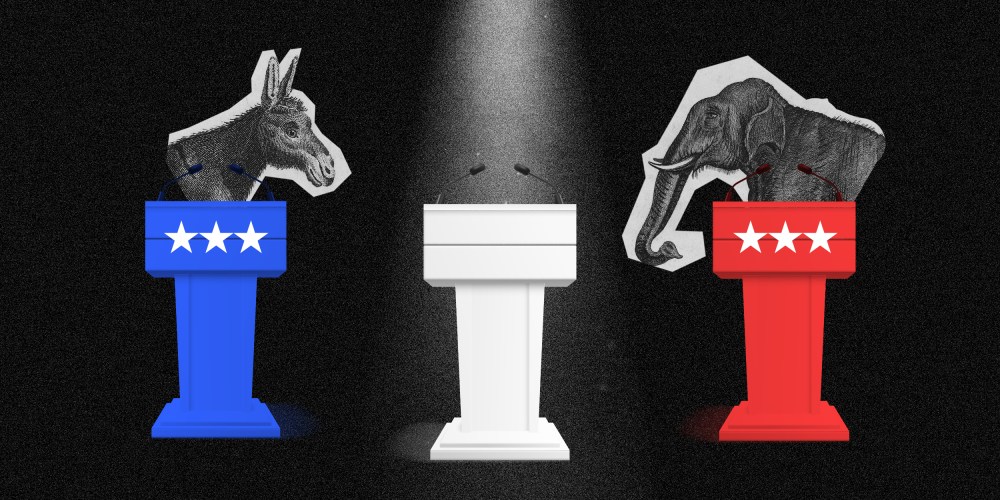
This week, a Gallup Poll revealed that support for a new political party in the United States has reached an all-time high. Nearly two-thirds of Americans — 62 percent — agree that Democrats and Republicans “do such a poor job representing the American people that a third party is needed.”
Last fall, only 40 percent reported to Gallup that they supported a third party; now, 63 percent say they do.
A closer look, though, shows the surge in support for a third party has come largely from the ranks of Republicans. While Democrats and independents have slightly cooled to the idea, Republicans have suddenly embraced it. Last fall, only 40 percent reported to Gallup that they supported a third party; now, 63 percent say they do.
This flirtation with a third party is, in many ways, a ritual of American politics, as the losing side in a presidential contest invariably grumbles about the status quo. (It’s no coincidence that Gallup’s previous high marks on third parties came in the aftermath of presidential races, in 2017 and 2013.)
Republicans have lost control of the White House, the Senate and the House of Representatives over the past four years. The understandable tensions that have stemmed from such losses have been aggravated by former president Donald Trump, who now seems intent on waging a civil war for control of the GOP. Polls show the former president still holds considerable sway over the party’s base, with 59 percent of Republicans naming him as their preferred candidate for the 2024 election and a significant number indicating they’d follow him into a third party if needed.
Meanwhile, the handful of Republicans who’ve broken with the president publicly during his second impeachment have been singled out for censure by their state parties, showing that the Trump divisions run deep. Even Senate Minority Leader Mitch McConnell, who voted to acquit the president, came under fire from Trump this week, in a scathing letter that promised primary challengers for any official who sided with the Kentucky senator.
We need to remember that we already have a third party — as well as a fourth, a fifth, a sixth, and on and on.
But there seems little chance that a GOP “civil war” will spark the rise of a new party on the right. The Republicans who are most vocal about bolting are Trump’s own supporters. As long as he controls the party, he’ll keep them there with him. The minority of Republicans who’ve broken with Trump could break off to form their own conservative party devoid of the Trumpist cult of personality, but the odds of that happening are slim, for several reasons.
For starters, we need to remember that we already have a third party — as well as a fourth, a fifth, a sixth, and on and on. To be sure, the impact of these minor parties is largely negligible. There are dozens of “parties” that are barely more than vanity projects for their leaders and donors.

But even the largest and most successful of these organizations, such as the Libertarian Party or the Green Party, have had little national impact. Neither has won a single race for the House or Senate or a single electoral vote in a presidential contest. (Congressman Justin Amash, repeatedly elected as a Republican, briefly became a Libertarian at the end of his last term.)
The poor performance of these minor parties is the result of the American political system’s bias to the two major parties. The authors of the Constitution loathed the idea of political factions and actively warned against them, but the system they created encouraged the rise of large parties and cemented their place in our politics.
The winner-take-all nature of our elections, in which a second-place finish leaves a party or politician with nothing, bears much of the responsibility here. The result has been large parties made up of coalitions of related interests, and those parties in turn bent the system to protect their positions of privilege. Campaign finance laws and qualifying rules for presidential debates, to take just two examples, serve as gatekeepers that prevent smaller parties from breaking through.


The winner-take-all nature of our elections, in which a second-place finish leaves a party or politician with nothing, bears much of the responsibility here.
Presidential races, with their emphasis on individual candidates, have offered an occasional window for a “third party” to make a mark. In 1912, former Republican president Teddy Roosevelt ran as the candidate of the Progressive Party. Taking in 27 percent of the popular vote and 88 electoral votes, Roosevelt forced the incumbent Republican William Howard Taft into a humiliating third-place finish. In 1968, Governor George Wallace, an Alabama Democrat, ran a strong campaign through the American Independent Party, winning 13 percent of the popular vote and 46 electoral votes. If Wallace had won just 1 percent more of the vote in two states, he would have thrown the presidential race to the House of Representatives.
But those impactful races are the exceptions, not the rule. Thanks to the Electoral College, most third-party efforts amount to nothing, even when the campaigns have significant popular support. When the billionaire H. Ross Perot ran as the Reform Party candidate in 1992, for instance, he took in 19 percent of the popular vote, but no electoral votes at all.
Perot did, however, have another kind of impact, one more common for third-party campaigns — placing a new issue into the national conversation. With Perot, it was his concern with the growing national deficit, which he helped make a major political issue in the 1990s and 2000s for Republicans and Democrats alike. But that was it. The major parties carried the issue forward, while the minor party once again faded from view with no legacy of building a party organization at the grassroots and seeing its candidates elected to significant offices.
Given the poor record of third party efforts in the past, there’s little chance that disaffected Republicans try to start from scratch today.
The only real hope for a third party would be if some high-profile officials who are already in office were to switch, all at the same time, to a new party. That would let them bypass the usual barriers that insurgent candidates face in winning elections and would give them an immediate impact as well. It’s unlikely to happen, but if a handful of Republican senators — say, Sens. Mitt Romney, Lisa Murkowski, Susan Collins and Ben Sasse? — were to break away, they would immediately become a key swing block in the Senate, drawing national attention and serving as a beachhead for others to follow in 2022 and beyond.
Barring such a dramatic development, this year’s talk of a new third party will likely fade away, just as most of its predecessors in the modern era have. The disaffected Republicans will be drowned out and displaced, and the GOP will continue to trudge along as the Party of Trump.

Kevin M. Kruse
Kevin M. Kruse is a professor of history at Princeton University. A specialist in modern American political, social and urban/suburban history, he is the author and editor of several books, including "White Flight" (2005), "One Nation Under God" (2015) and "Fault Lines: A History of the United States since 1974" (2019). He grew up in Nashville, Tennessee, and earned his bachelor's degree from the University of North Carolina at Chapel Hill and his master's and doctoral degrees from Cornell University.