




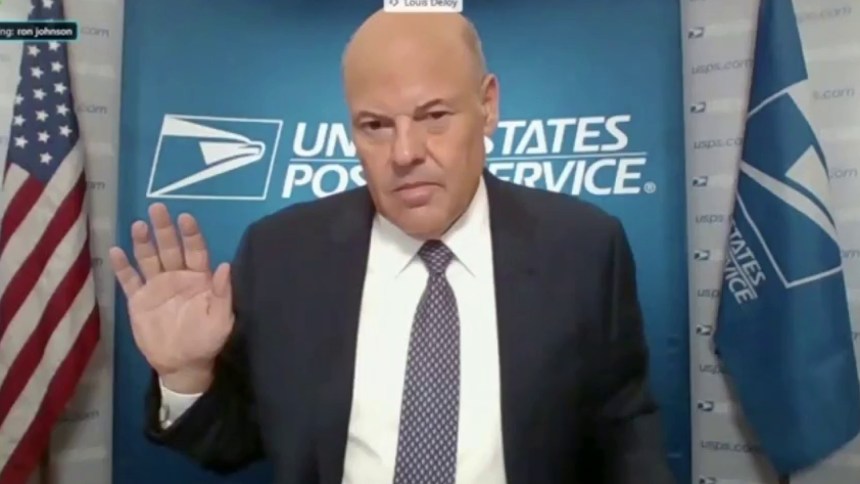
Postmaster General Louis DeJoy is reportedly under FBI investigation over possible campaign finance law violations while at his former business. It’s not a major leap of logic to assume the “campaign fundraising activity” they’re referring to is an alleged straw-donor scheme that funneled questionable cash towards the Republican Party.
These allegations, on top of DeJoy’s manipulation of the U.S. mail during the 2020 election, raise yet another red flag, marking him for what he is: a shady political operative who must be removed from his position of power.
The kind of circuitous contribution tactics he’s accused of don’t happen by accident — they actually serve as evidence of DeJoy’s alleged malfeasance.
FBI agents have in recent weeks “interviewed current and former employees” of DeJoy’s former business, “asking questions about political contributions and company activities,” according to The Washington Post. The report goes on to say DeJoy himself was issued a subpoena for information by federal prosecutors.
Mark Corallo, a DeJoy spokesman, confirmed the FBI investigation to The Washington Post but “insisted DeJoy had not knowingly violated any laws.”
“Mr. DeJoy has learned that the Department of Justice is investigating campaign contributions made by employees who worked for him when he was in the private sector,” Corallo said. “He has always been scrupulous in his adherence to the campaign contribution laws and has never knowingly violated them.”
If we parse Corallo’s words, they’re clearly not a denial that DeJoy engaged in wrongdoing — it’s a claim that he didn’t know that what he was doing was wrong. That’s not a credible defense.

DeJoy is a big-time player in GOP fundraising, having personally contributed over $1.1 million to the joint fundraising machine of former President Donald Trump’s 2016 election campaign and the Republican Party. He knows exactly what he’s doing, and he’s gone to great lengths to do it. The kind of circuitous contribution tactics he’s accused of don’t happen by accident — they actually serve as evidence of DeJoy’s alleged malfeasance.
It wasn’t just his own money that DeJoy provided to the GOP. He became kind of a political ATM for the party, one that could be relied upon to spit out cash without any concern of ever hitting a limit thanks to his employees, The Washington Post reported in 2020:
Five people who worked for DeJoy’s former business, New Breed Logistics, say they were urged by DeJoy’s aides or by the chief executive himself to write checks and attend fundraisers at his 15,000-square-foot gated mansion beside a Greensboro, N.C., country club. … Two other employees familiar with New Breed’s financial and payroll systems said DeJoy would instruct that bonus payments to staffers be boosted to help defray the cost of their contributions.
Although it may not be a crime to encourage your employees to make political donations, reimbursing them for it is a violation of federal campaign finance laws. It’s a practice that enables donors to evade individual contribution limits and mask the actual source of money used to influence elections.
The Washington Post reported that “federal and state campaign finance records found a pattern of extensive donations by New Breed employees to Republican candidates, with the same amount often given by multiple people on the same day. Between 2000 and 2014, 124 individuals who worked for the company together gave more than $1 million to federal and state GOP candidates. Many had not previously made political donations, and have not made any since leaving the company, public records show.”


When the GOP needed DeJoy to deliver — first through large, and lawfully questionable, donations and later as manipulator of the mail — he was the total package.
That kind of operation can’t happen via a coincidence or happenstance; it has to be orchestrated and directed, in this case allegedly by the guy who now runs the U.S. mail.
These allegations are all the more credible when you consider that DeJoy’s role as a political operative didn’t end when Trump appointed him postmaster general — it expanded. DeJoy’s appointment came just months before a presidential election that would see record-setting use of mail-in ballots, especially by Democrats, as the Covid-19 pandemic was peaking.
Yet the United States Postal Service saw its on-time delivery rate of first-class mail fall dramatically as soon as DeJoy took over. DeJoy claimed he was making major moves to save the USPS, but his detractors understandably saw his changes as an attempt to suppress mail-in voting that Trump had already spent weeks trashing.

DeJoy had to announce last August that he was postponing his cost-cutting moves until after the election. The following month, a federal judge in Washington blocked him from implementing them. U.S. District Court Judge Stanley Bastian ruled that DeJoy’s changes were clearly aimed at “voter disenfranchisement, given the increased role USPS will play in this year’s presidential election.”
“It is easy to conclude that the recent Postal Services’ changes is an intentional effort on the part of the current Administration to disrupt and challenge the legitimacy of upcoming local, state, and federal elections,” Bastion found.
During his joyride through the USPS’ standards, the new postmaster general surgically impacted mail service in certain areas of key swing states. “In the postal district for northern Ohio, on-time delivery rates dropped as low as 63.60% in mid-August. In the Detroit postal district, on-time delivery fell to 61.01% the same month,” The Guardian detailed.
The evidence is there. When the GOP needed DeJoy to deliver — first through large, and lawfully questionable, donations and later as manipulator of the mail — he was the total package. Now, the USPS Board of Governors should stamp DeJoy “Return to Sender” — or possibly have him forwarded to a federal courtroom.
