




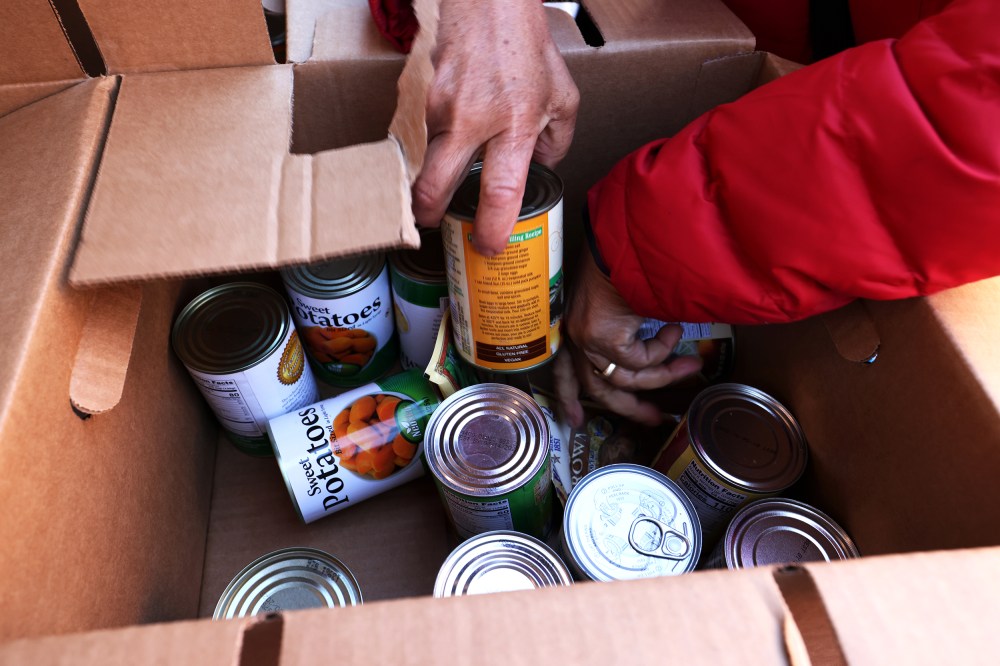
When Syona Arora got laid off at the beginning of the pandemic, she found herself with a lot of free time on her hands. For the first few months, she directed that energy to mutual aid projects in her neighborhood in south Philadelphia — helping match those with needs with those able to fill them. Then her cousin, who lives in Manhattan in New York City, opened a community fridge: literally a refrigerator, located outside, stocked with food for anyone who needs it.
The cavalry of wide scale federal relief is not coming.
The pandemic is starving us; 26 million Americans now report not having enough to eat; 16 percent of households with children report not having enough to eat.
“I thought, oh, that’s really awesome — I wonder if there’s one in Philly I could get involved with,” Arora told me. “I did some research, and there was nothing. And you know, I didn’t have organizing experience. I don’t have a career background in this work. But I thought, I guess I could figure this out?”

She started posting on Instagram, seeing if others would be interested, figuring out the legalities. “It happened pretty organically,” she said. “And every day, I had people asking me what they can do to help support the fridges,” which are both in her neighborhood. It’s filled with produce, with dairy products, with things people actually want and need. It gets wiped down multiple times a day. It’s in better condition than most office fridges.
“It’s really hard to categorize suffering right now.”
“Every day, the fridge empties out. And every day, it fills back up again,” Arora said. “We hold ourselves to a high standard with what goes in the fridge, and we have a high level of respect for each other. I think that’s why we’re able to keep this autonomous project running.”
The south Philly community fridges are just one example of the hundreds of ad hoc projects, initiatives and organizations that are filling the gaps in the social safety net right now. Because the cavalry isn’t coming. That’s what people in precarious financial situations — either dating before or sparked by the spread of the coronavirus — realized months ago.
After an initial infusion of cash, the federal government has failed to pass legislation to relieve the millions of Americans who’ve been economically affected by the pandemic. For many, unemployment benefits are difficult or impossible to access. New work is sporadic and high-risk. Those who’ve been laid off or had their hours reduced are dealing with food scarcity and hunger — many for the first time.

In every corner of the country, there are food banks that have been feeding the hungry for decades. But the calvary of wide scale federal relief is not coming. Even the most organized and well-funded food banks are overwhelmed. The organizations filling the gaps in established aid are often ad hoc, organized from the ground up, and figuring it out as they go — but without them, thousands would be struggling even more than they are right now.
Before the pandemic, 27 percent of the families served were headed by an elderly or disabled person. Now, that number has risen to 44 percent.
In western Montana, Flathead Rez Community Action (FRCA) has been distributing food — no strings attached — for months. Like a lot of coronavirus-inspired organizations, it grew out of a mutual aid group, initially launched to meet the specific individual needs of those out of work or isolated at home. In the early months of the pandemic, it used Facebook and a Google Spreadsheet to try and cover requests from seven different towns spread across the 1,938-square-mile reservation. Now, it has taken over a vacant job corps facility and partnered with community development organizations to transport produce from local farms and ranches and distribute it to hundreds of families in need.
“We don’t ask tribal affiliation. I’d say more than half of the families we serve aren’t tribal. We also don’t ask for income verification,” April Charlo, who co-founded the organizaton, told me. “We want to avoid that feeling of shame where you come into a place and you’re like, ‘I can’t believe I’m here at a food bank,’ and you have to check this box that basically says ‘I’m poor and I can’t provide for my family.’ We tell people just come, tell us where you’re from so we can serve you better, and let us give you food!”

Meera Fickling — another person with no background in organizing or philanthropy, but now one of the leaders of the Rocky Mountain Mutual Aid Network — told me something similar. “We’re really aiming for destigmatization,” she said. “We don’t means test, and we wouldn’t even have the resources to means test even if we wanted to. If you say you need help, then you need help. People aren’t clients. They are simply people who need help at a specific time. Of course, we hope that this goes two ways — if you request help, we welcome people to come and volunteer with us — but we’re working to really change the terminology that’s accompanied aid.” That’s one of things that Arora loves so much about the community fridge: because there’s such a flow of people stocking, servicing and taking from the fridge, you can never make assumptions about what they’re there for. They’re just part of the fridge community.
In rural Iowa, the Southeast Linn Community Center fills in the gaps in social services for children, seniors and low-income families. Before the pandemic, 27 percent of the families it served were headed by an elderly or disabled person. Now, that number has risen to 44 percent. For these households, there’s no option for higher risk residents to order groceries online.
The two small local grocery stories don’t have the capacity to fulfill many orders. Families whose children were on free and reduced lunches are receiving additional food stamp money, but that aid doesn’t extend to seniors on fixed incomes, many of whom are accustomed to browsing for the best deals to stretch their monthly checks. And in many households, any surplus income has been directed to home repairs following the devastating derecho storm that hit the area this summer.
“It’s really hard to categorize suffering right now,” the center’s executive director, Nicole McAlexander, told me. “Everyone is struggling right now. In a rural community, people value the social aspect so much: when you go to the banker, the post office, the kid’s basketball game — there are all these points of connection that tie a small town together and provide its personality. Those interactions are one of the reasons that people like to live in these small towns, and it’s so hard to access right now.”


Seniors need food right now, but they also need that connection. Which is why anyone, even those who weren’t previously receiving meals, can call the center and sign up over the phone. he center shifted from frozen meals to hot ones from local, familiar restaurants. And it has made it so people call in every Monday and actually place an order for their meal, which is then delivered.
“For seniors, routines are so important,” McAlexander said. “We had people who would come in here for coffee in the morning, and then we’d see them again at night for bingo. They’re craving routine, and we’re trying to give it to them.” Seniors now call in on Mondays and make their order — and whoever answers the call tries to spend more time in conversation with the person on the other line. They have volunteers sign up to be phone buddies. “But no matter what we do, it’s going to be so hard,” McAlexander said, “It’s already been such a long haul.”
That’s what the Equitable Giving Circle, based in Portland, Oregon, has been thinking about from the start. Its work isn’t just about Covid-19 need, but creating new ways of thinking about need and support — and repairing relationships that have been broken for years. Every week, the the group sources food from BIPOC — Black, Indigenous, and people of color — to feed between 365 and 450 families. The program started when executive director AJ McCreary attended a Black growers gathering last February, then saw the growing wave of food insecurity brought on by the pandemic. Her response: “Let’s buy CSAs” — community-supported agriculture programs — “from a bunch of Black and brown farmers and give them away.”
In March, the group launched a fundraiser to provide food boxes for 50 families — and raised $30,000 in a week. “Then I said, ‘I wanna double down,’” McCreary recalled. “My whole team responded: ‘This is not how this works. Not with the produce, and not with the money.’ But the need was there, so it had to work.”
Between grants from the city and donations, the group has continued to expand its mission: In addition to high-quality fresh produce, it provides eggs, protein drops sourced from Black-owned butcher shops, and is able to cater to specific dietary restrictions of families in need. “It’s become almost a game of finding the Black owned businesses,” McCreary, who grew up in Portland, told me. “We just have to look a little harder. But it shines a light on how hard it is for any Black, Indigenous or marginalized communities to get the word out — and it’s really exciting to put such large economic deposits in the Black and brown community.”
The group now has eight people on its payroll, all of whom are Black or Indigenous. They’re rolling out plans for rent and mortgage assistance. They’re organizing Black Friday boxes sourced entirely from Black businesses. They’re hoping to feed 1,000 families a week in the Spring. And they’re doing a lot of teaching. “Portland is so white, and it’s such a passive progressive place,” McCreary said. “But I’m excited for all of these things — and putting over $700,000 into the Black and brown economy.”
“I’ve been on the needing end of things,” McCreary continued. “And you don’t run around telling people about needs if they aren’t real. If you’re saying you have this need, it’s because you have a need. Your need for assistance, care, support, life, dignity — it’s all there. We believe there’s this really amazing thing about trusting people about their needs. Because when they don’t have that need anymore, they will tell you: I’m OK. After being taken care of for a while, they’re able to breathe and take care of themselves and others.”
That’s the idea at the very core of so many of these projects: How do we provide the sort of short- and long-term security that allows people to feel in control of their lives? To receive and then return care?
As McCreary put it: “We believe people need care before it’s a dire emergency.” It’s time the government believes — and acts — that way, as well.

Anne Helen Petersen
Anne Helen Petersen is an MSNBC columnist and the author of Culture Study, which you can subscribe to here. She wrote "Can't Even: How Millennials Became the Burnout Generation." Her Instagram is filled with her two pretty good dogs, Peggy and Steve.