




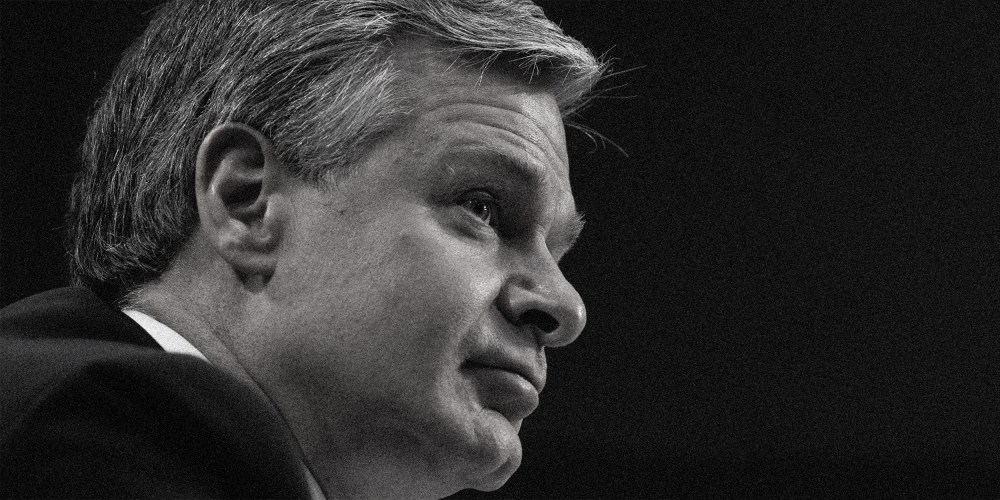
On Tuesday, FBI Director Christopher Wray appeared before the Senate Judiciary Committee to testify about the Jan. 6 attacks on the U.S. Capitol. Wray’s testimony reflected a leader seemingly unafraid to speak truth to powerful people, including those who have clung to power by lying for the last four months about the outcome of the 2020 election.
Until those in power hear and are made to own that truth, our domestic terror problem isn’t going anywhere.
Those simple truths shined some light into the fog of falsehoods that shroud not only the presidential election, but the subsequent deadly riots and the root of the domestic security threat facing our nation. Yet there was one truth that went unspoken during Tuesday’s testimony — namely, how the Jan. 6 attacks were allowed to occur in the first place, and by whose hand. And until those in power hear it and are made to own that truth, our domestic terror problem isn’t going anywhere.
Let’s start with four key takeaways from Wray’s testimony. First, the FBI categorizes the violent breach of the Capitol, which was an attempt to overturn former President Donald Trump’s defeat, as an act of domestic terrorism. That’s significant. Such a designation isn’t a subjective opinion; it aligns with the legal definition of domestic terrorism, which requires violence or force directed at intimidating the government for political purposes.

That means the people who continue to assert that the incident at the Capitol was merely a protest gone awry, with no element of planning or intent, are not grounded in the law — much less reality. It also means that the people charged in the riots, and those who incited them, aren’t patriots. They’re terrorists.
An important component of counter-radicalization is depriving both the radicalizer and the radicalized the affirmation that comes from the delusion that they’re part of some greater good. This is a strong first step toward deradicalization, as are the hundreds of FBI arrests aimed at holding people accountable by attaching consequences to their conduct.
This was a reminder that the racism that permeates American history is a painful part of our present.
Second, Wray spoke the important truth that white supremacy plays a significant role in the domestic terrorism threat and particularly in the violence resulting from that threat. He stated that there is a particular “lethality” to the kind of violence the FBI sees perpetrated by white supremacists. This was a reminder that the racism that permeates American history is a painful part of our present, and will likely persist into our future unless we see it for what it is: a deadly threat to our democracy.
Wray’s pronouncement also serves to rebuke those who claim the attacks were largely about political differences. In reality, many people who commit acts of domestic terrorism are fueled by hate, not politics. To those for whom politics has become a delivery system for hatred, Wray’s facts should serve as a wake-up call.


Third, Wray’s firm and negative response to a question about evidence of widespread voter fraud was a kind of shot across the bow against the so-called big lie that the election was stolen from Trump. Specifically, Wray replied that there was no evidence of widespread voter fraud, and certainly not of a nature that would affect the outcome of the election.
Fourth, Wray took on yet another lie, the false theory circulating on social media that antifa, or anti-fascist activists, perhaps posing as MAGA supporters of Trump, instigated the Capitol riots and committed the violence inside the Capitol. To that question, Wray simply explained that there was “no evidence” of that.
Still, there was one glaring, if inconvenient, truth left unsaid. Maybe Wray, who has proven a savvy survivor of the deadly political minefield inside the Beltway, believed this truth would be inferred from the others he revealed. Or, perhaps Wray calculated that to preserve the FBI’s mission and continue to restore the damage to the public’s perception of the bureau inflicted over the last four years, he needed to avoid inserting any appearance of political bias in his testimony. I understand that, but the omission is still a significant one.
Whatever the reason, here’s what Wray didn’t say: The act of domestic terrorism at the Capitol wasn’t a mysterious occurrence of spontaneous combustion. It was incited. The lies about widespread voter fraud and a “stolen election,” and that some group called antifa is responsible for the violent riots, didn’t get spread by themselves.
Those lies were generated by people — people in power who were seeking to maintain that power. The hate-based violence characterized by white supremacist idiocy was cultivated and cajoled by a president who served as radicalizer-in-chief, aided and abetted by like-minded sycophants in the Senate and the House. We can and will hold accountable those who committed violence at the Capitol on Jan. 6. But until we name, shame and bring lawful accountability to Trump and his congressional co-conspirators, our domestic terrorism problem will remain, fester and possibly become even worse.
