





At the 2022 New Yorker Festival, Quinta Brunson, the now-Emmy-award-winning actor and creator of “Abbott Elementary,” told those of us in the audience that when they come up with storylines for what happens inside the walls of the Philadelphia elementary school, she and her team of writers make it a point not to consider anything happening in the outside world. It was a point she also made on Twitter (when she still had an account there): that she refused to do a school-shooting episode as so many people on social media were suggesting she should.
They write what makes sense at Abbott, Brunson said at the New Yorker Festival. “‘Abbott’ is really great, because the stories of this school are unique to those walls. And these teachers, their main goal is to take care of these kids. … That is the heart of the show. It doesn’t concern itself with world events. … When we go into the ‘Abbott’ writers’ room, the news doesn’t even matter. We are talking about what’s going on with these people in this school.”
I taught in New York City public schools for 10 years. I thought Brunson’s statement perfectly summed up the lives of teachers, especially those who enjoy the job but abhor the many obstacles to doing it well. Teaching is such an odd profession, because grown people walk into a school building shortly after dawn and don’t leave until all the kids have. During that eight- to 10 hour period, there’s no consideration given to what’s happening outside. Nothing else matters except what is occurring within the building.

Some of us may dash to the bodega to grab a sandwich for lunch, but those 10 minutes of feeling the sun on our faces are clouded with thoughts such as: “Watch this be the one time that student who keeps saying she’s going to come for extra help actually shows up” or “I hope I have enough time before my next period to call [REDACTED’s] parent because he’s up to his foolishness again” or “Is that kid from my first period? What’s he doing out here?!”
In its first two seasons, “Abbott Elementary” was nominated for 15 Emmys and won four: outstanding writing for a comedy series, outstanding casting for a comedy series and outstanding supporting actress in a comedy series for Sheryl Lee Ralph in 2022 and outstanding lead actress in a comedy series for Brunson in 2023.
I’m tuning in because I appreciate the way Brunson gets school right and the way her show reminds us of the importance of public schools.
Wednesday is the premier of the third season, and viewers have plenty of motivation to tune in: Will Brunson’s character, Janine Teagues, date Gregory Eddie (Tyler James Williams)? Will Legendary, the charter school organization that tried to swallow Abbott during the last season, keep threatening a takeover? Will Janine’s mother (Taraji P. Henson) continue to cross her daughter’s boundaries, taking advantage of Janine’s need to care for people?
But those questions aside, I’m tuning in because I appreciate the way Brunson gets school right and the way her show reminds us of the importance of public schools.
It might strike you as a small thing, Brunson portraying so well a profession (and a world) that she’s never been a part of. (Her mother did teach kindergarten for 40 years.) But making a school building its own ecosystem is the foundation on which the show is built. Brunson understands that when a teacher is at school, that’s the only world that exists, and our goal in whatever world we’re in shouldn’t be to save that world but to survive in it and try to make it better.

Because she understands, unlike others who’ve created shows and movies set at schools, that the profession is filled with regular people doing their work and not superheroes trying to save the world, she’s simultaneously able to tell the joke and lay bare the realities of school systems that those outside in the real world find unbelievably horrific. Educators laugh because Brunson and her writers have managed to present these realities in almost the same way we experience them in the singular world of our school building.
For example, I’ve taught at public schools here in the U.S. and at private schools in Asia and Africa. I’ve encountered countless principals like the show’s beloved pseudo-villain, Ava Coleman, played so brilliantly by comedian Janelle James. Largely useless when supporting the professional growth of her teachers, Ava is more interested in the district-facing and policy-upholding requirements of an administrator … and then only sometimes. In some rare moments, she comes through for the teachers, but for her sake, not theirs.


I’ve taught at public schools here in the U.S. and at private schools in Asia and Africa. I’ve encountered countless principals like the show’s beloved pseudo-villain, Ava Coleman.
Take the season two episode “Sick Day,” in which Ava uses the school’s last ream of paper by making fliers for her side hustle, feeling the impact of her selfishness only when she’s forced to cover a class for a teacher who’s out sick. The teachers on the screen and those watching at home react with the same measured frustration. Later, when boxes of paper come pouring in, Ava confesses: “It was mostly for me. I don’t ever want to be in that position again.”
The joke lands because we teachers have always known our principals felt this way. We don’t care that the solution didn’t arise out of empathy for us. Just give us the paper.
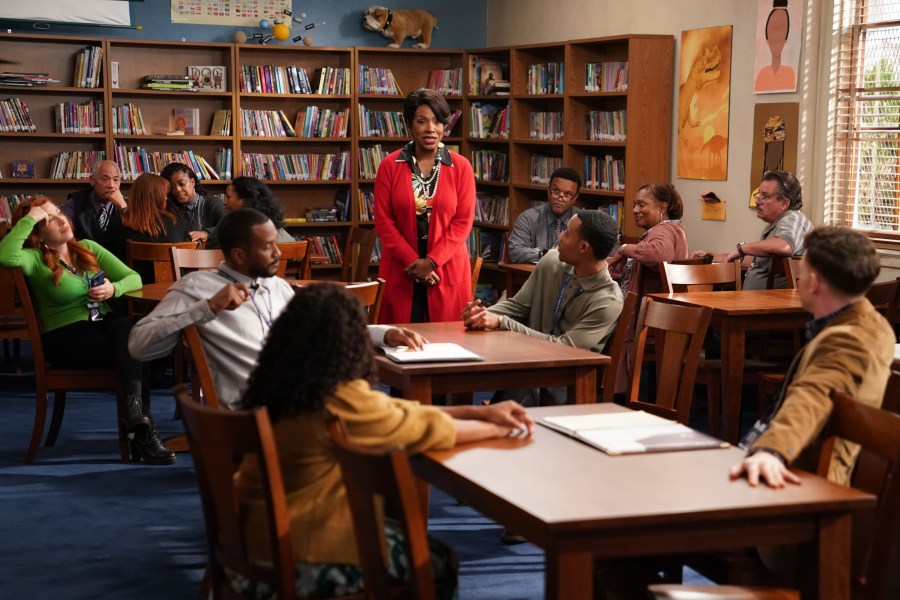
The nonchalance about the absurdity of a day in a school building makes “Abbott Elementary” a show that appeals to the masses and to teachers. I was skeptical that Brunson could pull it off when I saw the first trailers for the series. Far too many well-meaning Hollywood folk doing shows about a school have fallen into sentimental tropes or thinly veiled dislike of kids and the adults who care for them.
But by its second episode, I knew I’d be a faithful viewer of “Abbott” and a lifelong fan of its visionary creator. In that episode, because her young student was uncomfortable walking down the hall with a flickering light, Janine drags out a ladder twice her height, hellbent on fixing the broken light bulb.
Veteran teachers Melissa Schemmenti (Lisa Ann Walter) and Barbara Howard (Sheryl Lee Ralph) are the strongest evidence that Abbott writers understand how a school functions.
In any other show, Janine, then a first-year teacher, would have prevailed. The student would be overjoyed that her teacher saved the day! The novice teacher would launch into a soliloquy about no task being too difficult to tackle for her kids. But here, Janine’s ambition resulted in the entire school building being left completely in the dark.
Veteran teachers Melissa Schemmenti (Lisa Ann Walter) and Barbara Howard (Ralph) are the strongest evidence that “Abbott” writers understand how a school functions.
They take turns reminding the bubbly and idealistic Janine that she has no control over the injustices confronting their students. If everything is urgent, then nothing is. Chiding her about obsessing over a broken light is their way of insisting that she stay focused on the only part of the ecosystem she, or any other teacher, can control: her classroom.

Keturah Kendrick
Keturah Kendrick is a former educator who lives in New York City. She is the author of “No Thanks: Black, Female, and Living in the Martyr-Free Zone.” Her work has also appeared in Newsweek, HuffPost and USA Today.