




By bringing their nationwide challenge to mifepristone in Amarillo, Texas, where it could only be assigned to one of the country’s most visibly anti-abortion federal judges, the anti-abortion activists behind the ongoing effort to revoke the Food and Drug Administration’s 2000 approval of the popular (and safe) abortion-related medication unwittingly drew the public’s attention to the problematic practice of “judge shopping.” In response, Democrats in Congress are finally pushing back against the increasingly common practice. The only question is whether they’ll be able to persuade any of their Republican colleagues that the rise of judge shopping is bad for the public’s faith in all judges — those appointed by Democrats and Republicans alike.
Judge shopping is bad for the public’s faith in all judges—those appointed by Democrats and Republicans alike.
As I explained in an earlier column, federal courts in the United States have relatively generous rules about where lawsuits can be brought. Such rules encourage “forum shopping” where plaintiffs pick where to file their claims often because they believe the overall composition of the bench might be more likely to agree with their arguments.
In recent years, though, some litigants have gone beyond general forum shopping and begun “judge shopping.” That is, they’ve been filing claims in “single-judge divisions” where one judge hears every new civil case filed in a geographic subdivision of a federal district court. In those single-judge divisions, there’s no mystery as to who will hear their case. This kind of shopping, although not specifically prohibited, has historically been disfavored — because it undermines, or, at least, can undermine, public confidence that the dispute is being resolved by a neutral arbiter. Imagine how little faith we’d have in the outcome of NBA and NHL playoff games if individual athletes or teams picked the referees.
There’s been a recent and dramatic uptick in the number of suits challenging federal policies on a nationwide basis that have been brought in single-judge divisions. Texas alone has brought more than 30 different challenges to Biden administration policies in federal district courts in the state and has filed the majority of them in single-judge divisions with no ostensible geographic connection to the dispute. These disputes have challenged everything from the federal government’s immigration enforcement priorities and Medicaid reimbursement policies to new environmental, social and governance guidance adopted by the Labor Department — and lots of other policies in between.
When pressed on why they’re challenging nationwide policies in random, small courthouses and not in Austin or Washington, D.C., state officials have publicly admitted it’s because they want to have their cases heard by the judges they pick.
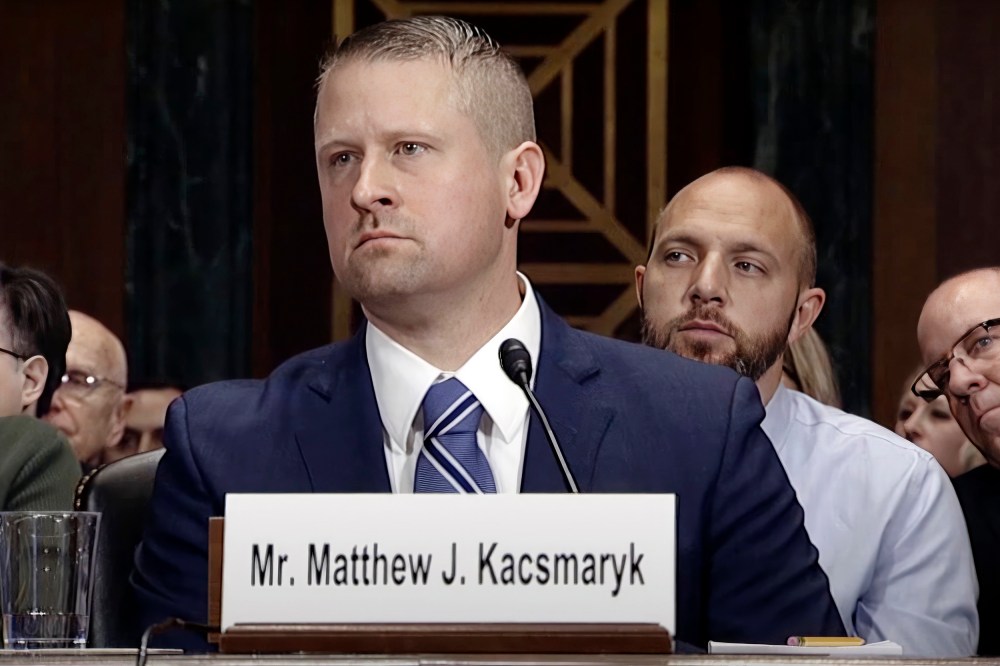
Ditto, the Alliance for Hippocratic Medicine, which filed its mifepristone challenge in Amarillo, one of Texas’ eight single-judge divisions. The group was formed in Amarillo shortly after the Supreme Court’s decision last June overruling Roe v. Wade, and there’s no question that the lawyers challenging the abortion pill chose Amarillo on purpose. Judge Matthew Kacsmaryk who, again, hears every case filed there, is well known for his strong opposition to abortion.


Sure enough, in a ruling that has been widely panned by legal experts from across the ideological spectrum, Kacsmaryk ordered the revocation of the FDA’s 2000 approval of mifepristone — only for the U.S. Supreme Court to put his order on hold indefinitely before it could go into effect.
But his ill-fated ruling brought needed attention to the nefariousness of judge shopping and Congress finally appears to be taking notice. Last week, Senate Majority Leader Chuck Schumer, D-N.Y., sent a letter to Chief Judge David Godbey, who oversees the U.S. District Court for the Northern District of Texas, regarding the alarming frequency with which conservative litigants are steering national cases to Amarillo. Schumer encouraged Godbey to exercise his statutory authority to randomize how the Northern District assigns new cases to its judges.
When Chief Justice John Roberts and prominent members of Congress from both parties recently brought similar pressure to bear on the chief judge of the U.S. District Court for the Western District of Texas, that led to a change in how patent cases filed in the single-judge Waco division are assigned. And Sen. Mazie Hirono, D- Hawaii, has introduced legislation that would go even further — and require that any nationwide challenge to a federal law or policy be brought in the federal district court in Washington (where cases are randomly assigned among the court’s 13 active and nine senior judges, all of whom hear at least some new civil cases).
Kacsmaryk’s ill-fated ruling brought needed attention to the nefariousness of judge shopping, and Congress finally appears to be taking notice.
Congress could also split the difference and leave it up to each district court to choose how to assign cases so long as each court eschews single-judge divisions. A court could require, for instance, that no new civil case that is unrelated to an existing one has a greater than 50% chance of being assigned to a specific judge.
Recent examples notwithstanding, this isn’t — or, at least, it shouldn’t be — a partisan issue. Texas may be ground zero for the most visible examples of judge shopping, but there are single-judge divisions in blue states, too. And it’s hard to imagine that, in a future Republican administration, Democratic state attorneys general won’t try to borrow a page from the Republicans’ playbook. That point doesn’t appear to be lost on Schumer or Hirono. The real question is whether they’ll be able to persuade lawmakers across the aisle that judge shopping does great damage to the public’s faith in the judiciary — whether the judges to whom the cases are shopped were appointed by Democratic presidents or Republican ones.

Steve Vladeck
Steve Vladeck is a professor of law at Georgetown Law, whose teaching and research focus on federal jurisdiction, constitutional law and national security law. He is co-editor-in-chief of the Just Security blog (@just_security) and co-host of "The National Security Law Podcast" (@nslpodcast).