




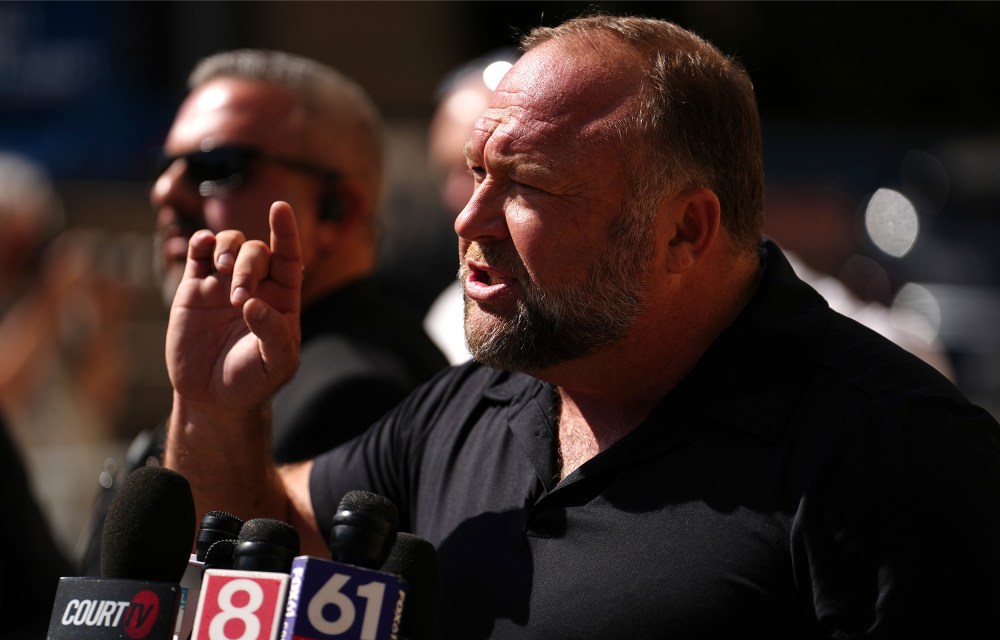
On Wednesday, a jury in Connecticut awarded the families of the 2012 Sandy Hook Elementary School shooting victims $965 million in their lawsuit against right-wing conspiracy theorist and media personality Alex Jones. The ruling follows nearly $50 million in damages awarded by a Texas jury, after years of Jones spreading lies about the shooting and the victims’ families on his network, Infowars.
The families’ quest for justice is just the latest in a long line of stories from this age of modern misinformation. Jones is one of the most prolific spreaders of misinformation and conspiracy theories in modern media history. Many readers already know Jones’ story, and the way he rants and raves on camera day after day while hawking supplements and survival gear. Though Wednesday’s judgment will likely put a significant dent in Jones’ finances, Infowars still garners hundreds of thousands of views every day. He’s the quintessential example of a guy who people hear is “controversial,” and that controversy drives interest in his content.
But his story is also one of media failure.
Despite spreading deranged conspiracy theories every time he appeared on TV, the web, or in public, Jones continued to receive coverage from mainstream media outlets
Jones first rose to notoriety in the early 2000s as this “crazy” guy who entertains by saying whatever comes to his mind on his radio show. That initial attention bought him appearances on mainstream television. According to media critic Parker Molloy, who writes The Present Age newsletter, Jones was invited on to ABC’s The View in 2011 to talk about Charlie Sheen getting fired from his show, “Two and a Half Men” on CBS. During that appearance, he made a comment to “Tower 7,” a reference to a common 9/11 conspiracy theory.
Something like that should have been the end of his time in the media limelight. But two years later, CNN’s Piers Morgan hosted Jones on his show shortly after the Sandy Hook shooting. Why? Because Jones had started a petition to have Morgan deported for “attacking the Second Amendment.” Instead of ignoring this trolling, Morgan welcomed it, and CNN displayed the web address for InfoWars throughout the interview. Over the years, despite spreading deranged conspiracy theories every time he appeared on TV, the web, or in public, Jones continued to receive coverage from mainstream media outlets looking for “provocative” voices.


Now that we’re standing in the aftermath of the Sandy Hook jury awards, we should see that the media industry, and its attitude that controversial speakers must be worth hearing, shares at least partial blame for creating the Alex Jones media monster. I’ve run into this attitude countless times, especially on Twitter. I will criticize the factual basis of some other media figure’s statement, and a random user will hop in my mentions saying something like, “Well, if they’re saying something that people are protesting, it must be worth listening to.”
In this context, false or outrageous statements aren’t treated with the disdain they deserve, but instead as the “forbidden fruit” of the discourse. We see this over and over again: Countless “intellectuals” have built their career pedaling bigoted, racist, homophobic, antisemitic or transphobic speech – and instead of being ignored, they are spotlighted as so-called “provocateurs.” Last year, the launch of a new “university” in Austin, Texas, received heavy coverage for its lineup of academics who have been criticized for being racist, transphobic or otherwise bigoted. The University of Austin openly advertises itself as purveyors of forbidden knowledge.
Nothing Jones says has value to society, and as the Sandy Hook court cases proved, much of his speech is actively harmful to people.
Jones is cut from the same cloth, and often himself traffics in bigoted speech. My favorite Alex Jones moment was the heavily memed “turn the friggin’ frogs gay” moment, in which he claimed that chemicals were seeping into the water supply and making frogs gay. It’s an entertaining, but obnoxious moment in a long career of entertaining but obnoxious moments. Nothing Jones says has value to society, and as the Sandy Hook court cases proved, much of his speech is actively harmful to people.

The media doesn’t have to hand a mic to every Tom, Dick and Harry saying outrageous and provocative stuff. In 2022, I think it’s time that we in the media officially retire the concept of “provocateurs.” We ignore the carnival barkers and people on the street corner shouting into a megaphone, so why do these people always seem to be on TV and radio? They never deserved a platform in the first place, and the least we can do to honor the victims of the Sandy Hook shooting is to think twice about who we’re inviting onto the stage.

Katelyn Burns is a freelance journalist based in New England.