




This essay was going to be about Armenians and Azerbaijanis, about how a side that has lost all hope can neither make peace nor create stability with a sore winner.
Then the carnage in Gaza and Israel hit the headlines and drove the point home: Unresolved conflict, injustice, insecurity and fear will always come back to create more insecurity, more violence and more fear.
This is the greatest Armenian catastrophe since the genocide of Ottoman Armenians in 1915.
At the time of the Soviet collapse, Armenia fought a war with Azerbaijan over Nagorno-Karabakh to secure rights for an Armenian-majority population that had been arbitrarily incorporated into Azerbaijan earlier in the Soviet years — an unresolved conflict come home to roost. Armenians won the war, but there was no deal to secure the peace.
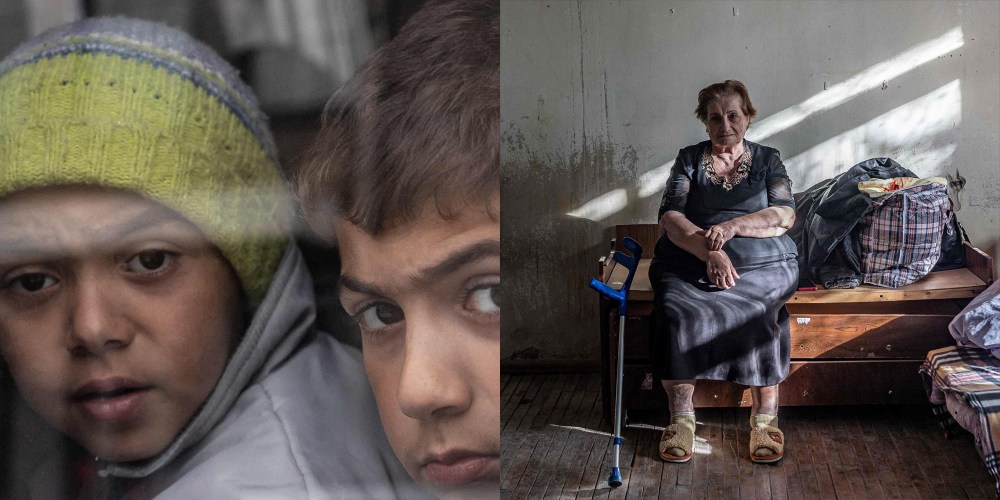
Then in 2020, in and around Karabakh (also called Artsakh), Azerbaijan initiated a high-stakes war, exercising an unjust use of force and using state-of-the-art armaments from Israel. It attacked a civilian population, killed and maimed thousands (on both sides) and eventually, three years after winning the war, it expelled 100,000 people from their homes and indigenous lands. This, after holding them hostage for nearly 10 months without food or medicine. It got what it wanted: land, without people.
Currently, it is the sore winner’s violence that has defined the post-war period in the Caucasus. Azerbaijan’s President Ilham Aliyev has detained Karabakh’s legitimately elected political leaders, calling them dogs, the children of Satan and terrorists — the last a label used by the powerful to act against one’s enemies without accountability. (Never mind that international bodies like the Organization for Security and Co-operation in Europe and the United Nations have met and worked with these leaders.) Displaying Armenian soldiers’ helmets in a public park demonstrates Azerbaijan’s dismissal of its neighbor’s humanity. Publicly. With impunity.

Such uneven military, geopolitical and human power is exercised by Aliyev, a dictator whose legitimacy and longevity has been directly aided by Turkey and Israel. The Russian peacekeepers in the area conveniently did little to keep peace. The Karabakh people, who had lived in a democratic society, were to be smoothly turned over to and subjugated by the Azerbaijani state, widely recognized as a kleptocracy.
The second war, in 2020, silenced the Armenian enclave’s century-old call for the right to live in peace on its own historic home. In 2023, complete ethnic cleansing followed.
But it won’t end there, because an unresolved conflict will always home to roost. Those with greater power and some wisdom must step in to bring prisoners and hostages home and to prevent new (and inevitable) violence on the doorstep of Iran, Russia and Turkey. Because Azerbaijan, still not satisfied, periodically attacks the Republic of Armenia proper. Again, with impunity, as Azerbaijan doesn’t respect the red lines that have been established by more responsible members of the international community.
Immunity and impunity arise from the sometimes conflicting, sometimes overlapping interests of external powers in a region that is the crossroads for imperial ambitions. The Turkey-Azerbaijan tandem offers cover for the transport of Russian gas, which is currently under international sanction. Turkey pounds American allies in Syria, which sends mercenaries to Azerbaijan. Iran does not want Russia, the U.S. or the E.U. at its borders. The E.U. says it wants peace but will not rein in Azerbaijan because it needs an alternative source to Russian natural gas (even if that partnership is self-defeating). The U.S. neither says nor does the right thing but is always “concerned.” An unresolved political conflict — or one resolved unjustly — only breeds more injustice. The critical questions now are: Will that “concern” translate to ensuring that all prisoners and hostages are released? Will there be an end to military aid to Azerbaijan? Will there be meaningful development assistance to Armenia to help settle 100,000 new refugees? Will those refugees be assured of a right to return — one day, when return does not mean certain persecution and violence? Will the dozens of centuries-old markers of Armenian presence and culture in Karabakh be protected? The warnings to the international community about impending, irreversible violence did not avert the war or the expulsion of 100,000 ethnic Armenians. What’s to be done now except to insist — over and over again — that Armenian lives must be acknowledged and protected? This is the greatest Armenian catastrophe since the genocide of Ottoman Armenians in 1915, and it has already vanished from international headlines. It’s been eclipsed by another catastrophe that is bearing out the same inescapable truth on the backs of innocent Israelis and Palestinians: that an unresolved political conflict — or one resolved unjustly — only breeds more injustice. We don’t lack for lessons or slogans: “Never Again” sounds good. But even as we keep saying it again and again, we allow preventable injustice to happen, again and again.
Salpi H. Ghazarian
Salpi H. Ghazarian directs special initiatives for the Institute of Armenian Studies at USC Dornsife and was the institute’s director from 2014 to 2022. She also co-founded and directed the Civilitas Foundation and its media arm, the trilingual online news channel CivilNet. 

