




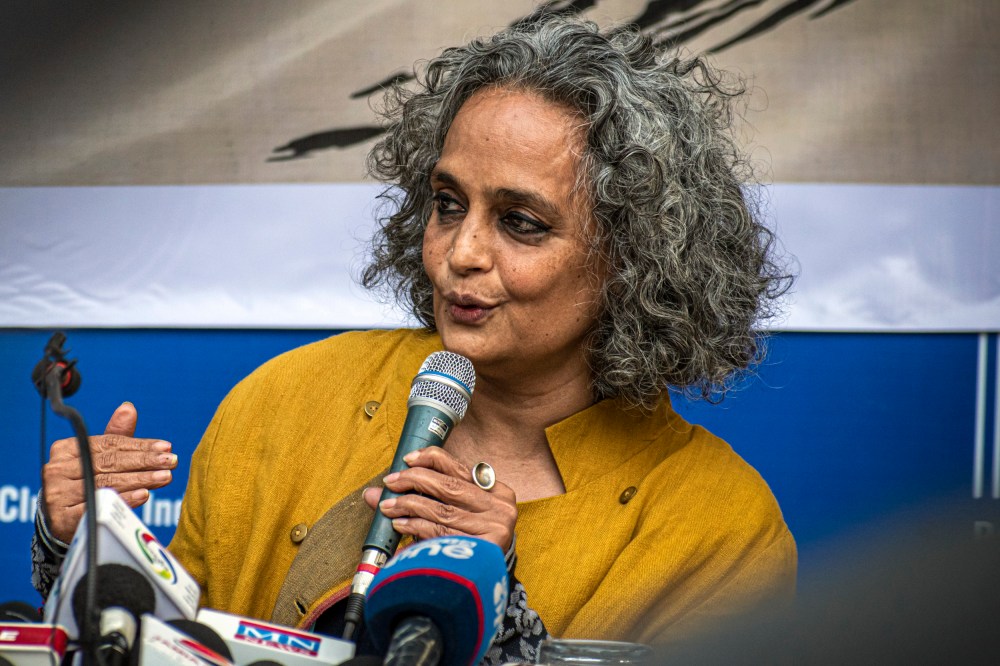
It has been 13 years since the Indian government first considered charges against the Booker Prize-winning author Arundhati Roy for sedition, incitement and hate speech for remarks she made about Kashmir in 2010, including her belief that “Kashmir has never been an integral part of India. It is a historical fact. Even the Indian government has accepted this.” This week, Indian officials cleared the case to proceed for “offenses related to provocative speech and the promotion of enmity,” according to The New York Times.
In 1997, readers around the world celebrated the arrival of Roy’s debut novel, “The God of Small Things.” At the same time, traditionalists in India railed against her for addressing topics they considered taboo, like the discrimination of India’s caste system, politics and sexuality.
If this is the case and charges against Roy proceed, it should be seen as a five-alarm alert for the future of democracy in India.
Over the following years, in a stream of wide-ranging essays, Roy has written critically on themes such as imperialism, capitalist economic development and the right-wing Hindutva movement of which, the ruling Bharatiya Janata Party government is a part. She found herself accumulating court cases almost as quickly as honors, yet she has only once been sentenced to prison, and that was for one day. Her works have faced bans in India, including in 2020, when Tamil Nadu University excluded “Walking With the Comrades” because of pressure from a BJP-affiliated student group.
Why, then, did the Indian government wait until this week to advance the charges — which could result in as much as seven years in prison — against her and Kashmiri law professor Sheikh Showkat Hussain?
There is speculation that the move is part of an escalating crackdown on free speech, possibly linked to a police raid last week in New Delhi that targeted multiple journalists associated with an online news site known for criticizing the Indian government. If this is the case and charges against Roy proceed, it should be seen as a five-alarm alert for the future of democracy in India.


Countries that are not yet as far along the path to autocracy as India is have little problem condemning famous citizens and have even encouraged violence against them (as was the case recently in Poland with vicious verbal attacks on filmmaker Agnieszka Holland). But governments have typically stopped short of actions that are likely to attract international condemnation. What is alarming is that Roy’s international prominence no longer seems to concern the Indian government; the legal case demonstrates the confidence of a government that is growing indifferent, if not impervious, to international opinion and brazen enough to advance its autocratic practices flagrantly.
Autocrats invariably target not only human rights defenders and journalists but also writers and artists. They instinctively recognize the power of words and, by extension, free and creative expression to spark imagination, kindle hope and allow people to imagine different and better worlds built on equality, freedom and human rights. In the absence of free expression, other freedoms are quick to die, paving the way for autocrats to write their own rules.
India has been steadily taking more aggressive steps to quash free expression, censor artistic expression and punish independent discourse. Legal charges, court cases and preventive detention have led to the imprisonment of writers and journalists — among them the 82-year-old Telugu poet Varavara Rao, who was held in preventive detention for almost three years as part of the larger Bhima Koregaon case before he was released on bail, and Fahad Shah, a Kashmiri editor who has been detained since his arrest in February 2022 on spurious charges in multiple jurisdictions. And these prosecutions have chilled speech for many others, as dozens, including Roy, have faced lesser forms of harassment, intimidation and online abuse. India ranked ninth in PEN America’s 2022 Freedom to Write Index, a count of jailed writers worldwide.
Last month, Roy received the European Essay Prize for lifetime achievement. At the conclusion of her acceptance speech, she said: “I loved the part in the prize citation in which it says, ‘Arundhati Roy uses the essay as a form of combat.’ It would be presumptuous, arrogant and even a little stupid of a writer to believe that she could change the world with her writing. But it would be pitiful if she didn’t even try.”
The irony is that while international pressure might not prevent the Indian government from locking up Roy, it could very well draw further attention to where she would be likely to want it most: her words.

Karin Deutsch Karlekar
Karin Deutsch Karlekar is the director of Writers at Risk at PEN America, the free expression and literary organization.