




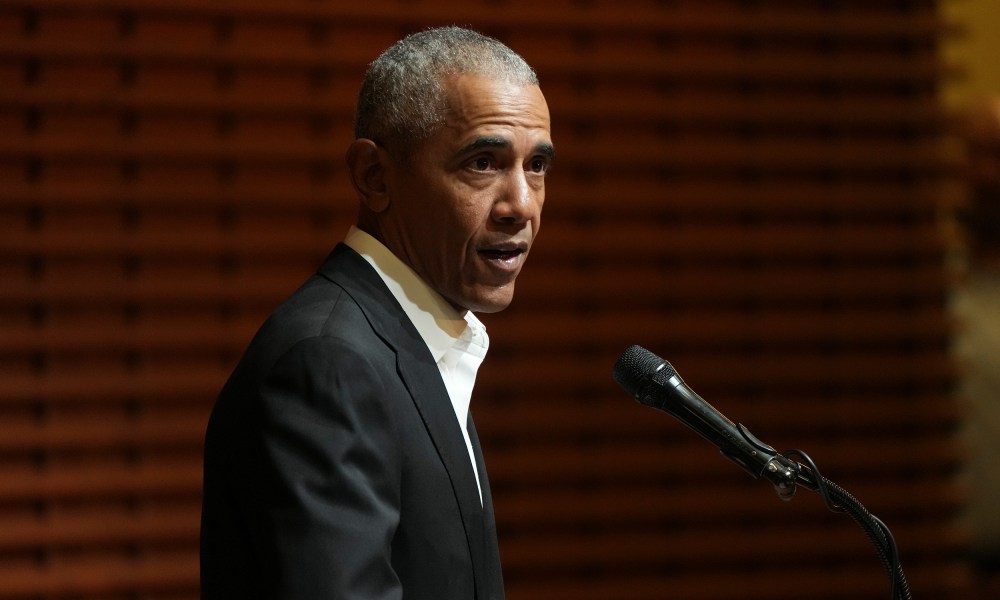
On Thursday, former President Barack Obama traveled to Silicon Valley and delivered one of his bluntest critiques yet of tech companies, which he said have fostered discord and disinformation at the expense of democracy.
Tech analysts correctly pointed out that Obama’s speech had its shortcomings — that it was vague on key details about solutions and didn’t advance a novel analysis of the way social media companies operate. But he did make nuanced points about the origins of and scope of the problem.
Most importantly, he used his enormous influence to counsel the public to think proactively about tech not just as consumers, but also as citizens. He eloquently made the case against “fatalistic” despair about technology, and encouraged people to think about how technology can be reshaped to serve, and not undermine, democracy.
“Putin didn’t do that. He didn’t have to. We did it to ourselves.” — Barack Obama
Obama’s speech, which he delivered at Stanford University, had the potential to be a stream of clichés about how we’re so divided as a society because we’re all glued to our phones and read different news sites. Fortunately, it wasn’t that. He took care to point out that major social media platforms exacerbate pre-existing divisions in our democracy, which emerged and persist for many reasons, including economic displacements from automation and globalization, the nationalist backlash against multiculturalism, dysfunction in our political system, and the ways in which the rise of successful authoritarian regimes such as China have made it easier “to discount democracy’s appeal.”
Looking back on his time in office, the former president said he regretted his “failure to fully appreciate at the time just how susceptible we had become to lies and conspiracy theories” — and he said he thinks Russian-backed social media disinformation operations in the run-up to the 2016 election exploited divisions that were already pervading domestically. Referring to Russian President Vladimir Putin, he said, “Putin didn’t do that. He didn’t have to. We did it to ourselves.”

With those qualifications — and with a general acknowledgement of the positive qualities of the tech revolution — Obama argued that the business models of social media platforms have now decisively tilted the experience of the internet toward less understanding and more rage:


Twenty years ago, pillars of web search were comprehensiveness, relevance and speed. But with the rise of social media and the need to better understand people’s online behavior, in order to sell more advertising, companies want to collect more data. More companies optimized for personalization, engagement and speed. And unfortunately, it turns out that inflammatory, polarizing content attracts and engages.
Over the course of his speech, Obama called for democratic oversight of social media companies while protecting free speech rights. He endorsed the Platform Accountability and Transparency Act, a bill that would require social media companies to disclose data to independent researchers on how their products work. He also called for the reform of Section 230, a law that protects companies from legal liability for what’s on their platforms. And he argued that there need to be explicit criteria for how to reform social media companies that go beyond discussing profit models:
The way I’m going to evaluate any proposal touching on social media and the internet is whether it strengthens or weakens the prospects for a healthy, inclusive democracy; whether it encourages robust debate and respect for our differences; whether it reinforces rule of law and self-governance; whether it helps us make collective decisions based on the best available information; and whether it recognizes the rights and freedoms and dignity of all our citizens.
As a number of tech experts expressed, Obama’s proposed solutions are vague. For example, it’s unclear how he wants to tweak Section 230. A mandate for tech companies to moderate content could potentially restrict free expression in ways that are at odds with the First Amendment, and it could encumber smaller companies far more than bigger ones. And Obama’s guiding principles of creating rules that strengthen healthy democracy are vague enough that companies like Facebook — no virtuous friend of civic health — can claim they’re already upholding some of them. They’re also broad enough to support diametrically opposed views on issues like content moderation. For example, less content moderation might be seen as the best defense for political dissent — a clear measure of the health of democracy; more aggressive moderation might be argued to be the best way to protect against harassment and incitement to violence. Obama presented us with dilemmas, but he did not pierce through them.
But that may be because he, himself, isn’t really clear on the answers. (That’s the case for me as well.) And on balance, Obama pushed the debate in a distinctly positive direction by encouraging people to shake off a sense of “grimness” regarding social media. Leaning into his signature optimism, he encouraged the public to think of technology as a tool, not just the way the world is.
“The handwritten sign was a tool. TV’s a tool. The internet is a tool. Social media is a tool,” he said. “At the end of the day, tools don’t control us. We control them, and we can remake them.”
“It’s up to each of us to decide what we value and then use the tools we’ve been given to advance those values,” he continued. “And I believe we should use every tool at our disposal to secure our greatest gift: a government of, by, for the people, for generations to come.” That’s a paradigm I can get behind.

Zeeshan Aleem is a writer and editor for MS NOW. He primarily writes about politics and foreign policy.