




You might think Republican political leaders in the South are trying to remake higher education in their states. And they certainly are. But in so doing, they’re consciously attempting to destroy what presently exists. Either they’ll refashion colleges and universities in their own image or render them inoperable in the attempt. Both outcomes are fine by them.
This past week, we received some evidence that this cynical strategy may be working. Scholars in the South are extremely dissatisfied with their institutions, according to a recent survey by the American Association of University Professors. Nearly half of the professors polled are, or will be, interviewing elsewhere in hopes of finding new employment.
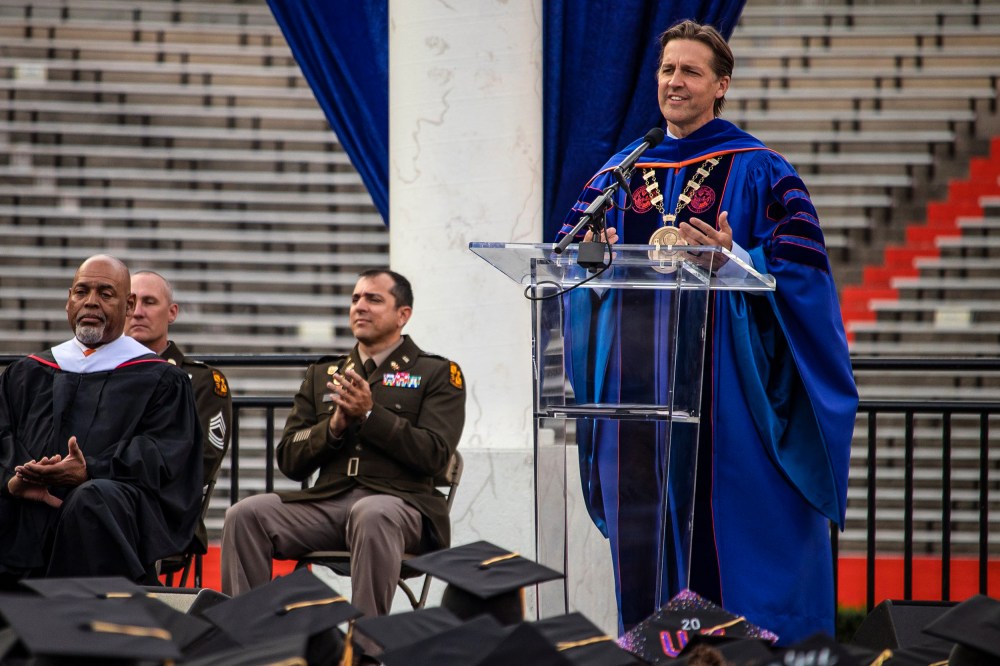
A recent New York Times article unintentionally offers some perspective as to why these professors might be eyeing the exits. It chronicles former Nebraska Sen. Ben Sasse’s first seven months as president of the University of Florida. It’s not only a story about Sasse as spectre — to many on campus he is invisible, a “mystery,” a “ghost.” The article is also a handy compendium of all that Florida Gov. Ron DeSantis (whose associates big-footed the presidential search committee) and other GOP politicians are doing to “disrupt” American higher education.
And by “disrupt,” I mean completely decimate the American professoriate. If that professoriate wishes to avoid that fate, it needs to start collectively defending its interests.
Sasse emerges as the present dividend — and future enabler — of a wildly successful Republican crusade to upend academic norms. These norms have prevailed since the mid-20th century. That status quo was based on providing the majority of professors a reasonable opportunity to achieve something called tenure.
Tenure is imperfect. But it is the only mechanism yet devised that thoroughly protects “academic freedom,” or the right of scholarly experts to speak their minds without losing their jobs. The tenure system was launched in 1940, and not coincidentally, American institutions of higher education and their faculties soon became the envy of the world.
Florida’s present assaults on academic conventions would have been impossible to execute as little as 20 years ago. Back then, most scholars had job security and reasonable wages and benefits. The professoriate hadn’t yet been deviously flipped into a casualized labor force. “Faculty governance,” in which a school’s professors play a crucial role in making decisions that affect them and their students, was still a thing. Most importantly, the institution of tenure had not yet entered its hospice care stage.
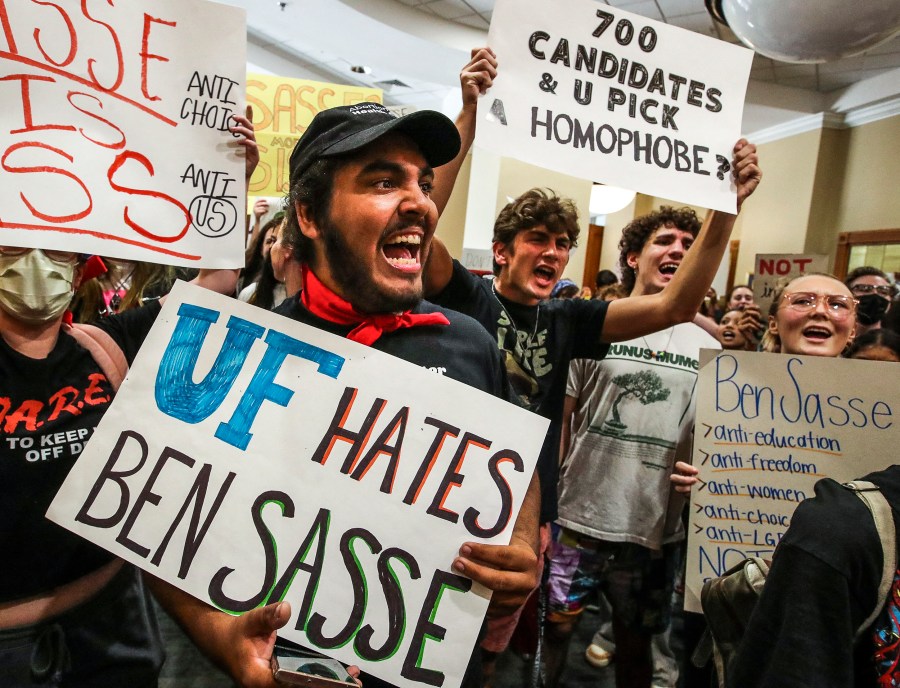
Reading about Sasse in The New York Times we encounter a slate of once-unthinkable worst practices. These include anointing Sasse to the presidency in near secrecy and outfitting him with a pricey consulting firm to assist with “strategic management,” and blatantly trying to prevent professors from exercising their academic freedom, not to mention engaging in a hostile, state-run ideological takeover of an entire public college. Naturally, Florida (as with many other red states) is engaged in a full-on assault on the institution of tenure.
As that occurs, the state is also undermining the expertise of scholars by permitting Prager U videos to be used in public schools. Given Florida’s parallel efforts to reframe slavery as a “personal benefit” to African Americans, we must see its actions for what they are: ruthless ideological warfare geared toward placing the entire educational sector in the service of right-wing world view — or destroying it in the process.
The Florida chapter of the AAUP has described this as a “politically and ideologically driven assault unparalleled in US history.” One professor, reporting from “ground zero of the culture wars,” chronicles the mobilization of unions, graduate students and scholars. These activists view DeSantis’ initiatives as an education problem, not just a higher education problem.

For these efforts to succeed, however, they need to be nationalized. One way to stave off this attack on the professoriate: Professors across the U.S. must exhibit what sociologists call “guild solidarity.”
Here’s a thought experiment: What if Neil Gorsuch, upon being nominated to the Supreme Court by Donald Trump in 2017, took the high road of guild solidarity? What if he refused to accept Trump’s nomination? After all, another qualified jurist, Merrick Garland, had recently been treated in a manner that violated the dignity of their common vocation. From the perspective of a judge, I would submit, Mitch McConnell’s blockade of Garland’s candidacy in 2016 was bad for judges.
Gorsuch didn’t take the high road. He didn’t see himself as a judge first, as a practitioner of a venerable occupation whose conventions supersede political loyalties. Had Gorsuch done the right thing, he’d have been immediately trucked by Trump. But then again, he eventually would have been memorialized on a postage stamp. His heroism would have been to sacrifice personal advancement for the good of his vocation, politics be damned.
Professors across the U.S. must exhibit what sociologists call “guild solidarity.” American professors have the opportunity to rise to the challenge of guild solidarity, politics be damned. I call on every American scholar with a public platform to bring their expertise to bear on what is happening in Florida and elsewhere. In blogs, podcasts and columns, they can reflect on what Sasse’s vision might wreak upon our craft. The UF president asked: “What will today’s generic term ‘professor’ mean when you disaggregate syllabus designer, sage-on-the-stage lecturer, seminar leader, instructional technologist, grader, assessor, etc.?” To my ear, Sasse’s query sounds similar to the cant of the multibillion-dollar virtual learning industry (another disruptor that is totally at peace with either reshaping higher education or razing it to the ground). In the classroom, scholars might take a few minutes to explain to their students what is happening in Florida. Even the most anti-liberal sage in a B-School or theological seminary has a dog in this fight. I can think of few conservative scholars who would agree that Dennis Prager’s exceedingly unlearned hot takes belong in any educational curriculum. What if our administrators protest the “politicization” of classroom time? Interesting scenario, that. The recent AAUP report lingered on the role of administrators and their complicity in “DeSantis’s war on college.” As I have noted elsewhere, the dismembering of the American professoriate was, in part, an inside job. Those who operationalized and crafted the policies that hollowed out our guild are often scholars themselves (Sasse, for example, has a doctorate from Yale). On every campus in America, these administrators need to be asked: Are you for scholars — or for their immiseration? Professors are not well understood. Many imagine that we spend our days corrupting the nation’s youth or doing nothing at all. We have to clear up that misconception, just as we need to rediscover our commitment to teaching (which many tenured professors at elite universities have disappointingly abandoned). But no matter what you might think of professors, we are an indispensable part of the solution. Without concerted professorial pushback, universities will become host organisms for the ideological pet projects of the wealthy (for example, UF’s Hamilton Institute, as noted in the Times piece, is getting major funding to pursue a partisan civics pedagogy on campus). Further, the economic mobility enabled by institutions such as UF and their reasonably priced tuition will disappear (yes, President Sasse has set his sights on raising tuition). If there ever was a time for guild solidarity, it is now. Otherwise, the aforementioned capture — or destruction — of the entire educational sector will proceed apace.
Jacques Berlinerblau is a professor of Jewish civilization at Georgetown University. 


