





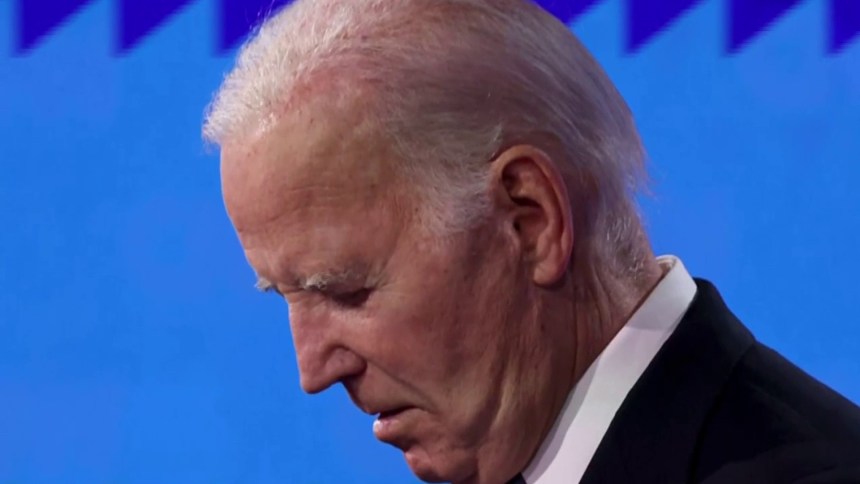
President Joe Biden is facing a barrage of media scrutiny and criticism over his age and mental acuity in the wake of his disastrous debate performance. In the immediate aftermath of the debate, Biden could shelter behind a wall of support from top Democrats. Influential party members such as former presidents Barack Obama and Bill Clinton issued statements of confidence in his candidacy on social media. But now that wall is cracking. A handful of Democratic lawmakers are calling on him to step aside. And even some of the most influential Democrats in the party are hinting that their views of Biden’s fitness — and that the status of his candidacy — are far more fluid than Biden’s dismissals would suggest.
Top Democrats’ more subtle positioning on Biden’s candidacy is the most striking indicator that the party could turn on the president.
On Tuesday Rep. Lloyd Doggett, D-Texas, became the first sitting Democrat in Congress to call for Biden to step aside. “Too much is at stake to risk a Trump victory—too great a risk to assume that what could not be turned around in a year, what was not turned around in the debate, can be turned around now,” he said in a statement. “President Biden saved our democracy by delivering us from Trump in 2020. He must not deliver us to Trump in 2024.” On Wednesday Rep. Raúl Grijalva of Arizona echoed Doggett’s call, saying Biden has a responsibility to “get out of this race.” On Thursday, Rep. Seth Moulton of Massachusetts also called on Biden to “step aside.”
Some notable former officeholders have also weighed in against Biden. Obama administration Housing and Urban Development Secretary Julian Castro told MSNBC on Tuesday that Biden should “absolutely” step aside and that “there are stronger options out there for Democrats.” Former Rep. Tim Ryan of Ohio said Vice President Kamala Harris should be the nominee. Even a Democrat trying to get into office, House candidate Adam Frisch of Colorado, has called for Biden to drop out.
In some ways, though, top Democrats’ more subtle positioning on Biden’s candidacy is the most striking indicator that the party could turn on the president. Asked by MSNBC’s Andrea Mitchell to assess Biden’s debate performance, Rep. Nancy Pelosi, D-Calif, the former House speaker, said, “I think it’s a legitimate question to say is this an episode or is this a condition? And so when people ask that question, it’s completely legitimate — of both candidates.” While the former speaker of the House repeatedly trumpeted Biden’s knowledge and values during the interview, the mere concession that Biden could have a “condition” was remarkable. She could have dismissed Biden’s struggles as an aberration and focused on Trump’s struggles with veracity and coherence. She chose not to do that.
The same day, Mitchell also asked Rep. James Clyburn of South Carolina, a top Democrat and a kingmaker in the Democratic primaries, how he would feel about Harris’ candidacy if Biden stepped down. Clyburn, like Pelosi, is an experienced and savvy politician; he could have immediately swatted down the question as an absurd hypothetical. Instead he entertained the idea: “I will support her if he were to step aside.” He added: “But I want to support her going forward some time in the future. I want this ticket to continue to be Biden-Harris.” The next day, he seemed to shift position, telling CNN that he favored a “mini-primary” if Biden were to step aside. Clyburn’s response was supportive of Biden’s candidacy, but for him to talk about what the party would do if it ended, in concrete terms, on multiple occasions, can’t be ignored. His language suggests a party in flux.
Major Democratic donors are also beginning to take action. A number of megadonors have pledged that they will not give more money to Biden — or even to the party at all — unless he steps aside. Add to all this a growing number of reports suggesting that behind closed doors, dissent is rising, as well. The Washington Post, citing several sources familiar with recent remarks by Obama, reported that the former president has “privately told allies who have reached out to him that President Biden’s already tough path to reelection grew more challenging after his shaky debate performance on Thursday.” That’s a more pointed critique than what he said on social media. According to NBC News, Clyburn, Pelosi and House Minority Leader Hakeem Jeffries, D-N.Y., all have privately expressed concern about Biden’s viability postdebate, according to sources apprised of those discussions. Anxiety in the party could ebb as quickly as it began to flow after the debate. But the emerging picture is of a party that’s unusually introspective, nervous about November and open to alternatives as it faces off against one of the most dangerous men to ever seek the presidency. So far Biden has insisted publicly that he’s unfazed by the criticism. But if momentum shifts against him and huge numbers of elected and influential Democrats call on him to step aside, he may feel he has no option but to step aside. It’s one thing to be stubborn, it’s another to be at war with your party. The New York Times, citing two allies who have spoken with him, reported Wednesday that Biden “knows the coming days are crucial and understands that he may not be able to salvage his candidacy if he cannot convince voters that he is up to the job after a disastrous debate performance last week.” If that’s true, it’s a slightly hopeful sign that, for all his flaws, Biden remains at least somewhat self-aware of the predicament he’s caused.
Zeeshan Aleem is a writer and editor for MS NOW. He primarily writes about politics and foreign policy. 

