





Since Tuesday night’s election results were tallied, there has been a recurrent refrain as to why Democrats lost so badly — they ignored the working class, both white and nonwhite.
In what amounted to the proverbial act of coming down to the battlefield and shooting the survivors, Sen. Bernie Sanders, I-Vt., labeled the Kamala Harris campaign “disastrous” and said Democrats should not be surprised that “a Democratic Party which has abandoned working class people would find that the working class has abandoned them.”
There are a couple of problems with Sanders’ argument. The most obvious and glaring is that it simply isn’t true that Democrats abandoned the working class.
It simply isn’t true that Democrats abandoned the working class.
During his nearly four years in office, President Joe Biden was arguably the most pro-union president since FDR. He literally walked a picket line, supported union organizing efforts, increased funding for the National Labor Relations Board. He infused $36 billion into the Teamsters Union pension plan (an act that Sanders praised).
Biden’s attention to the working class went far beyond the symbolic. The Inflation Reduction Act, the bipartisan infrastructure bill and the CHIPS Act all led to a fertile job creation environment — and a significant increase in manufacturing jobs, which declined during Donald Trump’s presidency. (It bears noting that all of this legislation passed in the U.S. Senate with the support of the senior senator from Vermont, Bernie Sanders.)
Indeed, since Biden took office, the U.S. economy has added more than 16 million jobs — which starkly contrasts Trump’s negative job growth rate. As for wages, the working class saw a higher increase in their pay than any other group of Americans, so much so that it undid one-third of the growth in wage inequality since 1980.
During Biden’s administration, subsidies for Obamacare grew. He forgave billions in student loan debt, much of which went to community college students. His Department of Labor changed overtime eligibility rules, boosting wages for more than 4 million workers and also increased pay for construction workers on federal projects.
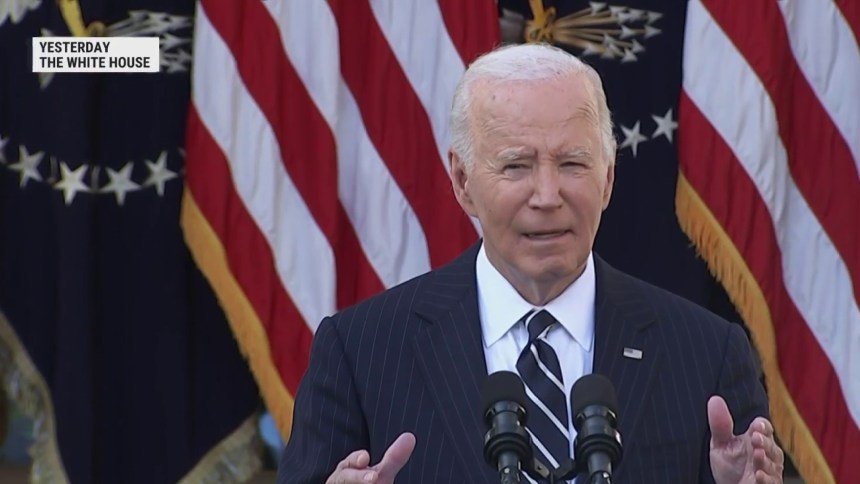
Critics like Sanders would likely argue that these successes weren’t messaged properly to working-class Americans. That’s not true either. As the New Republic’s Greg Sargent pointed out earlier this week, the Harris campaign poured $200 million into ads that focused on her economic message. In fact, she outspent the Trump campaign by around $70 million on ads about the economy.
What was the content of these ads? Calls to end corporate price gouging, lower housing costs, cut middle-class taxes and protect Social Security and Medicare. Other Harris ads accused Trump of only looking out for his billionaire pals and corporations and attacked him for enacting tax cuts that were primarily directed at the wealthiest Americans.
This is the definition of an economic populist message.
Critics like Sanders would likely argue that these successes weren’t messaged properly to working-class Americans. That’s not true either.
Yet, Biden’s record and the disparity in the two candidates’ economic messages didn’t increase the party’s support among working-class voters (which are defined here as those without a college degree). Arguably, it improved Harris’ margins in swing states where these ads predominately ran, but according to preliminary exit polls, Trump won them by 14 percentage points over Harris (56%-42%), a 6-point improvement over his performance in 2020.
Harris only did one point worse than Biden among white working-class voters, but she was still mired in the low 30s with them. Instead, her losses came among the nonwhite working class, a group with which she did 16 points worse than Biden — and 26 points worse than Hillary Clinton.
In short, under Biden, Democrats adopted one of the most pro-working class policy agendas in recent political memory, enacted much of it — and accrued no electoral benefit.
As for Trump, his main economic agenda item was a pledge to increase tariffs, which by increasing costs on imported items, would have disproportionately harmed low-wage workers. Did he have a plan for lowering housing or dealing with health care? What about lowering inflation?

What Trump essentially offered the working class were attacks on undocumented immigrants, which his campaign blamed for much of the nation’s ills.
As in 2016, Trump served as a political voice channeling the fears, cultural grievances and resentments of working-class Americans — and, as has been the case for much of the past 60 years for Republicans, it worked.
Of course, it’s not just Trump. The GOP’s attention to the white working class is overwhelmingly symbolic. They offer nothing substantive on policy. They oppose expanding health care access or raising the minimum wage.


During Trump’s tenure in office, his major legislative accomplishments were a tax cut for the wealthy and the further tilting of the economic playing field in favor of corporations and not workers. While some working-class voters drifted away from him in 2020, he easily won them back in 2024 (and of course, won the majority of such voters in both elections). None of his policy positions mattered much at all.
During Trump’s tenure in office, his major accomplishments were a tax cut for the wealthy and further tilting the economic playing field in favor of corporations, not workers.
Take, for example, what happened in Missouri on Election Day. Voters in the Show Me State didn’t just narrowly support a referendum enshrining a right to abortion in the state constitution by a 58%-42% margin, they backed a ballot measure raising the minimum wage and requiring employers to provide paid sick leave. Yet, at the same time, only 40% of the state’s voters cast a ballot for Harris, who, unlike Trump, supports both policy initiatives.
Democrats are a party of “doing stuff” with an electorate utterly indifferent to the stuff they do.
As Larry Mishel, former president of Economic Policy institute, who has written extensively on politics and the working class, said, there is a glaring lack of connection between material reality, even material gains, and recognition or appreciation for such gains. “Partisanship shapes perceptions. There is simply a disconnect between policy, outcomes, and political rewards.”
Is there a path for Democrats to reverse their declining support with the working class? The short and depressing answer is that they likely can’t.
Appeals to the working class might have worked for Democrats when the Republican presidential nominee was a blue blood like Mitt Romney or even a creature of Washington like George H.W. Bush or Bob Dole. But when facing off against a racist demagogue like Trump, it’s a nearly insurmountable challenge.

Moreover, the Democrats’ political coalition is liberal and overwhelmingly Black (even with the inroads Trump made on Tuesday), which only compounds the challenge. The party can’t run against undocumented immigrants or retreat on cultural issues like guns, LGBTQ and civil rights, or abortion, which are such powerful political drivers among the working class.
In 1992, Bill Clinton could get away with naked appeals to white voters, like when he attacked the rapper Sister Souljah. Back then, the Democratic Party was around 80 percent white. Today, the number is closer to 56 percent.
Quite simply, the Democratic coalition as presently constructed doesn’t allow for the kind of political appeal that might (but probably wouldn’t) win back the working class.
Indeed, when I recently asked a red state Democrat what the national party would need to do to win over working-class Republicans, he joked, “Firebomb an abortion clinic.” The cultural divide is so intense — and Republicans are so hostile toward the left — that it’s hard to see any reasonable way for Democrats to bridge it.
If there is any path for Democrats to return to national power, it might be in doubling down on what produced such significant political gains for the party in 2018, 2020 and 2022 — college-educated suburban voters. At the same time, they need to find ways to arrest their slide with minority voters. Or considering the fact that the last four presidential elections have gone Democrat, Republican, Democrat, Republican —which hasn’t happened in America since the late 19th century — maybe they should just wait for an inevitable anti-Trump backlash.
But if Democrats think they can win back the loyalty of the working class, they likely should think again.

Michael Cohen is an MS NOW columnist. He is also the publisher of the newsletter Truth and Consequences and hosts the weekly podcast That ‘70s Movie Podcast.