





Recent history has provided White House chief of staff Jeff Zients with two road maps he could follow now that House Republicans have officially launched an impeachment inquiry against President Joe Biden. He could take the approach former President Bill Clinton’s administration did and comply with the House’s request even as he offers a solid defense of the president. Or he could take a page from former President Donald Trump’s playbook and dig his heels in against Congress. Both Clinton’s strategy and Trump’s strategy worked, in a sense, but only one of them would respect the Constitution and have the added benefit of demonstrating that the House’s investigation is just a charade.
The strategy developed by John Podesta, Clinton’s fourth and final chief of staff, was to draw a bright line between the actual work of the president and the work of defending Clinton from the investigation into his affair with Monica Lewinsky. To staffers not working on impeachment caught talking impeachment, Podesta warned, “I will break your [f—ing] neck.” Maintaining such strict discipline among staffers was intended to show the public that Clinton was busy running the country while Republicans were prying into personal affairs.
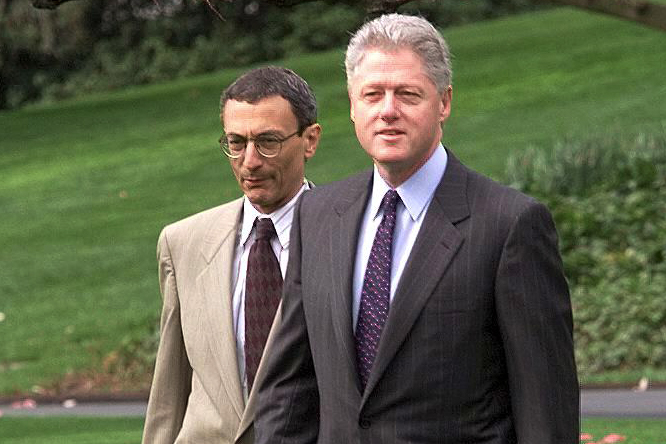
There were definitely accusations that the White House was stonewalling during independent counsel Kenneth Starr’s investigation, especially once the news about Lewinsky broke. But Podesta and other senior officials sat for grand jury testimony that eventually was included in Starr’s final report. Even though Clinton questioned the wisdom of launching an impeachment inquiry, his administration never questioned the House’s right to launch one.
Even though Clinton questioned the wisdom of launching an impeachment inquiry, his administration never questioned the House’s right to launch one.
Clinton instead promised that he would fully cooperate with Congress provided that the inquiry was “constitutional, timely and fair.” Clinton submitted answers to 81 questions from the House Judiciary Committee, and Starr himself testified to defend his findings, but there was little in the way of original investigation. The House eventually did pass two of four articles of impeachment, neither of which gained much traction in the Senate trial, even among many Senate Republicans.
The other strategy comes from Mick Mulvaney. As “acting” chief of staff for Trump in late 2019, he was seen as more of a figurehead than an actual leader, especially when the Ukraine scandal kicked off. Mulvaney was also deeply implicated in the scheme Congress was investigating. Trump had withheld military aid to Ukraine to pressure its president to announce investigations of Biden and his son Hunter.
Mulvaney, the former head of the Office of Management and Budget, and his successor, Russ Vought, were key figures in making sure that the millions of dollars that Congress had appropriated didn’t go out the door. Mulvaney made the crucial mistake of telling the truth at a disastrous news conference, admitting that the aid and the call to investigate the Bidens were linked and telling the media to “get over it.”

Unlike Podesta, Mulvaney insisted that there be zero cooperation from the administration with House Democrats’ impeachment inquiry. And in contrast to the relatively unified White House under Podesta, Mulvaney clashed with the White House counsel over the members of the administration who did testify during the House inquiry.
In a late-game attempt to shift to the Clinton model, the White House tried arguing that Trump was focused on governing while Democrats were obstructing progress. But that claim rang hollow, as Trump had never been focused on governing. The House passed two articles of impeachment against Trump, one of which accused him of “obstruction of Congress” for refusing to hand over requested documents and ignoring congressional subpoenas. Mulvaney was one of the Trump staffers who refused to testify despite having been subpoenaed.
For now it looks like the Biden White House plans to follow the Podesta model, at least to a degree. It has spent the months since the GOP reclaimed control of the House hiring lawyers for the White House counsel’s office to prepare for a probable impeachment probe. It has also launched a “war room” and walled off the rest of the White House from impeachment matters. For Biden, full compliance is the better option, no matter how asinine the requests are or how deep into the weeds this snipe hunt goes. But the wide-reaching probe by House Republicans could eventually prompt the White House to be more standoffish. Among the things GOP investigators are demanding are bank records from Hunter Biden and Jim Biden, the president’s son and brother, respectively, in an attempt to link him to their accusations of corruption and bribery. The New York Times has reported that Biden’s staffers “have said they have cooperated with requests for information during the investigations so far but would not commit to how they would handle future requests since they have not received them.” The Trump administration also left Zients a potential Pandora’s box of a gift that could be used to justify denying document requests. A 2020 memo from the Justice Department’s Office of Legal Counsel determined that an impeachment inquiry is invalid without a vote of the full House. And, wouldn’t you know it, Speaker Kevin McCarthy, R-Calif., kicked off this inquiry without a vote, most likely because he didn’t have the votes. The lure of going tit-for-tat with the GOP on this front is tempting, especially after the fuss Republicans made during the 2019 Trump impeachment. But that Office of Legal Counsel opinion wasn’t based on any concerns about the House’s legitimacy; it was meant only to safeguard Trump specifically, and it attempts to put constraints on what is ultimately a power only the House can determine for itself. No, for Biden, full compliance is the better option, no matter how asinine the requests are or how deep into the weeds this snipe hunt goes. Going along with this farce will be deeply annoying, time-consuming and likely expensive for both the executive and legislative branches. But if the White House wants to show that any articles that may eventually be drafted aren’t worth the Government Publishing Office paper they’re printed on, it should fully cooperate so the GOP’s failure to make a case can’t be blamed on stonewalling from Biden.
Hayes Brown is a writer and editor for MS NOW. He focuses on politics and policymaking at the federal level, including Congress and the White House. 

