




In the long and ongoing struggle between American workers and employers, the U.S. government has mostly come down on the side of employers. Federal power more often than not has been explicitly exerted in favor of corporations, or the federal government, through willful neglect, has allowed companies to run rampant against labor.
It’s striking, then, that the Treasury Department published a report Monday that concludes labor unions are good for economic growth. The pandemic and its aftermath saw a surge in victories for workers. The finding comes as a cooling labor market has raised concerns that the pendulum has begun to swing the other way. But coupled with other data from the last week, this report provides even more ammo to support workers’ pushing for fairer conditions and wages.
This report provides even more ammo to support workers’ pushing for fairer conditions and wages.
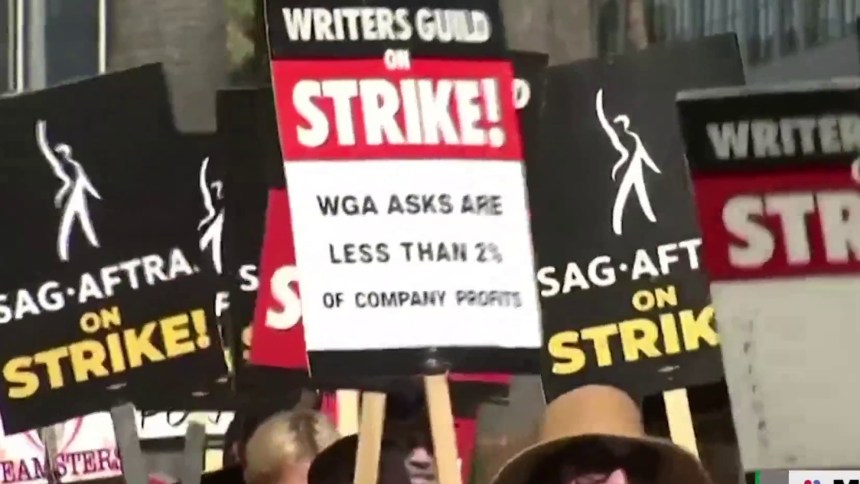
Worker solidarity has been one of the biggest headlines this “hot strike summer.” Screen actors and writers remain on the picket lines against major production studios. UPS and the Teamsters managed to come to a deal after a looming strike threatened to pull around 340,000 drivers off their routes. UPS workers ratified that agreement on Aug. 22 — but three days later, on Friday, members of the United Auto Workers voted overwhelmingly to authorize a strike if the Big Three automakers don’t meet their demands.
It’s in that charged environment that Treasury Secretary Janet Yellen and Vice President Kamala Harris hailed the report’s release. In a call with reporters Harris stressed that “when union workers stand in solidarity and fight for better wages, better benefits and better working conditions, it benefits all workers.” Yellen said the report’s findings “challenge arguments that unions hold back growth.” Instead, she said, stronger unions “could contribute to reversing the stark increase in inequality we’ve seen in recent decades, promoting economywide growth.”


Yellen’s comments reflected the way the Treasury report states what should be basic concepts in such a matter-of-fact way — like, for example, that the wage gap between the top 1% and everyone else has grown as union power has declined. It shouldn’t be controversial to note that unions “raise wages, fringe benefits, and amenities for their members, and spillovers lead to similar improvements for nonunion workers.” Nor should it be overlooked that Monday’s report also makes the case for unions’ benefiting companies:
In addition, evidence suggests that unions’ contribution to firms’ productivity likely makes modest positive contributions to overall economic output. Furthermore, the theory and empirics are clear on the ways in which unions have, in the past, and could, in the future, increase productivity more substantially: through increasing the voice effect of union members and increasing workers’ happiness and connection to their jobs. Unions are well positioned to target these goals in their negotiations and to emphasize the benefits that could come to both workers and firm owners alike with productivity-enhancing actions.
Treasury’s stance is a long overdue rebuke of the Reagan era’s demonization of unions and the corresponding increase in union busting by private corporations. And it comes on the heels of a pair of National Labor Relations Board decisions that make it easier than it has been in decades to organize. In brief: If a company doesn’t voluntarily recognize a union, that union can ask the NLRB to run an election to show that workers really want to be unionized; if the company violates labor law before or during the election, the NLRB will order the company to recognize the union and start negotiations right away; and elections can’t be punted into the future with delays.
The Biden administration may be guilty of being a little too self-congratulatory about its support for unions. Organizers haven’t forgotten the role President Joe Biden’s Labor Department played in imposing a contract on railway workers who’d threatened to strike last year. And while it’s true that Biden has cleared the low bar for being the “most pro-union president ever,” the White House has a long way to go before it can be said that the full weight of the government is on the side of workers.
But I appreciate the rarity of having an administration that understands that the American middle class didn’t simply spring forth as a product of the free market. It was born, in fits and starts, thanks to the hard-won victories that the labor movement achieved over decades and against some of the most powerful forces that unfettered capitalism has marshaled. In linking the renewed growth of the middle class to the rebirth of unions, Biden has staked out a position that has the potential to actually earn him the plaudits he seeks.

Hayes Brown is a writer and editor for MS NOW. He focuses on politics and policymaking at the federal level, including Congress and the White House.