




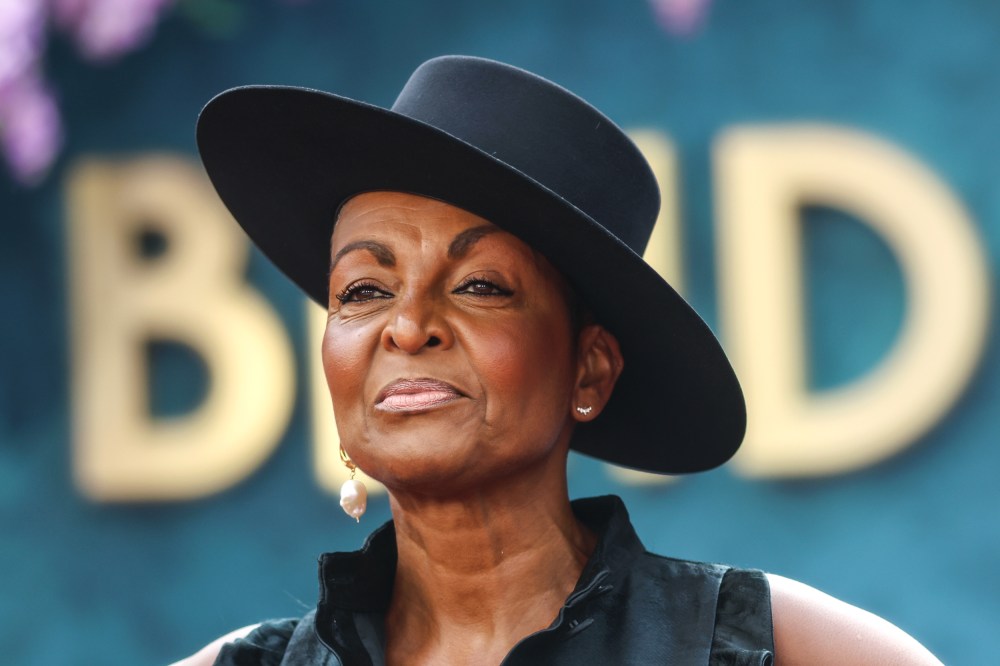
The war on “wokeness” has crept down the chimney and into the season of wonder and light, with right-wingers causing a spat over a British Christmas commercial that portrays Mrs. Claus as an elegant Black woman who runs the roost as her husband rests with his feet up by the fire.
In case you haven’t seen this ad for the company Boots, a massive health and beauty retailer known for extravagantly produced Christmas ads, let me explain. This year’s commercial, called “Making Magic,” takes the viewers inside Santa’s workshop, with a quick pit stop in Santa’s home chalet. Mrs. Claus, portrayed by Adjoa Andoh, known for her role as Lady Danbury in the Netflix romance series “Bridgerton,” stomps through the door to see her husband snoozing in his red suit.
The war on ‘wokeness’ has crept down the chimney and into the season of wonder and light.
After letting out an impatient “There he goes again” gasp, Mrs. Claus whips off her sunglasses, applies some lipstick and gets down to business with a very British “Shall we?!”
She is fit, festive and fashionable. Big earrings. Toned arms. Short Afro. Long gown. It really is worth watching the spot so you can see for yourself how she swans about surrounded by a glittery swirl of worker bees and werk-it-gurl elves who help her put the finishing sparkle on gifts that will be delivered by her husband after his cat nap. When Santa wakes up (finally!) and takes off on his appointed rounds, Mrs. Claus cheekily turns to the camera and says, “You thought it was all him?”
The whole scene is like a fever dream fantasy with Eve’s hit song “Who’s That Girl?” as the thumping soundtrack. But right-wing critics in Britain said the ad was a nightmare, and some turned to X to call for a boycott, claiming the ad was “woke on steroids” and “anti-white racism.”
Some noted that at one point Mrs. Claus used them/they pronouns, and a conservative British Catholic cleric speaking on a podcast said, “Santa Claus was portrayed as some big, fat, lazy oaf.” Critics from the U.K. were particularly offended by the casting of Andoh, who stirred up a bit of controversy while serving as a commentator for ITV’s coverage of the coronation of King Charles when she referred to the royal family as being “terribly white” in contrast to the “rich diversity” of the people present in Westminster Abbey during the event.
Because Boots is a part of the Walgreens global pharmacy conglomerate, the #boycottboots hashtag has drifted across the Atlantic, where some right-leaning consumers in the U.S. say they might shop somewhere other than Walgreens.
This feels like performative umbrage. People are that deep in their hackles about a commercial that satirizes a fictional character who rides on a sleigh pulled by flying reindeer and mythically squeezes himself down chimneys all the over the world to deliver gifts to millions of children (of all colors) on a single night? Really?
I understand that tradition is important, but sometimes it seems obvious the people who insist on gatekeeping a traditional retrograde world order are looking for reasons to stoke division instead of just letting people do their own things in their own lanes.
Did they completely miss the advertiser blowing a kiss to all the women who do the bulk of the physical work during the holidays that fall at the end of the year?
And here is what I find most mystifying: Did they completely miss the cheeky undercurrent where the advertiser was blowing a kiss to all the women — regardless of color, class, religion or geography — who do the bulk of the physical work during the religious and cultural holidays that fall at the end of the year?
And that doesn’t even include all the emotional labor.
At the end of the commercial, when “Who’s That Girl?” is cranked up, there is a hat tip to the women who do most of the cooking, cleaning, planning, shopping, organizing, decorating, deconstructing, entertaining, elevating, hand-holding, shipping, wrapping, refereeing and general whirligig sprinting at full tilt, until they can finally kind of, sort of relax on the unofficial Dec. 26 holiday known as “don’t ask Mama for a darn thing all day or else you might just get your feelings hurt.”


Advertisements are designed to work on several levels. Of course, the first order is to get consumers to open their wallets. But the pathway to a purchase often means tugging on some emotion or making a potential consumer feel seen, understood or empowered in some way. This is where the diversity, gender and culture wars can create a landmine. Creating a sense of belonging for a group that is not respected or accepted by another group can stir up vertigo, anger or an excuse to go on the attack.

Conservative groups have targeted companies that lean into diversity with the phrase “go woke and go broke,” sparking boycotts and whipping up a froth of social media backlash. (Though “woke” is still a term that no one can precisely define beyond the assertion that someone or something is doing something or promoting someone they don’t like or condone.) Target saw a dip in digital sales after prominently featuring Pride merchandise. Bud Light also saw sales sink by 10% when it featured a transgender TikTok influencer in a promotion. British carmaker Jaguar also saw a backlash more recently after unveiling an avant-garde rebranding campaign that that attempts to “break moulds” by featuring diverse, austere models dressed in rainbow colors and spangly makeup.
No doubt about it, that Jaguar ad is indeed unusual, especially for a car advertisement. But it was wasn’t the eccentricity that stoked controversy, but the diversity and the nod toward LGBTQ culture.
The conservative groups lambasting these companies and their campaigns seem to engage in a theory of subtraction by addition. If diversity is part of the equation, then they lose something, and what they sometimes feel is snatched from them is the centering of majority-culture stories and majority-culture characters as the reflexive cultural default.
Conservative groups have targeted companies who lean into diversity with the phrase “go woke and go broke,” whipping up a froth of social media backlash.
And yet, the Boots ad is part of an overall trend where the commercials are sometimes more diverse than the programming we see on our screens — because corporations fully understand demographic trends on the horizon, especially in America. Even as companies like Walmart, Ford and Molson Coors have retreated from their diversity, equity and inclusion programs for employees known as DEI due in part to pressure from conservative activists, businesses across the U.S. continue to churn out commercials reflecting their acknowledgment that the consumer base is indeed increasingly diverse. Census projections predict that non-Hispanic white people will comprise less than half of the U.S. population within the next two decades.
It’s why you see more Black, brown, Asian and Indigenous characters throughout advertising. It’s why you see ads with so many mixed-race couples planning for vacations and shopping for home appliances. And it’s likely why companies like Boots, Jaguar and others will nod to a wave of diversity that includes trans, nonbinary, gay or gender-fluid individuals.
Consider this: A Gallup poll released in 2023 found that 1 in 4 high school students surveyed in the U.S. identify as being somewhere on the LGBTQ spectrum. Of the students surveyed in 152 schools nationwide, 26% identified as LGBTQ, 12% identified as bisexual, 5.2% identified as questioning, 3.9% identified as other, 3.2% said they were gay or lesbian, and almost 2% said they did not understand the question.

One in four is a large number. Those students will soon be adults deciding where they purchase soap powder and SUVs. And with numbers that large, those students are dispersed all across America in all kinds of communities, and maybe even inside the families of the people bellowing most loudly about an ad that riffs on a fanciful brown-skinned, be-Afroed Mrs. Claus character, surrounded by a swirl of festively efficient elves who appear to be queer, trans or gay — or folks perfectly comfortable working alongside that cohort.
The fact is, not everyone is comfortable working or living alongside that cohort. That is going to take some time, and in truth we might not get there for decades. Our divisions seem to be widening. So, for people who hate the themes and ideas presented in the Boots commercial’s glimmering rendition of Santa’s “werkshop,” maybe the best thing is to treat it like a Christmas present you never really wanted. Put it aside. Lock it away. Put it out of view and understand that everything is not for everyone. But everyone deserves to see themselves reflected in some way, some of the time.

Michele Norris is a senior contributing editor for MS NOW.