




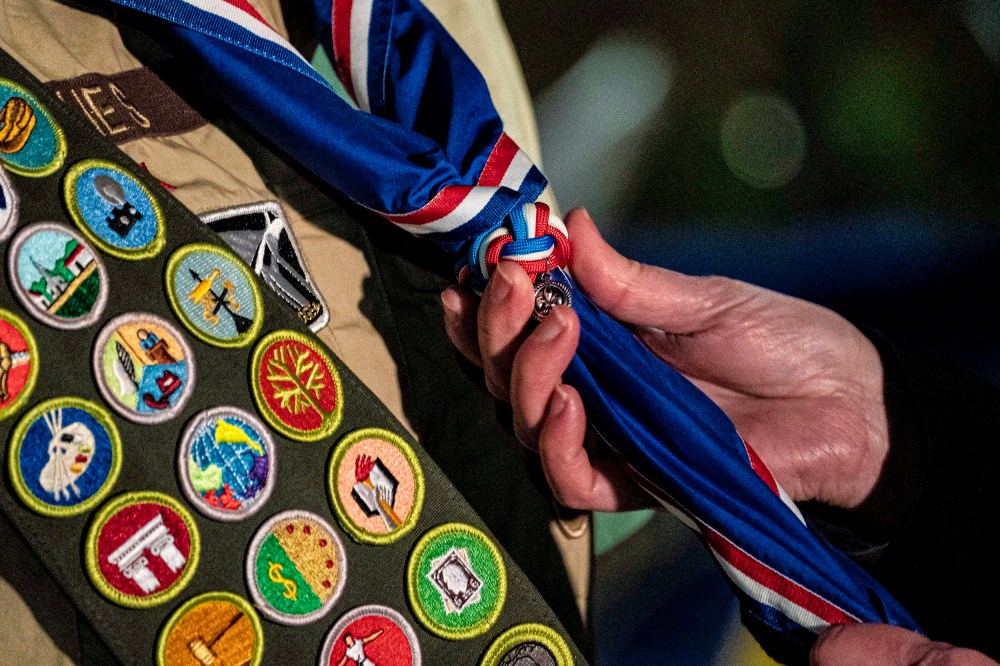
On a clear night in the winter of 1991, I faced my final test to become an Eagle Scout. I had earned the required 21 merit badges, learned to make a one-match fire, cleared invasive brush from a local park and hiked for miles through the rainforests of the Pacific Northwest to get to this point. All that was left was a short interview with two older men at the local office of the Boy Scouts of America in Seattle.
Naturally, I almost blew it.
After reviewing my application line-by-line with the steadfast efficiency of traffic court judges, the two men asked if there was anything else I wanted to say before they decided whether I would be granted the rank of Eagle, the organization’s highest award.
The smart move would have been to say nothing. But I thought of the Scout Law, which states, among other things, that a Scout is brave.
The smart move would have been to say nothing. But I thought of the Scout Law, which states, among other things, that a Scout is brave and forged ahead with a long-winded argument for making Scouting more welcoming to boys who were from other religious backgrounds — or even not religious at all — by dropping or changing the constant references to a “duty to God” in meetings.
I have no idea why I chose this particular crusade. The troop met in my own Presbyterian church and no one had ever complained to me about this. I just thought the Scouts should be more inclusive.
The two men, who were the right age to have fought in World War II, sat stone-faced as I went on with my earnest little speech. When I finished, they said only a curt “thank you” and sent me on my way. They clearly disagreed with my argument, but I passed the review.
I have thought of this moment a lot over the years, as the Boy Scouts faced repeated tests of how welcoming it would be. When I was a Scout, the organization ended a 14-year legal fight over refusing to allow a woman to be a scoutmaster and lead a troop. The organization went on in the 1990s to fight court battles all the way up to the U.S. Supreme Court for refusing to allow gay scoutmasters. And while there are Boy Scout troops based at Buddhist temples and Unitarian churches, the BSA reiterated as recently as 2018 that promoting a belief in monotheism is central to its mission.
But recently the tide has shifted.
In 2014, the Boy Scouts lifted a ban on gay Scouts but kept a kind of “don’t ask, don’t tell” policy in place for adult leaders. In 2015, it ended the ban on openly gay leaders as well. In 2017, it allowed transgender boys to join. And in 2019, it allowed girls to join their flagship program and earn the rank of Eagle. (Girls can also still choose to join the Girl Scouts, a separate organization that has long charted a more inclusive course.)

In light of these changes, the group’s leadership announced recently that it would change its name to Scouting America next year. The organization’s new president, Roger Krone, said the more inclusive name is meant to make clear that all children and teens are “very, very welcome” to join.


“It sends this really strong message to everyone in America that they can come to this program, they can bring their authentic self, they can be who they are and they will be welcomed here,” he told The Associated Press.
Social conservatives harshly criticized the change. Rep. Andrew Clyde, R-Ga., complained on X that “the Left has now taken ‘Boy’ out of ‘Boy Scouts.’” Sen. Ted Cruz, R-Texas, who also opposed allowing gay scouts in 2013, wrote on X that the rebranding would “make clear that ‘boys’ are no longer welcome.” The social media account Libs of TikTok, best known for singling out school librarians and children’s hospitals for attacks for being LGBTQ-friendly, plaintively asked, “Why do they have to ruin everything?” while commentator Ben Shapiro said it represented the “hollowing out” of the Scouts.
Almost all of this commentary — much of which is coming from non-Scouts, as best I can tell — is wrong. The Boy Scouts remain overwhelmingly boys; only about 176,000 of its 1 million members are girls. And any hollowing out already occurred under older, less inclusive policies.
The Boy Scouts were on a downward path the entire time it was fighting to keep certain kids and adults out.
Coincidentally or not, the Boy Scouts was on a downward path the entire time it was fighting to keep certain kids and adults out. The group’s membership dropped from a peak of 4.8 million in the 1970s to 2 million in 2018. It lost more when the Church of Jesus Christ of Latter-day Saints cut its ties in 2019 to start its own youth program and suffered further losses when the pandemic made big meetings of young kids impossible.
The Boy Scouts also took a big hit in public confidence over its handling of sexual abuse, which it has only recently resolved. In 2023, the group came out of a Chapter 11 bankruptcy with a plan to establish a $2.4 billion fund to support more than 80,000 men who suffered sexual abuse in Boy Scout-related activities. It has also put in place new policies to report and investigate suspected abuse and support victims in the future.
By many measures, the new Scouting America will be a more inclusive and thoughtful program than the Boy Scouts I was in as a teen. More kids will be welcomed; more diverse leaders will be in charge. But for those of us who have been paying attention, it’s clear that these changes came only after Scout leadership fought them as hard as they could for as long as they could.
The Boy Scouts became inclusive only as a last resort, and there’s nothing brave about that.

Ryan Teague Beckwith is a newsletter editor for MS NOW. He has previously worked for such outlets as Time magazine and Bloomberg News. He teaches journalism at Georgetown University’s School of Continuing Studies and is the creator of Your First Byline.