




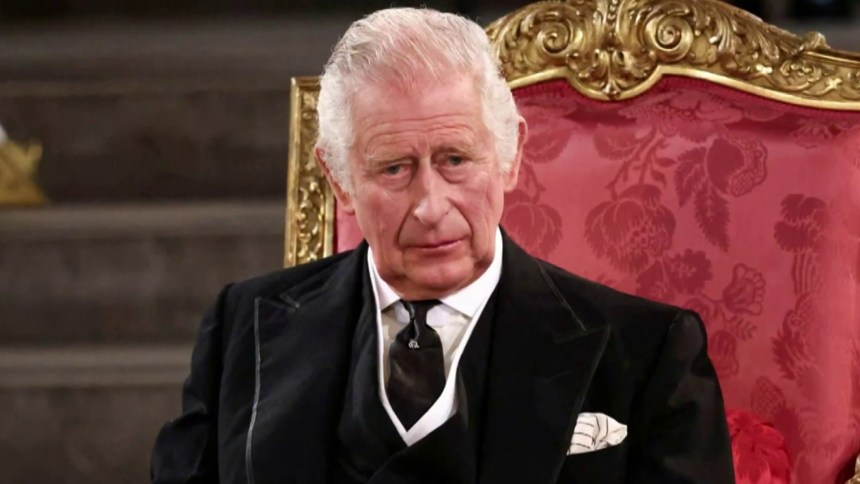
Something strange happened after Queen Elizabeth II died: the tide in the U.K. seemed to shift around the recently anointed King Charles III, who spent much of his life being generally disliked for some combination of perceived ineptitude, controversy, lack of leadership and, well, lack of likability. It came as a surprise, then, his sudden boost in approval ratings after the queen passed away.
But it appears that’s now over.
Charles’ comparatively lower approval ratings — his mother maintained around an 80% approval rating for the last decade of her life — has precipitated an existential crisis of sorts for the monarchy.
I am half-English and have spent a lot of my life there. Throughout much of my childhood, collective dissatisfaction over the heir to the throne hummed in the background, a cultural fixture of sorts. This reached its peak with Charles’ 1993 phone sex scandal, in which secretly recorded conversations between him and Camilla Parker Bowles, during their extramarital affair, were released — a big embarrassment for Charles, not least because of his appalling attempt at dirty talk (lest you forget, he professed to wanting to be Camilla’s tampon).
I was in England when the queen died and the change in attitude toward Charles was palpable, if not a little jarring for a republican — or anti-monarchist — such as myself. The tenor changed. The media was overwhelmingly sympathetic. Even my own mother, for whom Charles had been a point of ridicule, exhibited a newfound affection for Elizabeth’s heir. Charles’ approval ratings shot up to 70% in the immediate aftermath of his mother’s death, after steadily hovering between 50% and 60% for the previous decade. The latest Ipsos poll, however, released April 28, shows Charles’ approval ratings plummeting to 49%.
Any distaste for Charles as an individual is of course matched by the monarchy’s own baggage, a veritable who’s who of transgressions and atrocities, from racism to colonialism to sexual misconduct.
Back in September, I spoke with William Emes, a 30-year-old mental health professional, who said the scandal involving Prince Andrew, in which he was accused of raping a trafficked teenage girl, soured his view of the royal family. A self-identified socialist, Emes also objected to the vast inequity upon which the institution is predicated — supported by tax-payer money no less. In terms of his views of Charles himself, Emes expressed ambivalence: “I see him as someone who certainly wasn’t great when he was young, but maybe he’s matured a bit more.”
Ruby Baker, 30, whose family is Irish and staunchly republican (there is a strong anti-monarchist sentiment amongst the Irish, who successfully fought for independence from the United Kingdom), reflected a more unequivocal stance on the monarchy, of the kind more likely to be reflected in younger Brits. “They’re not just quaint little figures who are rolled out at events; they actually do something, stand for something, and in a democratic society I don’t know how we can stand for this — it’s like a divine right to inequality,” Baker said.


Charles’ comparatively lower approval ratings — his mother maintained around an 80% approval rating for the last decade of her life — has precipitated an existential crisis of sorts for the monarchy. In the wake of the queen’s death, many Commonwealth nations are reevaluating their relationship with the United Kingdom. For 14 of these nations, the British monarch is still technically their head of state. A number of these countries — including Antigua and Barbuda, Belize, the Bahamas and Jamaica — have indicated they will reevaluate their relationship with the monarchy and decide whether to remove Charles as head of state. Less than a week after the queen died, Bahamas Prime Minister Phillip Davis announced his intention to hold a referendum on the matter.
The monarchy and its Commonwealth appear to be all the more vulnerable amidst a climate of waning tolerance for anachronistic institutions.
This is, of course, not a new phenomenon. It is a reflection of changing times predating the queen’s death. In November 2021, Barbados removed the queen as head of state. But without the queen at its helm, a steady symbol of continuity for over seven decades, the monarchy and its Commonwealth appear to be all the more vulnerable amidst a climate of waning tolerance for anachronistic institutions, and at a time when questions of class and race are being foregrounded.
“The accession of Charles is of course putting this debate front and center: What are we doing with this British, distant, White monarch as our head of state?” Kate Quinn, associate professor of Caribbean history at University College London, told The Washington Post in September. She added, “The voices are getting louder. I think we’re in a particular historical moment where a number of factors are coalescing that could create fertile ground for the proposed changes to succeed.”
Charles’ coronation perhaps marks the end of an era more than it marks the beginning of one. His slumping approval ratings reflect growing dissatisfaction with the monarchy overall, which are at historic lows. The latest survey from the National Centre for Social Research shows only 29% of Britons believe the monarchy is “very important.” These dwindling numbers were tenuously outweighed by the queen’s high approval ratings, behind which the monarchy can no longer hide.
Baker believes Charles’ reign will be more of the same. “I think he probably will do the exact same stuff — I think his legacy will probably be very similar to hers.” This, it would seem, is all that is necessary for the monarchy to atomize, a trajectory which higher approval ratings might be able to delay, but lower ones will only accelerate. Baker holds out hope, however, that the end will come with more of a bang than whimper: “Hopefully, he will f— it up and end it all.”

Noor Noman is a writer focused on culture, race and LGBTQ issues.