




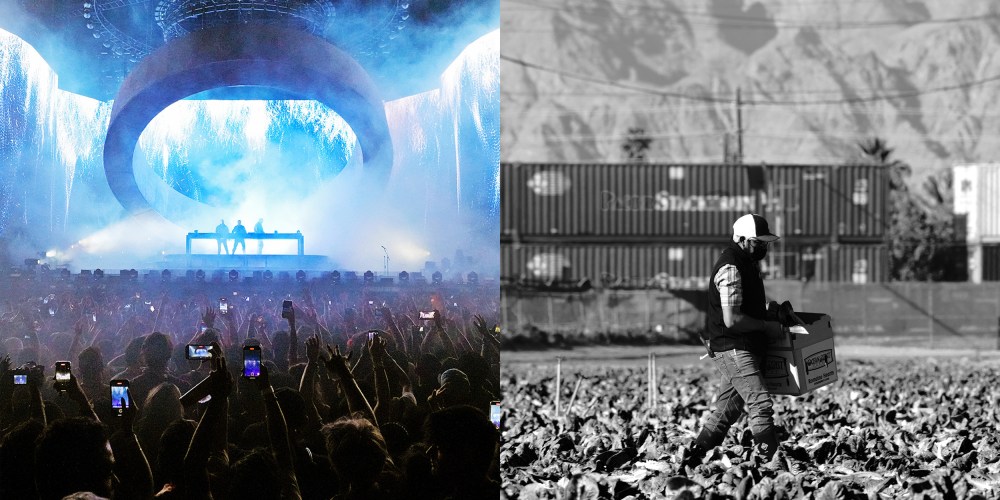
There have always been two Coachellas, which means a viral Instagram post from The Farmworker Project calling attention to “a continued and historical marginalization” of the valley’s farmworkers is, as the words “continued” and “historical” suggest, not sharing any new information.
The “Valley of Contrasts” was that even before the debut of the Coachella Valley Music and Arts Festival.
The “Valley of Contrasts,” as it has sometimes been called, was that even before the debut of the Coachella Valley Music and Arts Festival in 1999. (This year’s two-week festival ends Sunday.) And despite The Farmworker Project asking people who see its social media post to tag their favorite musical artists, the disparity between opulence and hardship won’t change unless everyone looks past the glitz and glamour onstage and sees the people who help make the festival happen.
Even though the contrasts are old, they appear to be getting even starker. For example, in 2019, the Desert Sun described how farmworkers, after hours of picking grapes in the oppressive heat, were picking up $11 per hour night shifts as garbage crew members at the music festival, which in 2017 alone raked in $114 million in profit.
“Between the two gigs,” the newspaper noted, “they could work up to 48 hours between Friday morning and Monday afternoon.”
In November, Yahoo News described how extreme heat in the Coachella Valley region has created a “climate gap” between “mostly immigrant farmworkers and more affluent residents” in a report that noted that “low-income communities are the first and worst hit by global warming.” Exposure to such extreme heat can lead to death. Last summer, in a story on rising temperatures and health risks in the valley, Kaiser Health News reported that 58-year-old farmworker Leoncio Antonio Trejo Galdamez had died in his son’s arms after working on an irrigation pipe project during the day.
The Covid-19 pandemic has only exacerbated the problem for a farmworker community with deep immigrant and Mexican roots. A 2020 Los Angeles Times story described how the coronavirus had caused major health and economic disruptions to an area that is close to 97 percent Latino and where, based on latest census data, almost 19 percent of people live below the poverty line. When the Coachella City Council passed a “hero pay” ordinance mandating certain businesses pay employees an additional $4 an hour for 120 days, growers associations sued the city and claimed that paying farmworkers more money would hurt their companies’ bottom line.
When the Coachella City Council passed a “hero pay” ordinance mandating certain businesses pay employees an additional $4 an hour, growers associations sued the city.
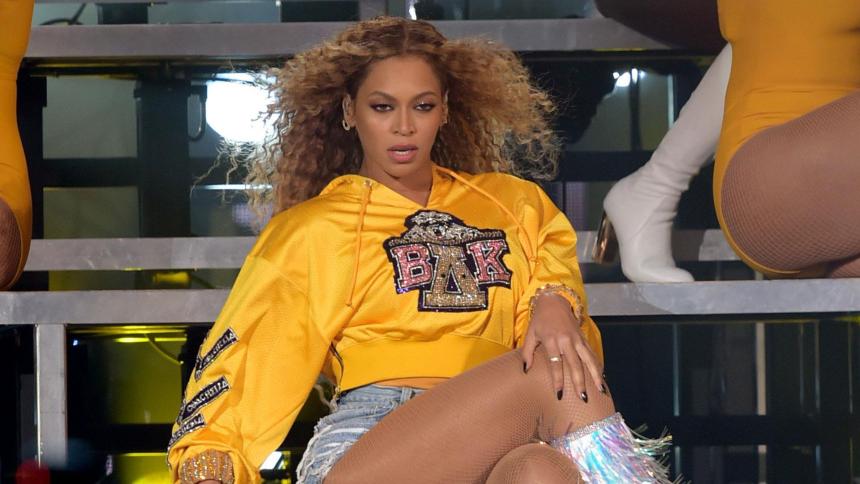
Such examples should raise serious concerns about the welfare of the people who work in Coachella Valley, but every time the Coachella festival rolls around, the spotlight mostly stays fixed on the talented millionaires who take the stage; it rarely swings around onto the invisible Coachella. Entertainment media coverage is a serious business, and in the end, publishing stories about angry influencers or mango sticky rice will always take precedence.
Once again, America’s farmworkers — or, better stated, America’s immigrant and Latino farmworkers — get ignored.


Given that Coachella Valley is where a 1965 strike by Filipino farmworkers started the modern-day fight for farm labor rights and resulted in the creation of the United Farm Workers, you would think more high-profile Coachella musicians, celebrities, brands and influencers could be more vocal about the plight of those farmworkers. Sure, having “Mexican royalty” Grupo Firme play during the 2022 festival is a big deal, but mainstream acts raising awareness about the invisible Coachella when they have the platform would be an even bigger deal.

But those big acts speaking out is unlikely, which is why it’s important to amplify the work of local voices and artists who want the world to see “the other Coachella” through a mural collection called the “Coachella Walls.” The murals celebrate the city’s past and working-class roots, but they also depict topics such as pay equity and the dignified treatment of workers.
Farmworker communities must continue to be elevated in this country. An invisible population, even after two years of a pandemic, farmworkers are literally “The Humans Who Feed Us,” as Mónica Ramírez, founder and president of Justice for Migrant Women, calls her project that focuses on the lives of farmworkers. The work they do should be enough for Americans to be grateful, but in a society that favors spectacle and massive music festivals, farmworkers still lose out.
Latino farmworkers have been more likely to contract Covid-19 than non-Latino farmworkers, and there is legislation in Congress to acknowledge such sacrifices. According to its co-sponsors in the House, the bill would create “a first-of-its-kind, merit-based visa program specifically designed for the nation’s agricultural sector.” Congress could pass that or other farmworker protection bills right now. The prospect, however, seems bleak, given how polarized and partisan Congress is.
Congress could pass farmworker protection bills right now. The prospect, however, seems bleak, given how polarized and partisan Congress is.
History helps explain why farmworkers are still an invisible group. U.S. policies such as the Bracero Program, a 1942 agreement that allowed Mexican guest farmworkers to fill a labor shortage caused by World War II, tolerated inhumane conditions that persist today. After bringing in guest workers, exploiting undocumented workers and benefiting from cheap labor, in the 1950s, the U.S. government conducted mass deportations of Mexican workers. Such a pattern clearly demonstrated how much Americans thought of low-wage workers: You can pick our food, but you won’t ever earn the right to live a life worthy of such work.
These patterns keep repeating, and those dismissive attitudes still resonate in places like the Coachella Valley. If only there was a major high-grossing music festival with some of the world’s biggest stars that could briefly put aside its focus on mass spectacle and use its impact to shine more light on what is happening right next door to it. Maybe then things would actually change.

Julio Ricardo Varela is the founder of "The Latino Newsletter" and co-editor of "Pressing Issues from Free Press."