





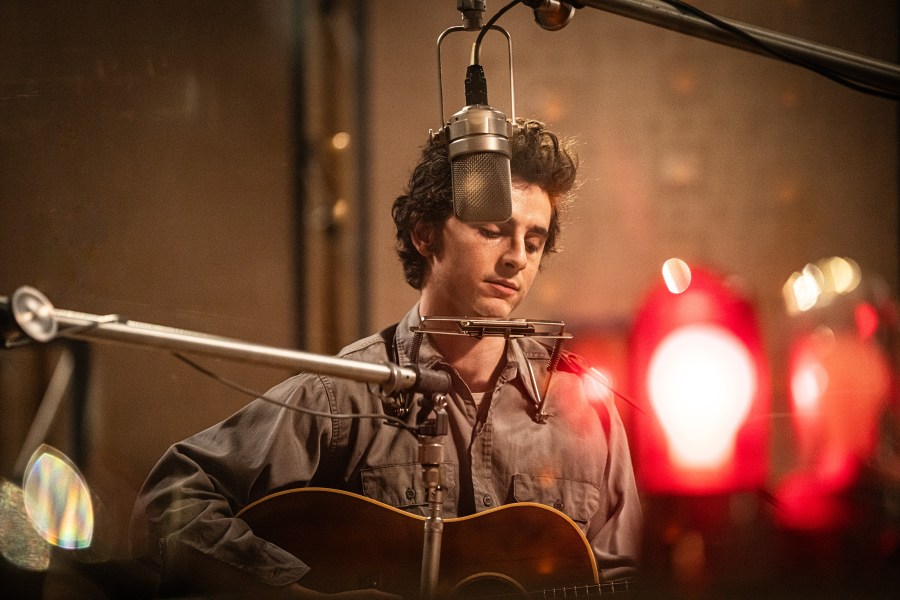
After a seemingly endless, though occasionally hilarious, pre-release media campaign, “A Complete Unknown,” the Bob Dylan biopic starring Timothée Chalamet, is now in theaters. As with any biopic, there are questions about its historical accuracy — both from sincerely curious fans and from nitpicking diehards.
Pay the armchair historians no mind. Yes, the film gets whole swaths of the known story of Dylan’s early days in Greenwich Village wrong, but those gripes are largely irrelevant. Hollywood has long taken artistic license in portrayals of real-life characters; what matters is how a film does it. Director and co-writer James Mangold and his co-writer Jay Cocks may not always stay true to the literal facts, but they nail the look, feel and emotional and artistic arc of Dylan’s life in the early 1960s.
As the film mentions more than once, Dylan himself began his career by creating a biography from whole cloth.
Besides, when I interviewed Dylan in 2022, and asked him how he imagined a young artist might approach weeding through the infinite choices Spotify offers, he told me, “You’d have to limit yourself and create a framework.” With so much information, so many characters and so many diverging stories making up the early days of Dylan’s professional life, Mangold took essentially the same approach, to great effect. While some may quibble, it is, after all, just a movie, not a history lesson.
Elijah Wald, author of “Dylan Goes Electric!,” on which “A Complete Unknown” is based, says he’s untroubled with the artistic license that Mangold took with his work. “The book was optioned almost a decade ago, and was going to start production just as the pandemic kicked in,” Wald says, “but I think it really benefitted from that delay. It would have been a different film. The script would have been different. And Timothee wouldn’t have had those years of absorbing himself in Dylan’s music; of learning to play the guitar and harmonica. It would have been more an imitation, because he wouldn’t have been able to go so deep. All those things add up to a very different film.”
As the film mentions more than once, Dylan himself began his career by creating a biography from whole cloth, and he has continued to fast and loose with his life’s story throughout his career. For writers covering him, parsing fact from fiction has been a fun, if sometimes frustrating task. But thanks to the dogged work of numerous writers, historians and documentarians, the story of Dylan’s early years are pretty well known, including the film’s moment at 1965’s Newport Folk Festival when Dylan strapped on an electric guitar, simultaneously decimating the cultural importance of that gathering of folk purists and essentially inventing the modern rock star.
So why let the facts get in the way of great storytelling, especially if Mangold, Cocks, Chalamet and company capture the feel and the significance of the period so well?

“There were many people who were pivotal people in the Greenwich Village scene who are not there at all; important people like Phil Ochs, Len Chandler and Tom Paxton, which I found really irritating,” says author David Browne, author of a new history of Greenwich Village’s bohemian music scene. “But wrapping the film up in an almost completely imagined relationship between Dylan and Pete Seeger — because it was easy to make Dylan a disrupter to the Pete Seegers of the world, even though he was just as disruptive to his contemporaries — as well as a love triangle, makes storytelling sense, and I wound up really liking the film.”
Where do you start if you want to know what really happened to Bob Dylan and his fellow folkies — almost all of whom are barely even mentioned in the film — and what led him to abandon the scene that had nurtured him so unceremoniously?


Why let the facts get in the way of great storytelling?
Wald’s own “Dylan Goes Electric!” is an obvious must-read. The narrative at the book’s heart, chronicling the parallel lives of Dylan and Pete Seeger, allowed Mangold to streamline the film’s narrative, dispensing with many of the Greenwich Village characters Dylan befriended (and often exploited) in favor of Seeger as Dylan’s mentor, foil and unwitting nemesis.
And while Dylan’s own 2004 memoir “Chronicles, Volume One” is replete with half-truths, quarter-truths and not-truths, his recollections of his days in Greenwich Village are gripping, detailed and full of characters and anecdotes that capture the time and place perhaps even better than “A Complete Unknown.”
A fantastic complimentary memoir to Dylan’s is artist Suze Rotolo’s “A Freewheelin’ Time: A Memoir of Greenwich Village in the Sixties.” Rotolo was the model for the film’s Sylvie Russo — whose name and character were reportedly fictionalized at Dylan’s own request — but her relationship with Dylan was only a small part of a long and fascinating life. And while her book doesn’t ultimately paint the real-life Dylan in the most positive light, it gives amazing insight into his origin story.
As for the broader background from which Dylan sprung, the core of Browne’s book, “Talkin’ Greenwich Village,” revolves roughly around the period when Judy Collins, Peter, Paul and Mary and eventually Dylan put the neighborhood on the map for young, aspiring East Coast musicians. Quite literally everyone who has been excised from Dylan’s story as told in “A Complete Unknown” — from artists like Dave Van Ronk and Phil Ochs to Dylan’s early patrons and managers like Carolyn Hester and Terri Thal — are present. And even those who do appear in one form or another in the film become fully realized figures in Browne’s book.
Finally, “Bob Dylan in America” by Sean Wilentz is a great choice for anyone looking for something meaty that places Dylan in the wider context of the culture and the times. Wilentz, who is both an esteemed historian and a true fan of Dylan, also digs deep into the artist’s early inspirations, from the Popular Front to the Beats, which are barely even hinted at in Mangold’s film.
Yes, “A Complete Unknown” may not be completely accurate. Like so many rock ’n’ roll biopics, though, its goal was not historical fidelity, but entertainment and the introduction of an important artist to a new generation. So break out the popcorn, damn the facts, and ask your local cinema to turn up the volume.

Jeff Slate
Jeff Slate is a New York City-based songwriter and journalist. His writing can be found at The New Yorker, Esquire, The Wall Street Journal and Rolling Stone, among others. He tweets at @jeffslate.