




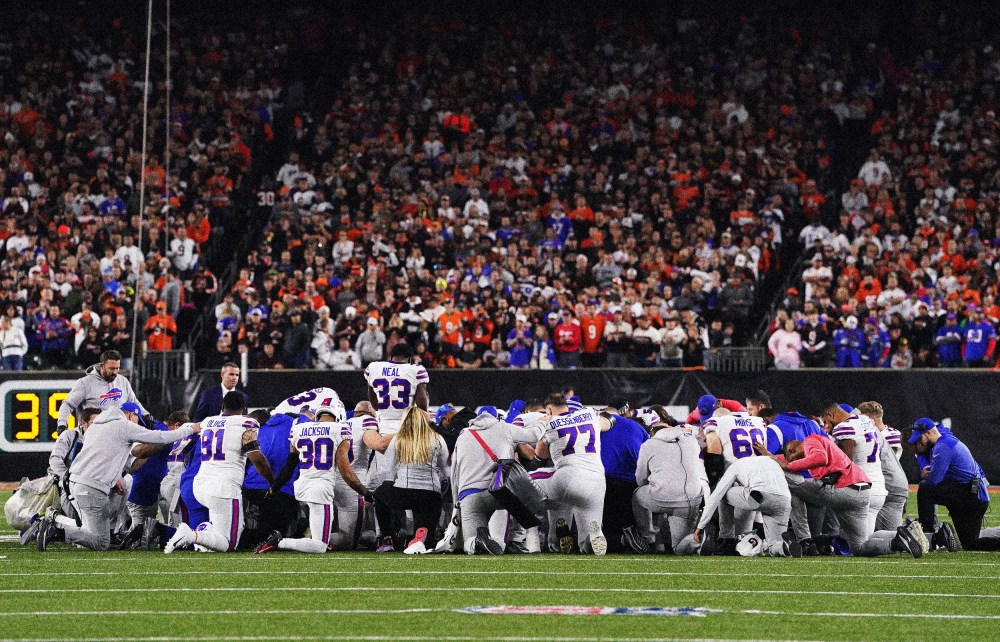
I wasn’t watching the Monday Night Football game in which Buffalo Bills safety Damar Hamlin went into cardiac arrest after making a tackle on Cincinnati Bengals wide receiver Tee Higgins. But I watch plenty of football. So when I read on Twitter about medical personnel performing CPR on Hamlin before rushing him by ambulance to the hospital, I felt complicit in something terrible.
When I read about medical personnel performing CPR on Hamlin before rushing him to the hospital, I felt complicit in something terrible.
I felt similarly complicit when Miami Dolphins quarterback Tua Tagovailoa was lying motionless on the ground in September. Likewise, after Los Angeles Chargers safety Derwin James was ejected for a nasty helmet-to-helmet hit on Indianapolis Colts receiver Ashton Dulin last week. No ejections or even penalties were assessed last month when New York Jets wide receivers Denzel Mims and Corey Davis were concussed after being accidentally kicked in separate incidents. I feel complicit, too, whenever I view any combination of the Pittsburgh Steelers, Baltimore Ravens and Bengals playing. Those AFC North contests always seem to excel in brutality.
Along with tens of millions of others in America, I lustfully consume a shiny, colorful and savage spectacle. We cheer a game that features enormous, elite athletes hurtling into one another at high speed. Football involves 22 men of freakish physical stature simultaneously engaged in modestly regulated violence. This may be why fights on the gridiron are rare compared to those on baseball diamonds: Football players can do so much damage to one another within the rules of the game that there’s little need for extracurriculars.
Our participation in this spectacle raises an uncomfortable moral question: At what point are we who are obsessed with football enabling the destruction of young men’s bodies and by association their lives?

I am not so naive or narcissistic to think that my question is original or likely to stimulate change. To be clear: If the goal is to prevent the type of traumatic injury that befell Hamlin and Tagovailoa and thousands prior to them, then football in the United States is unreformable. No op-ed or rules committee or requirement of Guardian Caps is going to prevent what happened last night from happening again.
Football has been discussing and (begrudgingly) implementing reform for over a century. In 1905, President Theodore Roosevelt threatened to outlaw the sport after 19 collegiate players died in one season! As a result, the flying wedge was made illegal. In 2009, all wedge formations (which involve athletes linking hands or arms and surging forward to block as if they were a moving wall) on kickoffs were prohibited. Thankfully, this eliminated the position of the “wedge buster.” This would be the unfortunate special teams player thanklessly tasked with running full speed into a multiperson battering ram charging at him from the opposite direction.
Every year, there are more reforms. Kickoffs, those high-speed human train crashes waiting to happen, have been reduced to a minimum. Penalties for “targeting” are on the rise. Crackback blocks, in which players blindside an onrushing and usually unsuspecting opponent, are now illegal. Trained spotters, scanning for concussions from the stands, have been hired. Independent neurologists prowl the sidelines.
Those reforms likely make a small difference. Yet, nothing can alter the fundamentally and uniquely dangerous nature of this particular sport. Those reforms likely make a small difference. Yet, nothing can alter the fundamentally and uniquely dangerous nature of this particular sport. Yes, we can stop breathless broadcasters from celebrating instances in which players get “jacked up!” Even so, players continue to get “jacked up!” on just about every other snap from scrimmage. Yes, we can call penalties. But what good is 15 yards to a person who has just sustained a craniofacial injury? In a memorable video from six years ago, Mike Pereira, who was once the vice president of officiating in the NFL, describes a brutal crackback block as warranting a foul on the offending player but then Solomonically concludes the penalty should not have resulted in an ejection! Football is mostly unreformable because it is a lucrative business that is an integral part of American culture. From August to February, this game is a constant presence in our lives. On any given Friday, Saturday or Sunday, people all over the country are sitting in stadiums watching high school, college and professional competitions. Tens of millions more are streaming the games, watching on television and, in many cases, betting on them. Which is to say, football can’t really ensure player safety because of the passion it instills in us, the fans. Until we stop cheering, tweeting about, gambling on and watching these games, horrific injuries are going to occur. And that mass civil action, as my own unheroic witness demonstrates, is unlikely to occur anytime soon. It’s all well and good to pray for players when their lives hang in the balance. It is thoughtful to contribute to their charities (Hamlin is known for his philanthropy, and donors have given his charity toy drive millions of dollars since Monday night’s tragedy). It might be better, however, if all of us who watch football on any level somehow find a way to divest from a game that we, and the men who play it, love too much.
Jacques Berlinerblau is a professor of Jewish civilization at Georgetown University. 


