




Russia is intensifying its invasion of Ukraine and has made menacing threats that it’s willing to use nuclear weapons to defend its interests. In a reasonable world, the Democratic Party would be discussing how to ensure the United States’ role in the war doesn’t lead to a nuclear confrontation with an increasingly desperate and paranoid Russian President Vladimir Putin. Instead, the party is succumbing to perilous groupthink. Democrats are converging on an irrationally hawkish posture out of fear of being perceived as weak against Russia or being grouped together with the MAGA right.
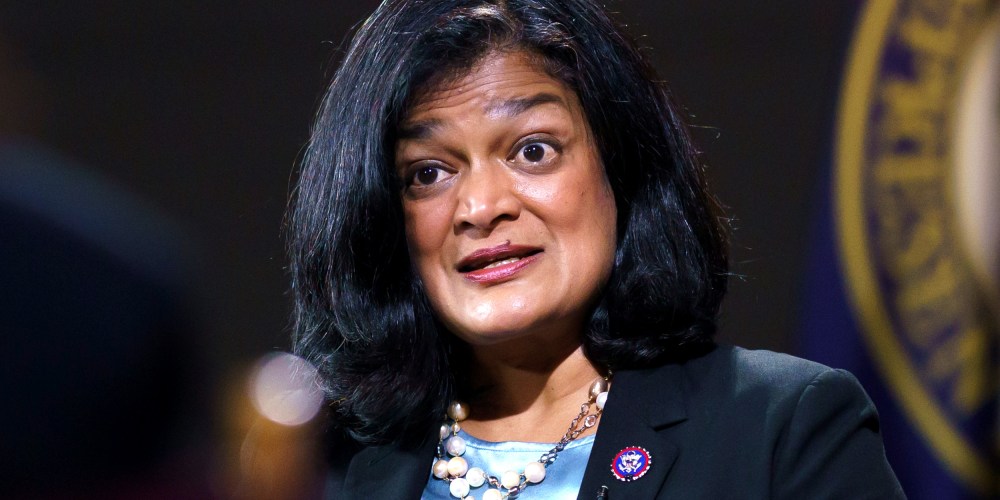
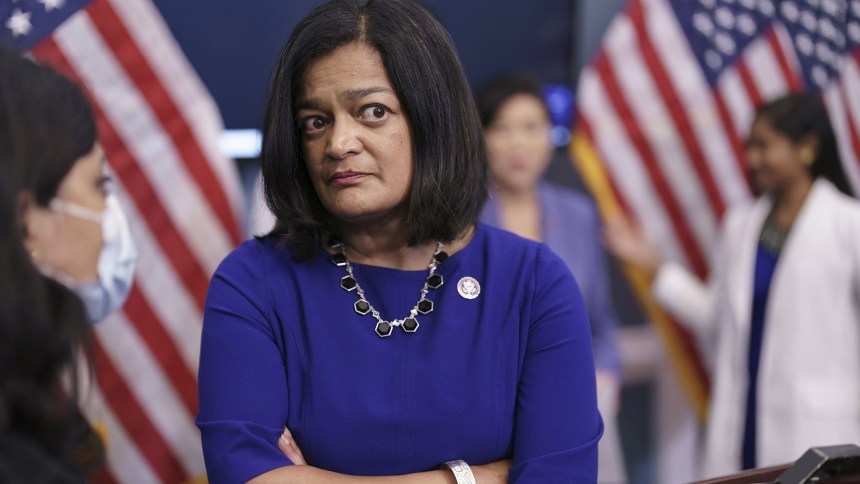
The most recent example of this is the firestorm of controversy sparked by a letter that 30 members of the Congressional Progressive Caucus, led by Rep. Pramila Jayapal, sent to the White House on Monday. What should have been an uncontroversial call for a return to Cold War norms of diplomacy was swiftly slammed and smeared. In the process, the very idea of diplomatic engagement was conflated with appeasement — a stunning, dangerous development.
In reality the letter merely called for diplomacy alongside military support for Ukrainian liberation.
The letter praised President Joe Biden’s military and economic aid to Ukraine and then asked Biden “to pair the military and economic support the United States has provided to Ukraine with a proactive diplomatic push.” The signatories cited Biden’s and Ukrainian President Volodymyr Zelenskyy’s own predictions that, as Zelenskyy put it, this war “will only definitively end through diplomacy.” With that in mind, they argued, “it is America’s responsibility to pursue every diplomatic avenue to support such a solution that is acceptable to the people of Ukraine.” The authors of the letter also stated that the U.S. should not pressure Ukraine “regarding sovereign decisions” — “nothing about Ukraine without Ukraine,” as Biden said. Guaranteeing Ukraine’s freedom, as approved by Ukrainians, is essential in any framework for discussing peace, the letter noted.
Somehow this simple reminder that this conflict can only be resolved with proactive diplomatic engagement — the same observation that Zelenskyy and Biden have shared in the past — received a tsunami of fierce pushback from Democratic lawmakers and liberal commentators. Democrat Rep. Jake Auchincloss of Massachusetts described it as “an olive branch to a war criminal who’s losing his war.” Liberal journalist Aaron Rupar called it a “bad move” because “Putin should not be rewarded.” Many commentators slammed it as “appeasement.” As the criticism intensified, a number of signers quickly distanced themself from the letter, and on Tuesday, Jayapal withdrew the letter altogether — an exceptionally rare reversal.
The whole episode set a troubling precedent. Progressives who ran and hid from the condemnations implicitly validated the incorrect claims that calls for diplomacy mean throwing Ukrainians under the bus or being weak or credulous about Putin’s agenda.
In reality, the letter merely called for diplomacy alongside military support for Ukrainian liberation. These two approaches are not at odds, but complementary. Combined, they allow the U.S. to support Ukraine while reducing the likelihood of nuclear confrontation and potentially shortening the length of the conflict.
The letter was not calling for the U.S. to go behind Ukraine’s back and come up with some secret deal to cede Ukrainian territory. If Ukraine doesn’t agree to it, it’s not a deal.
But there are other other things that the U.S. and Russia could discuss bilaterally that pertain to the U.S.’s national security interests. First and foremost: how to reduce the increasing likelihood of a nuclear confrontation. “We’re in a situation where we’re talking much less to Russia than we did with the Soviets even in the darkest days of the Cold War,” said George Beebe, a former director of Russia analysis at the CIA and special adviser on Russia to former Vice President Dick Cheney. This creates a “danger zone” with a higher likelihood of misperceptions or accidents leading to escalation.
By opening up more frequent, higher-level and direct communications, both parties can describe their posture and intentions more clearly and spell out their red lines. It’s important at a time when one incident like, for example, a nonstate vigilante actor shooting down a satellite over Ukraine, could be misunderstood by the other country as an opening salvo of war. While there is a little bit of communication going on between the U.S. and Russia, it’s extremely narrow in scope. And the primary contact among top officials recently has been between Defense Secretary Lloyd Austin and his Russian counterpart. Austin is a former general, not a trained diplomat; his specialty is the art of war, not the art of negotiation.
Biden has said that the chance of “Armageddon” is the highest it’s been since the Cuban missile crisis of 1962. As many experts have observed, the communication norms that helped de-escalate that crisis and form a deal are not in place today. (Former President Barack Obama echoed this point recently as well.) Beebe pointed out how the Soviet ambassador to the U.S. was a “central communication node” in helping de-escalate 60 years ago; today in Washington the Russian ambassador to the U.S. is a pariah. A former deputy secretary-general of NATO has said “discreet talks” about missile moratoriums might “lower the nuclear temperature.”
The U.S. and Russia can also — eventually — begin to explore conditions for a settlement that don’t have to do with Ukrainian territory, but involve U.S. policy and interests, like sanctions regimes and America’s projection of power in Europe. Right now, with Ukraine making impressive gains and Russia escalating in response, it’s not the right time to talk about the endgame. But one does not wait until an obvious “victory” scenario like total Russian surrender — which administration officials have said they don’t expect is likely to happen — before establishing any kind of communicative rapport. Engaging helps one feel out the other party over time and figure out where they will and will not yield when the times come for an actual substantive negotiation. “You have a continuous dialogue in order to be able to see if you can detect openings or detect divisions within their system, opportunities you can capitalize on,” said Trita Parsi, an MSNBC columnist and the executive vice president at the Quincy Institute for Responsible Statecraft. (The Quincy Institute reviewed a draft of the letter before it was published, and continues to support it.) Without regular discussions about what it will take to limit the scope of and end the war, the U.S. can’t even pick up on those windows of opportunity, which could help make the war shorter in the long term or mitigate harm. Opening the door to multilateral engagement could also be helpful. Turkey and the United Nations already helped negotiate an agreement with Russia and Ukraine allowing them to export grains that had been blocked by the war, which in turn helped alleviate a global grain supply crisis. Some analysts believe that third-party diplomacy building on the grain initiative model could lay the groundwork for de-escalation in the future as well. And again, none of this means disregarding Ukrainian interests or caving on demands for their freedom. The House progressives’ letter was poorly timed insofar as it should’ve come out earlier in the year or after the midterms. But still, the reversal over optics instead of substance is unsettling. Explaining the withdrawal of the letter, Jayapal said it “created the unfortunate appearance that Democrats … are somehow aligned with Republicans who seek to pull the plug on American support for President Zelensky.” That appears to be a reference to House Minority Leader Kevin McCarthy’s comments that if Republicans took over the House, they would not issue “a blank check” to support Ukraine. But Jayapal’s suggestion that the CPC and the House GOP could even be seen as on the same page is bizarre, when the letter explicitly supports Biden’s military assistance. A thorny problem has emerged: U.S. support for Ukraine — and U.S.-Russia policy more broadly — is not a foreign policy matter, but increasingly registers as a hot-button domestic political issue. Putin’s meddling in the 2016 elections and his ideological affiliation with former President Donald Trump have supercharged Democrats’ animosity toward him. It’s an understandable reaction, but in this case it has clouded their judgment. Democrats must be clear-eyed and allow for a broader spectrum of intelligent debate on the war without fear of looking weak. Political cowardice always grates, but it’s particularly appalling when the stakes are a possible nuclear war.
Zeeshan Aleem is a writer and editor for MS NOW. He primarily writes about politics and foreign policy. 


