





If there is one surefire recipe for winning the GOP’s Iowa caucus, it is this: pander to the white conservative evangelical vote! To achieve this, you should drop scripture bombs in Des Moines, sack secularism in Sioux City, and advocate for the Christianization of the American government in Waterloo — corndog in hand.
Or you can do none of the above and simply be Donald J. Trump. That identity alone — as Ron DeSantis and other Republican presidential aspirants continue to learn — is presently enough to carry this crucial demographic.
In spite of Trump’s no-show at last week’s debate, and his photo shoot at the Fulton County Jail, and everything else about this man, the most recent poll still has him with a slightly softening, but still commanding, lead over his GOP contenders. Trump’s mysterious viselike grip on Republican voters is emerging as an existential dilemma for the other candidates, for evangelical theology, and ultimately for America itself.

In the 21st century, Republicans have taken the White House when — and only when — white conservative evangelicals are galvanized about their nominee. George W. Bush proved that with the so-called values voters in 2004. Trump broke a 12-year GOP drought in 2016 by securing 80% of white evangelicals nationally (a huge number when you consider this group makes up more than one quarter of the American electorate).
This has traditionally meant that in Iowa and beyond, a Republican presidential aspirant campaigns in a language we’ll call “White Conservative Evangelical” (WCE). At last week’s GOP debate, three of the eight candidates spoke (and, in Vivek Ramaswamy’s case, shouted) various dialects of WCE. Oddly, Gov. Ron DeSantis of Florida was not one of them.
DeSantis talked not about the divine, but the “decline” (as in America’s). He never discussed the Bible or his personal faith journey, but he did propose invading Mexico. Maybe he thought he was in New Hampshire where this conservative Christian vernacular is far less understood?
Trump’s mysterious viselike grip on Republican voters is emerging as an existential dilemma for the other candidates, for evangelical theology, and ultimately for America itself.
DeSantis’s blunder underscores growing concern about his campaign’s religious outreach. The first problem is that, unlike some other Catholic politicians, he hasn’t figured out how to connect with evangelical voters. Rick Santorum, the former senator from Pennsylvania, spoke fluent WCE and carried Iowa in 2012. Pat Buchanan, another Latin Mass traditionalist, mastered the tongue and came in a close second to Bob Dole in Iowa in 1996.
DeSantis isn’t really clicking with fellow Catholics, either. In June, “America: The Jesuit Review” took a deep dive into DeSantis’ Catholic faith. Many of those quoted in the piece seemed a bit baffled by what kind of Catholic he actually is. For pro-life Catholics, his abortion politics aren’t full-throated enough; for other Catholics, his views on immigration and the death penalty contradict official church teachings.
In national contests, the Catholic vote is usually more or less split, so these misgivings are understandable. What is ominous for DeSantis, however, are the doubts documented in that profile about his actual commitment to Catholicism. Maybe he shouldn’t have told an evangelical journalist that the sacraments were “nice.” Nice? The sacraments embody a core Catholic conviction about how God interacts with humanity. Calling them “nice” is as natural as DeSantis’s much memed debate smile.

Having covered “faith and values” politicking for five election cycles, I can assure you that it’s never a good sign when doubts emerge publicly about a candidate’s stated faith posture. Sen. John McCain of Arizona comes to mind. Realizing (belatedly) the significance of the white evangelical ballot in 2007, he suddenly proclaimed himself a Baptist. This piqued the interest of the national press corps, who could recall what an acerbic, Barry Goldwateresque critic of the religious right the maverick once was (McCain eventually received an anemic 72% of the evangelical vote in 2008).
Feckless as DeSantis’ “faith and values” game might be, his inability to gain traction with evangelicals is not entirely his own fault. Consider the fate and faith of former Vice President Mike Pence and South Carolina Sen. Tim Scott. At the GOP debate last week, Scott and Pence, both evangelicals, were speaking their mother tongue (though Scott was code-switching for a white audience).
Both have unimpeachable evangelical street cred (Scott claimed to practice abstinence until he was 46 years old). Both thumped the Bible. Scott invoked Ephesians 3:20, in a somewhat original exegesis, as a call to “break the backs of the teachers unions.” Meanwhile, Pence, vowing to be a “a champion of life in the Oval Office,” cited Jeremiah 1:5, a well-known anti-abortion “prooftext.” And he talked about his Inauguration Day promise to “the Heavenly Father.”
The pressing question is how to soften up Trump’s evangelical support.
Yet in the polls, both are mired in the low single digits. This suggests that one’s personal piety has nothing to do with gaining the white conservative evangelical vote. This also suggests DeSantis could attend Mass regularly, carry a rosary and invoke St. Augustine (like Joe Biden does), and he’d still be unable to overtake Trump.
Perhaps Vivek Ramaswamy is aware that when it comes to religion (as with everything else), he should do whatever Trump is doing. He mimicked the new Trumpian variant of WCE as if he’d studied it on Duolingo. Trumpian WCE is a jittery patois whose syntax is placed in the service of endless smackdowns. Its speaker shucks, jives, zings, owns, trolls, ups the ante and doubles down.


At the debate, it was Ramaswamy against the federal administrative state; Ramaswamy against MSNBC; Ramaswamy against “Pope” Zelensky (watch it there, buddy! Conservative Catholics are the braintrust of the religious right); Ramaswamy against all others on stage.
As with Trump, Ramaswamy’s biblical citation is nearly nonexistent. Creedal statements are merely slogans — “God is real, there are only two genders” — and nuance is nowhere to be found. Religion (but whose religion?) was proclaimed the one-step solution to the mental health and gun crises.

Positioning himself as Trump’s theocratic understudy is clever. It’s not a huge ideological stretch, either, given Ramasamy’s support of Hindutva, or Hindu nationalist, policies with its attendant Islamophobia and anti-secularism. But let’s recall — because a certain percentage of evangelicals will never forget — that Ramaswamy wasn’t speaking his mother tongue.
If Trump goes through some things and does not make the ballot in 2024, the question becomes: Can white evangelicals go all-in for his non-Christian backup? If more than a few celebrity pastors can still repeatedly express the vilest anti-Catholic sentiments, just imagine what they’ll say about a Hindu businessman.
For all of the candidates, the pressing question is how to soften up Trump’s evangelical support (assuming that the deus ex machina of America’s criminal justice system cannot bring him to heel). DeSantis in particular may find a small opening, but it’s surrounded on all sides by a looming abyss.
I’ve always been intrigued by Franklin Graham’s blithe concession that while Trump defends the faith, he does not live the faith. It intrigues me because it meshes with an idea I and others observed in Martin Luther’s thought. Back in 1523, the founder of Protestantism placed great hope in the idea of a Christian prince. The fellow was likely an immoral, carousing reprobate (as princes were wont to be), yet the prince nevertheless maintained law and order and ruled with an iron hand. In so doing, he defended “True Christians” from their enemies, aka the enemies of God.
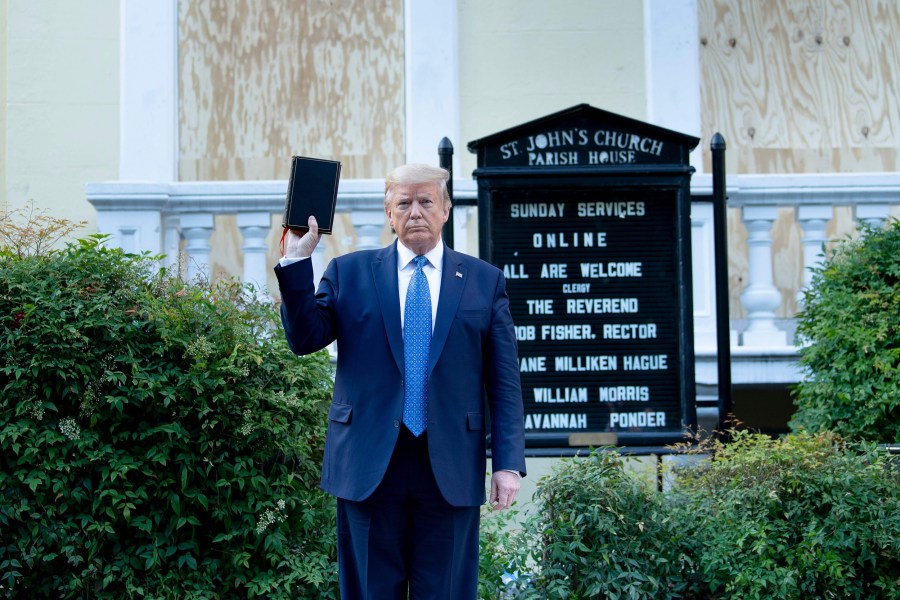
Trump did something similar after Black Lives Matter protesters were forcibly ejected from Lafayette Square Park in June 2020. That rampage produced the most frightening, and significant, photo op of his presidency: a scowling Trump, standing in front of a shuttered liberal church, brandishing a Bible (the RSV) that evangelicals shun! The wrong Bible — not to mention the gonzo display of state violence — didn’t seem to bother white conservative evangelicals.
The re-emergence of this submerged authoritarian strand in Protestant thought is DeSantis’ opening: If evangelicals care more about crushing their enemies than about their own theology, then he too could be their prince. When it comes to payback — be it against public health officials, elected state attorneys, professors, DEI administrators, librarians, Bud Light, Disney, the LGBTQ community — few have DeSantis’ track record. Unlike blustery Ramaswamy, he can connect the words of WCE with retributive actions. When even “Jesus is too woke,” a President DeSantis would put Him in His place.
Of course, there is another possibility, one that leaves all the GOP candidates in the lurch: Modern Evangelicalism may have capsized theologically. The faithful may be taking their cues not from Scripture, but from whatever it is Trump is saying or posting on any given day. The religion has flipped, as it were. If this is the case, DeSantis and all of his colleagues are already in the abyss and, in a worst-case scenario, the same might be said of America.

Jacques Berlinerblau is a professor of Jewish civilization at Georgetown University.