




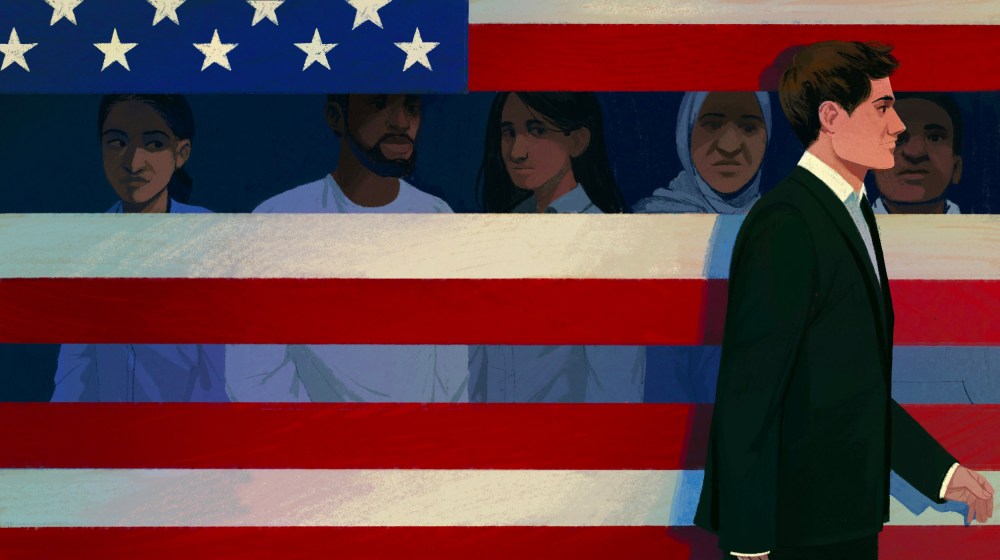
The Othering and Belonging Institute at the University of California, Berkeley recently released its Inclusiveness Index for 2023. That index, using six universal indicators, ranks the international community and states across the country on a scale of inclusivity — to examine “the degree of institutional inclusion and protections extended to vulnerable groups across salient social cleavages.”
The trajectory is clear: The United States is becoming a more divided and unequal society.
Since the institute’s first report in 2016, the U.S. has steadily fallen from its starting rank of 23rd among the 129 nations included in the study to 77th. As for racial inclusivity, in particular, the U.S. is close to the bottom, ranking 118th on the index, up from 123rd but far below the 8th place ranking the U.S. enjoyed in the institute’s first measurement.
The Index and its rankings serve are a means of tracking and analyzing policy changes within a global context. And the trajectory is clear: The United States is becoming a more divided and unequal society.
Our country’s lower position on the institute’s scale is not a mystery. While the United States has long been a divided society, the developments of the past five years have exacerbated already dismal race relations. The open embrace of white supremacist rhetoric during former President Donald Trump’s administration and the restrictive voting laws passed after his defeat in the 2020 election; the recent Supreme Court rulings that targeted women’s bodily autonomy and upended the remaining uses of affirmative action in college admissions; the waves of legislation that target the existence of LGBTQ people; and the use of attacks against “critical race theory” to marginalize the voices of Black and brown people have created an atmosphere of exclusion in American society.
The state-level rankings in the Index are just as concerning. The states scoring the lowest on the inclusivity scale are Louisiana, Mississippi, Alabama, Texas and Arkansas. Yet, when adjusting for the project’s racial-specific metrics — which account for political representation, income inequality and incarceration by race — Iowa was ranked dead last and Minnesota, a state with a reputation for being progressive, was ranked 45th.
What might further surprise some Americans is that on the matter of racial inclusivity, the state of Mississippi, where the Dobbs v. Jackson case originated, ranks 11th. As the project’s authors note, the Index should not be viewed as an absolute. The state still ranks 49th in overall inclusivity, and Black Mississippians, as they have for so long, are facing real neglect and discrimination. The Jackson water crisis and state officials’ response to it is one case in point.

But the institute’s findings also serve as a reminder of the progressive and valuable work done by activists at the grassroots level in Mississippi. That work is occurring against the backdrop of a positive story emerging from the Magnolia State: a recent surge in student test scores that some observers have called the “Mississippi Miracle.” The state has jumped from 49th place for fourth-grade reading in 2013 to 21st place in 2022.
At the same time, though, Mississippi has been swept up in the nationwide conservative project aimed at limiting the teaching of Black history to students. In March 2022, the state passed its version of a bill banning the teaching of critical race theory in K-12 schools, even as the state’s Department of Education acknowledged that such no such curriculum existed in the state. Though the legislation does not explicitly mention critical race theory, Gov. Tate Reeves announced upon signing the bill that critical race theory was “running amok” and was a threat to “the integrity of education and aims to only humiliate and indoctrinate.” His claim reveals a fundamental misunderstanding of critical race theory, which at its simplest interpretation explains how systemic racism shapes American society. The institute’s findings also serve as a reminder of the progressive and valuable work done by activists at the grassroots level in Mississippi. In February, Mississippi officials announced their intention to review the AP Black Studies course after Florida blocked the course in its schools. Unlike Florida, however, by April, Mississippi’s Department of Education had approved the course. And the state passed new education standards in December 2022 that were more accurate than the state initially intended. When state officials first introduced their proposed standards in December 2021, parents and activists correctly pointed out that the proposal pared down civil rights history and removed from the curriculum important figures like the Rev. Martin Luther King Jr. and Medgar Evers, the field secretary for the Mississippi NAACP who was assassinated in Jackson in 1963. By January 2022, community feedback had caused the Department of Education to reverse those changes. And a second public meeting in September 2022 resulted in those standards doing more to address the disability rights movement and improving the coverage of Sikhism within an elective on minority studies. My point is not that Mississippi has passed perfect education standards for their K-12 schools or that parents and activists should be satisfied. My point is that activists and parents in Mississippi demonstrated the importance of continued local engagement, even against the tide of regressive and discriminatory policies. Black activists in Mississippi, like Fannie Lou Hamer before them, have been fighting for their rights across a broad spectrum, including their recent advocacy demanding clean water in Jackson. Black Mississippians are unlikely to celebrate their placement at 11th on this ranking of racial inclusiveness. If the past is an indication, continuing dissatisfaction will push them to continue working to improve their communities. But the findings from The Othering and Belonging Institute can serve as a reminder to dig deeper than the headlines and presumptions and see the lasting impact of grassroots activism and the potential it holds for building a more equitable and just society.
Keisha N. Blain
Keisha N. Blain is an award-winning historian and writer. She is a professor of Africana studies and history at Brown University and has written extensively about race, gender and politics in national and global perspectives. Her most recent book is “Until I Am Free: Fannie Lou Hamer’s Enduring Message to America.” 

