




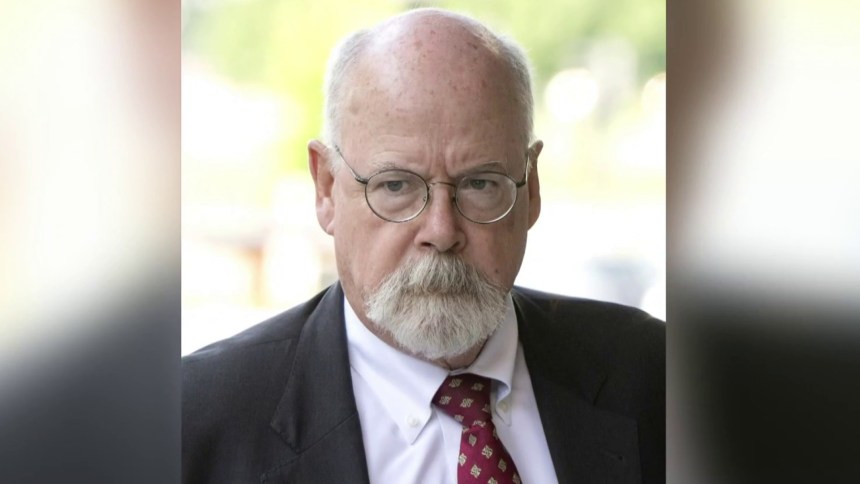
On Monday, special counsel John Durham released the final report from his investigation of the Trump-Russia probe — and after four years, nearly 500 interviews, two acquittals and at least $6.5 million in expenses, the American people should demand their money back.
Much of Durham’s details were outlined in a 2019 report by Michael Horowitz, then the Justice Department’s inspector general. Even Durham’s allegedly major bombshell — that the FBI should never have opened a probe into coordination between the Trump campaign and the Russian government — is contradicted in the report’s final few pages, where Durham concludes that the bureau should have opened a “preliminary investigation.”
Of course, the real point of the Durham investigation was never about discovering truth, but rather about muddying the waters around special counsel Robert Mueller’s investigation of Russia’s interference in the 2016 election. That is why Durham’s investigation amounted to so little — and his report is so inconsequential: Mueller’s investigation was far from a hoax.
The Mueller report remains a singularly damning indictment of the former president.
More than four years after the release of the Mueller report, its conclusions about the breadth of Donald Trump’s breathtakingly unethical and criminal behavior have largely been flushed down the national memory hole. But contrary to the repeated claims of Trump and his enablers, the Mueller report didn’t exonerate the former president.
You don’t have to believe me. Here is Robert Mueller saying it under oath:

In May 2019, Mueller made it clear that if he and his team had “had confidence that the president clearly did not commit a crime, we would have said so.”
They didn’t.
In fact, the Mueller report remains a singularly damning indictment of Trump. It highlights repeated instances when the former president and current front-runner for the 2024 Republican nomination not only colluded with Russian officials to influence the 2016 election, but also repeatedly obstructed justice as president.
As a candidate for office, Trump famously asked Russian President Vladimir Putin to hack Hillary Clinton’s e-mails. “I will tell you this, Russia: If you’re listening, I hope you’re able to find the 30,000 emails that are missing,” Trump said in July 2016. “I think you will probably be rewarded mightily by our press.” The next day the Russians started doing exactly that. And we know this only because of Mueller’s investigation.
Trump wants all this information to be forgotten — and guess what, he has largely succeeded.
According to Mueller, the Trump team openly “welcomed” Russian interference and even put together a “messaging strategy” around e-mails from Clinton’s aides that had been published by WikiLeaks and hacked by the Russians. According to testimony from former campaign aide Rick Gates, Trump most likely knew in advance that those leaks were coming. Perhaps the most obvious example of the Trump campaign’s collusion with Russian officials was his former campaign chairman Paul Manafort, who shared internal polling data with people who had ties to Russian intelligence. Shortly before he left office, Trump pardoned Manafort and two other members of his campaign named in the Mueller probe.
In short, Trump and those around him actively tried to profit off and encourage Russia’s interference in the 2016 election. But that’s not even half of it. Mueller’s report also highlighted 10 separate incidents of Trump’s obstructing justice while serving as president.


Again and again, Trump tried to end Mueller’s investigation. He repeatedly sought to fire the special counsel but was talked out of it every time. He tried to persuade former Attorney General Jeff Sessions to un-recuse himself in order to block the investigation. When that didn’t work, Trump enlisted others, including his former campaign manager Corey Lewandowski, to do the convincing for him.

He pushed his White House counsel Don McGahn to falsify records that would show he hadn’t tried to get Mueller canned. He dangled pardons for those caught up in the investigation. And over and over, he lied to the public.
Trump wants all this information to be forgotten — and guess what, he has largely succeeded.
The response to Durham’s report featured more of the same false claims about Trump’s alleged exoneration, as Republican members of Congress joined Trump and fell over themselves on social media to falsely declare that the real outrage of the Russia investigation was the inquiry itself — not the findings of presidential malfeasance.
It’s not just Republicans. Democrats have participated in this act of national amnesia. Even though in 2019 more than half of House Democrats called on Speaker Nancy Pelosi to open impeachment proceedings over Mueller’s report, no part of the report ended up in either impeachment of Trump. (Instead, the first impeachment centered on whistleblower revelations about Trump’s holding military aid to Ukraine hostage, while the second focused on the Jan. 6 riots.)
One of the major conclusions of the Mueller report was that Trump couldn’t be criminally prosecuted in office, but after he lost re-election, all bets were off. But the Justice Department hasn’t shown much interest in holding Trump criminally liable for the repeated incidents of obstruction of justice Mueller and his team detailed.
It’s true that with Trump, there’s a lot of criminal behavior to choose from. But Mueller’s report lays out Trump’s potential criminal liability in excruciating detail. Yet the dominant narrative about the Russia investigation is that it was somewhere between a hoax and a dud — and no one is clamoring to hold Trump criminally responsible for his behavior. When Republicans regularly and falsely claim that the Mueller investigation found no wrongdoing, they rarely get pushback from reporters or pundits. It’s not just another GOP talking point.
Indeed, the real bombshell of Durham’s report isn’t that Trump was investigated over Russian collusion in the first place; it’s that so few seem to care about Mueller’s findings. But Durham’s efforts can’t obscure the truth: that collusion really happened and that Trump went to extraordinary and criminal lengths to keep it a secret. We cannot and should not forget those facts.

Michael Cohen is an MS NOW columnist. He is also the publisher of the newsletter Truth and Consequences and hosts the weekly podcast That ‘70s Movie Podcast.