




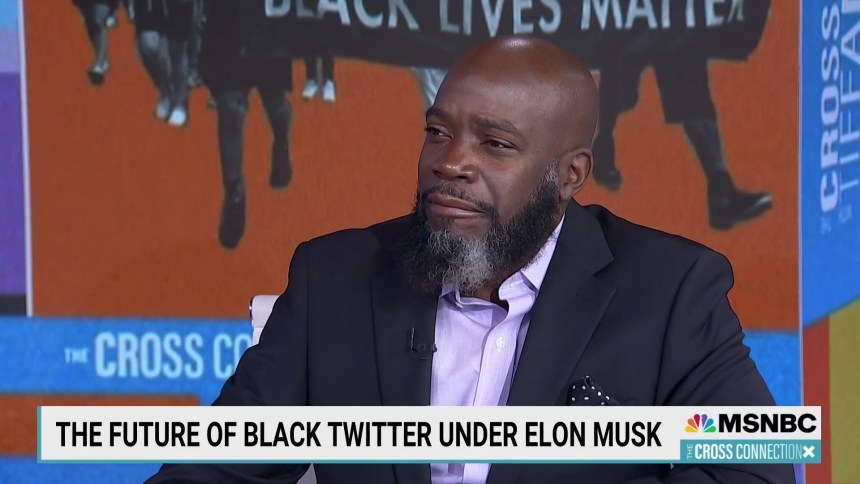
Last year, Elon Musk purchased Twitter at the inflated price of $44 billion. While some lauded it as a fix for Twitter’s ongoing struggles, others were concerned that Musk’s embrace of racist and alt-right accounts would ruin the platform — particularly for the many minority users who have formed communities and a digital home on the site.
Musk’s antics since his official takeover have especially led journalists, power users and even cultural analysts to ask: “What’s going to happen to Black Twitter?”
Black Twitter serves as a potent example of Black digital expertise, one that de-centers whiteness as a default internet identity.
One of the largest gatherings of Black online users ever, Black Twitter is a community of Black collectives: college students, young professionals, tech bros and ladies, queer folk, academics, sex workers, celebrity fandoms, 40+ parents and more. It’s a community bounded by technology and culture rather than by physical location. Finally, Black Twitter serves as a potent example of Black digital expertise, one that de-centers whiteness as a default internet identity. Black folk have rarely been considered civil, rational or productive by mainstream American society, yet we dominate this influential platform. Black users are roughly a quarter of Twitter’s user base. Their presence has led influential folk to describe Black Twitter as the “perfect use case” for the service.
Musk’s actions — re-activating racist and alt-right accounts like Kanye West’s, posting Hitler memes or complaining about “woke”-ness in multiple tweets — have encouraged Black users to seek out less problematic spaces, such as Mastodon, Spoutible, Spill and now Instagram’s Threads app. None of these apps are able to match Twitter’s feature set, but more important, none of them have tenure.
That is, Black Twitter evolved as Twitter evolved. Some Black Twitter users have been there since the app’s inception in 2006. Twitter has furnished Black information about politics, relationships, drama, comedy — even as it added features to make these conversations more robust. Those experiences can’t be easily replicated in a feature list or through a new algorithmic feed, nor through a shiny new interface. Black Twitter has history, something that (perhaps unfairly) won’t be applicable for the new contenders until Black users have had time — time to learn the ins and outs of a new application, time to build out their social graphs and time to figure out how these new apps afford Blackness in ways that are familiar and pleasurable.

I’ve been studying Twitter, in the form of Black Twitter, for nearly as long as it’s been around. I’ve found that Black Twitter is either a source of camaraderie or confusion; many have no idea what it’s for. Many think Black Twitter works “best” when it addresses and confronts injustice, citing the protests in Ferguson, Missouri, or Minneapolis as powerful examples of the platform’s capacity for political engagement.
I argue that in order to fight together, we have to learn to live — and love — together. From this perspective, Black Twitter is vital as a space for Black folk to create, maintain and discuss the Black everyday in a way that reaffirms connection, and often joy.


At its core, Twitter is an online third place, one that is neither work nor home. On Twitter, everyone is welcome and socializes together. There is no VIP section, and crucially, the privileged must interact with others as equals. Twitter interactions, in which users can write to anyone and everyone can read your posts, let it function as an equitable space where “anyone can get it” regardless of celebrity status, wealth or political power. Twitter is an energetic space thanks to its publication speed, in which world news is shared and discussed as eagerly as news of the latest celebrity affair.
It’s not all good, of course. Twitter has been reported on as hostile to women and other minorities, in both its unevenly applied moderation policies and its prioritization of engagement over civility. Bots are often deployed for disinformation or to inflate follower counts. Pornography, which Twitter has never explicitly discouraged, is easily accessed. It is often described as a “hell site” in part because of many people’s experiences with the above, but also because our beliefs that the internet should be democratic and civil dictate how we think Twitter “should” work.
And then there’s Black Twitter: an online gathering of Twitter users who identify as Black and are expert users. Few things highlight Black Twitter’s power to influence politics and American life as much as the Trump administration’s initiatives to declare Black Lives Matter, a social media movement drawing immense power from its online activism, as “domestic terrorists.” Twitter’s capacity to activate and mobilize social movements helped influence larger Black voter turnouts in 2018 and 2020, which is antithetical to the GOP’s ongoing strategies for Black voter suppression.
Before we congregated on Black Twitter, Black information needs were imperfectly served by dozens of websites, bulletin boards or blogs or YouTube. For nearly a decade, Black Twitter has been where we went to get our news, to grieve or celebrate together and to debate issues specific to Black culture. As many of the more prolific tweeters move on to other spaces, we are experiencing a digital diaspora, one in which we must once again aggregate information from multiple online sources. These untried, nascent spaces will provide a sense of newness — that new car smell! — for a while, but I foresee that Black Twitter will continue to display flashes of brilliance and insight at least through the next presidential election, if not for a few years after.
So what’s my answer to the “what’s next for Black Twitter” question? Think of Musk’s ownership as similar to a building’s management by a slumlord. In the immediate future, Twitter will decline and even decay. Many fine people will loudly proclaim their disgust at the new ownership and depart. Some will hang on, even as they are afflicted by shoddy management and unreliable technologies, until they can no longer find their friends or favorite accounts. Many more will stay on Twitter because it’s a habit, a comfortable or convenient place to socialize or find entertainment. Just like folk still live in those decaying neighborhoods and buildings, Black everyday life — the core the Black Twitter experience — will continue as long as its users find value and pleasure in using the site.

Andre Brock
André Brock is an associate professor of media studies at Georgia Tech. His award-winning book, "Distributed Blackness: African American Cybercultures" (NYU Press 2020), theorizes Black everyday lives mediated by networked technologies and was recently named one of the "Top Tech Books of All Time" by The Verge.