




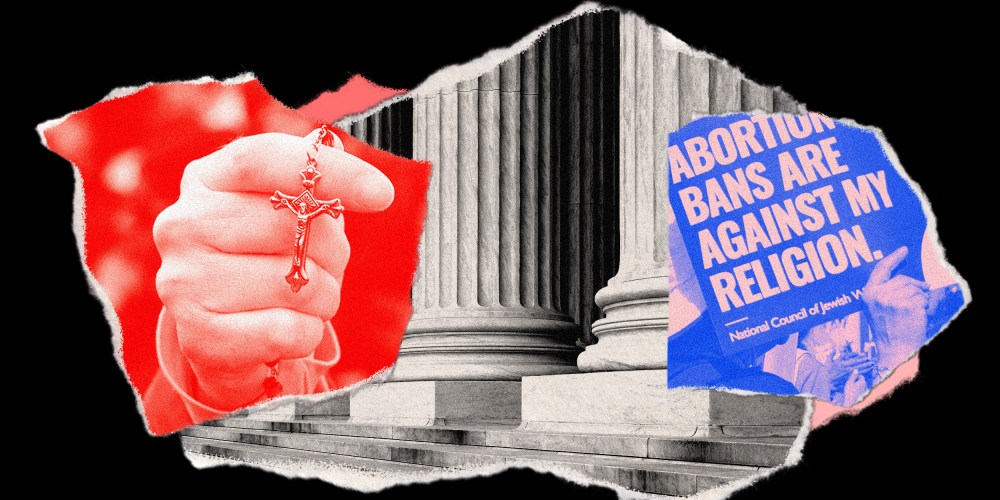
In April, Florida enacted a law that sharply restricted abortion access in the state and banned most abortions after 15 weeks. That law, known as HB 5, is now encountering some exciting and innovative legal opposition, not only from groups that fight for civil liberties and reproductive freedoms, but from religious groups as well. The challenges in Florida — and somewhat similar ones in Kentucky and Indiana — may signal subtle but significant shifts in how activists across the country are contesting a recent string of conservative Christian legislative triumphs.
Even if these cases don’t immediately succeed, the plaintiffs are helping to transform the debate on the meaning of secularism in America by exposing a false division between “religious” and “secular” citizens. Ideally, these interventions will foster a much more sophisticated political dialogue about the promise of secular governance. For at some point these cases are going to force a district or circuit court judge, or maybe even a gaggle of United States Supreme Court justices, to confront some of the neon-light-blinking religious inequalities that HB 5 and similar laws create.
Abortion restrictions don’t just infringe on the rights of secular people — they also suppress the rights of many religious people outside the Christian right.
The reality is that abortion restrictions don’t just infringe on the rights of secular people — they also suppress the rights of many religious people outside the Christian right.
For decades, the Christian right has been ingeniously framing, weaponizing and us-vs.-them-ing the religious-secular divide. The “us,” as far as their rhetoric goes, are religious people — all religious people. Of all stripes. Of all theological persuasions. As if “religion” binds together in hand-holding fellowship every pious American from Maine to California.
The diabolical “them” are “secularists.” This cohort is hellbent on whisking God, school prayer and “Merry Christmas!” salutations out of public life. “They,” so goes this argument, want to subject you to state-sponsored atheism and your kids to read V.I. Lenin’s “What Is To Be Done?”
Absurd and reductive as this dichotomy may be, it has been devastatingly effective. Demagogued to perfection by conservative commentators, it insinuates that a minority of nonreligious “secular” Americans are subjecting a majority of religious ones to apartheid-like rule.
The aforementioned cases may have the effect of exposing the inaccuracy of this secular-religious binary. They do so by highlighting religious diversity. Conservative Catholic and Protestant theological beliefs on abortion, they point out, aren’t universally shared by other faiths. In Jewish law, or halacha, a premium is placed on the health of the mother, not the developing fetus. According to one well-known Islamic sunnah, “life,” or ensoulment, is assumed to begin at 120 days. Liberal forms of Christianity display a spectrum of views on abortion, many of them coinciding with pro-choice positions.
The Rev. Tom Capo of the Unitarian Universalist Congregation of Miami, whose motion now rests with Florida’s 11th Judicial Circuit, has skillfully pointed out that HB 5 fails “to account for the diverse religious views of many Floridians. . . whose faith leads them to take a very different view of when life begins and to counsel abortion.” Capo’s motion argues that the state’s legislation favors a particular Christian theology, and that this act of non-neutrality violates the establishment clause of the First Amendment, which prohibits Congress from establishing a religion. (As if to prove how little he cared about the optics of neutrality, Gov. Ron DeSantis owned the libs yet again by signing the bill into law at a conservative, Spanish-language church.) Second, it contends that HB 5 trespasses upon the religious free exercise of those citizens who don’t abide by conservative Christian worldviews.
Last, it argues that the law restricts the free speech of clergy. This component of the motion is extremely interesting in light of the U.S. Supreme Court’s recent Kennedy v. Bremerton decision. There, a 6-3 conservative majority affirmed that coach Joe Kennedy’s ritual of praying at midfield after football games was constitutionally protected free speech.
Let’s accept that a municipal employee like the former coach (“former” because he seems to have left coaching to take a MAGA victory lap) has a free speech right to pray with student athletes. If so, why then can’t a rabbi advise a congregant to have an abortion on the basis of their shared faith convictions? While the coach’s religious expression is protected by the Constitution, a reverend’s pastoral counseling in favor of abortion might be construed as abetting a crime in Florida. This is a glaring double standard, and the pro-conservative Christian tilt of these allegedly neutral laws is precisely what these cases make abundantly clear. Another thing that intrigues me about Capo’s motion is how infrequently it mentions “separation of church and state” (an anti-HB 5 case filed in the 2nd Circuit, by contrast, lingers on separation, whereas others are centered on privacy concerns). The drafters of the Capo document have accurately taken the Supreme Court’s fevered anti-separationist temperature. They have understood that the court’s conservative jurists do not believe that separation of church and state has constitutional sanction. In the Kennedy case, none of the conservative justices even mentioned the word separation; only Justice Sonia Sotomayor did in her dissent. We may be witnessing a subtle evolution of secular judicial thought away from advocating for separation of church and state. Some activists are now deeming HB 5 as unconstitutional not because it violates separation of church and state — an idea whose constitutional validity is ferociously contested, and an idea that is on a decadeslong judicial losing streak. Rather, they argue that the Florida law is unconstitutional because it aligns the government with a particular theology and impedes religious free speech. There are lots of religious people who, like nonreligious people, find shelter and solace in secular policies. As a scholar of secularism, I always remind my students that separation of church and state and the establishment clause are not the same thing. The former makes a specific metaphorical demand (i.e., build a wall!), which the latter does not. Separationism is not in the Constitution, while disestablishment (which refers to the First Amendment’s formula “Congress shall make no law respecting an establishment of religion…”) is. Show me an amendment that — like the 14th — pledges “equal protection under the law” to all citizens regardless of their belief or non-belief, and I’ll show you a legal path forward for American secularism. In the era of Donald Trump, “equality” might be a better framing optic than “wall construction.” Equal protection is what the Florida plaintiffs are seeking; the right to make personal decisions according to their, not someone else’s, religious scruples. Their intervention will ultimately force the courts to confront the reality, and constitutional implications, of religious diversity. Their intervention pierces through the untenable us-vs.-them logic of the Christian right by demonstrating that when it comes to abortion, there is no unified “us.” Instead, there are lots of religious people who, like nonreligious people, find shelter and solace in secular policies.
Jacques Berlinerblau is a professor of Jewish civilization at Georgetown University. 

